Sharing:
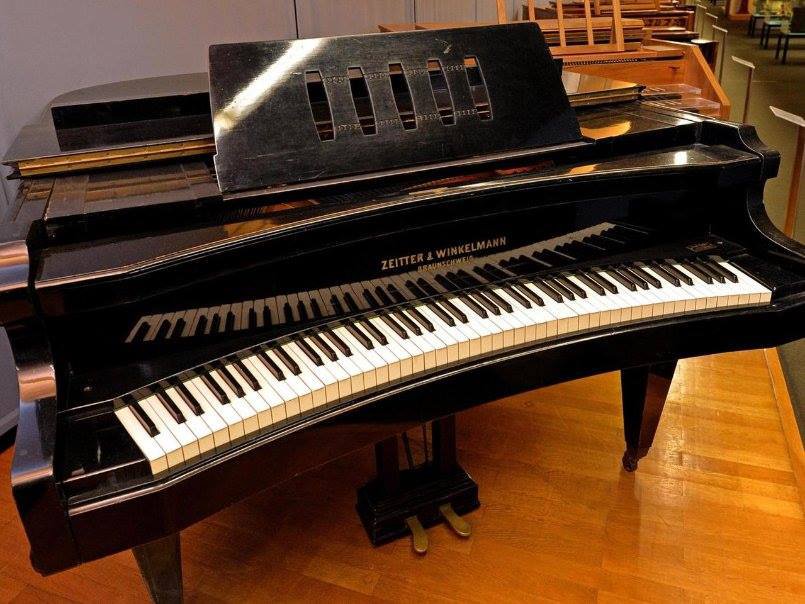
In 2014, a grand piano with the so-called Clutsam curved keyboard (see photo) was added to the musical instrument collection of the "Germanisches Nationalmuseum" (1). Its peculiarity lies in the fact that the keys are bent towards the pianist and are presumably intended to promote an ergonomic hand position when playing. "This piano was built around... 1910 (but cf. below Busoni's article) in Braunschweig," states Frank Bär, the director of the collection. "Its peculiar keyboard dates back to the Australian Ferdinand Clutsam (2), who received a patent for this type of keyboard in 1907." There are no precise figures, but it can be stated that this type of piano was not very successful.
SEPTEMBER 1, 1909
The Berlin magazine "Signale für die musikalische Welt" publishes a short text by Ferruccio Busoni in response to an article by Leopold Schmidt (1) regarding the curved keyboard proposed by the Australian pianist and composer George H. Clutsam (2).
The hallmark of the artist - I say the artist!, not one who simply practices an art - is to continually pose new problems and seek their own satisfaction in solving them; therefore, every facilitation that comes from the outside favors, according to the natural order of things, the amateur, while the artist, considering the problem already solved, moves away from it.
Amateur and artist are both engaged in overcoming difficulties: in this, I believe I can discern the trait that connects them, and that differentiates them at the same time, since the amateur struggles against difficulties that the artist has already overcome; the artist, instead, continually proposes new ones to themselves and conquers them.
Purely technical facilitations may be of some utility to the artist, who aspires to a different perfection, only insofar as they allow it to be achieved.
Assuming "that a high note which the singer reaches with difficulty increases the power of expression," what happens in the case where the greater difficulty is found in a passage of secondary importance and artistry? This passage will be disproportionately highlighted following the effort required to perform it.
The more means an artist has at their disposal, the more opportunities they will find to use them.
Art - especially musical art - demands freedom of movement. Until now, it has had to employ most of its strength to overcome material obstacles. The seemingly greatest technical facilitation is but a small step in infinite space.
Let us praise those who advance and who liberate, however limited their strength may be. For how could there ever exist a device invented and operated by men that would make one perceive the millions of voices of Harmony? Will technique ever suffice to make the thousand registers of the Cosmic Organ resonate?
Here is a "scholar" facing a keyboard whose line deviates slightly from the usual one; he fears that art will be destroyed by it. To what fragile an art does his thought turn!
Have thunderstorms perhaps disappeared from the world because Franklin invented the lightning rod? In art, as it seems to me, every facilitation indicates that a new difficulty has taken the place of the one now overcome. If we were to agree with the "scholar" that "the lack of mechanical obstacles makes the way of playing less interesting," we would simply see the performer faced with a new difficulty. But what interest could seeing a performer struggle with the continuous removal of such obstacles offer to the listening scholar is incomprehensible. And even more incomprehensible is what contribution this struggle brings to the preservation or salvation of art.
(1) Cf. www.gnm.de/ausstellungen/dauerausstellung/musikinstrumente/
(2) Cf. https://ozvta.files.wordpress.com/2011/12/clutsam-george-1912014.pdf
(3) Leopold Schmidt (1860 - 1927), German music historian and conductor.
[Laureto Rondoni]