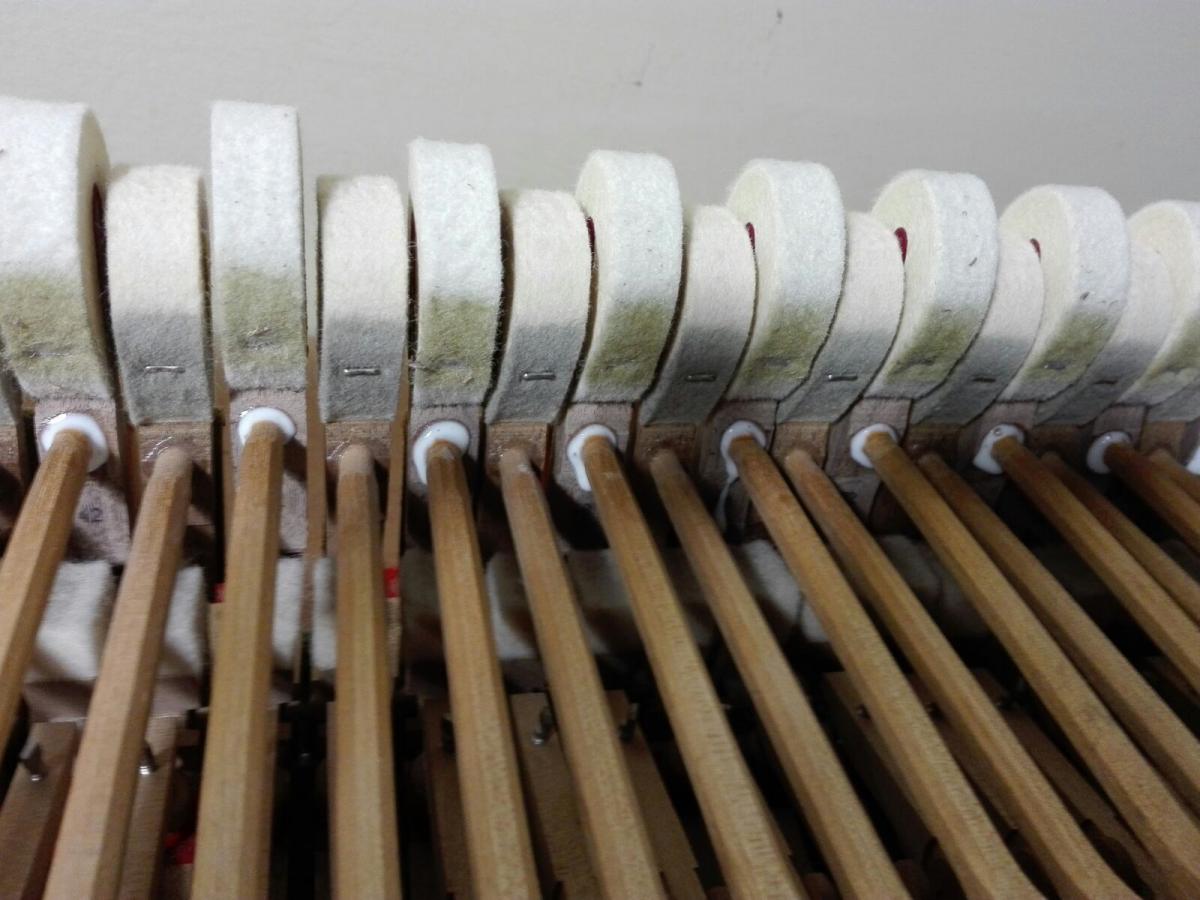
Then no one forbids you from trying with some samples, especially on the cantabile where the greatest differences in hammer voicing are detected.
Taking a hammer assembly and mounting it hoping that it works is never an appropriate choice for the technician; there are technicians with long experience who have replaced thousands of hammer assemblies and always keep discarded hammers specifically to try them out. Unfortunately, today the construction methodology of hammer assemblies changes, so one must turn to the market. Even Yamaha now—I recently tuned a brand new C3 X straight from the factory—makes hammers with a double layer of glued felt.... However, in the end, I believe much depends on the quality of the felt used and the tension applied by the press. With two or three layers, it is probably easier to tension the felt even with presses that are not cutting-edge.
If it needs to be changed, it will be changed. The technician told me that the current hammer voicing is in bad shape and the replacement depends on my sensitivity (unfortunately very high). He cannot restore the correct shape because he would have to sacrifice a lot of felt, and the tuning lasts only a couple of days on flattened hammers. If I don't do it today, I will do it tomorrow; it only prolongs the duration of discomfort.
I just got some photos from the technician. The hammer rail has red felting (the old one had been gilded) and is less impregnated (the gray part includes the lower edges and around the wooden core). It looks very similar in size, but with a more pointed and less rounded shape, especially on the highs (it was evidently shaved poorly, which is why I heard a nice sound, but "dirty" on the fortes and not sharp in the attack, with a strong hammer noise, interesting if it were less loud). The intervention will also include the replacement of the mortise felt. A question out of curiosity: I have always noticed from some videos that hammers are replaced one every two. From the photos, the same thing can be seen. Why is that?
Regarding the adjustments I would like to propose to the technician
Hammer-string distance: 45mm
Key dip: 10mm (or 9.5?)
Let-off at 1 mm from the string on the treble notes
Hammer drop at 2 mm
Check (Parata) at 13 mm
I would like an agile keyboard, with the possibility of an easy pianissimo (which I call "thought pianissimo" because it is enough for me to think it to achieve it) with the possibility of repetition by lifting the key very little. Pianoexpert, do you confirm or do you have other suggestions?
I am turning to pianoexpert because he made me fall in love with piano mechanics through his video tutorials. Sometimes I think I want to learn this profession, which is not just craftsmanship, but ART!!!
How can you impose measurements on a technician? It is neither good nor useful because the distances are indicative and must be evaluated on the instrument.
You can certainly make recommendations so that an agile keyboard is obtained, allowing pianissimos to be performed very naturally; in fact, this is a result of a complete overhaul, otherwise it means that certain choices were not made correctly.
Regarding the photos you posted, I prefer not to comment, because it would lead to an infinite discussion. Rely on the technician. The hammers must always be felt on the instrument.
Giovanni's embarrassment is justified. There are other methods and ...other colle...e not just this one. Anyway, the final result, as Giovanni already said, depends on many things. First of all, the correct friction values. Checking the pins. proper keyboard balancing, correct regulation measurements, and correct tension of the repetition springs. Last but not least, a good voicing of the hammer felt. In short, a "complete overhaul"
Naturally, I would also replace the capstans and leave the original one mounted.
Pay attention also to the new capstans; the friction of the center pins must be checked as well.
Intervention completed. Mechanically it is identical to before (perhaps the key travel is a bit more consistent). I like the sound, perhaps a bit closed on the bass: it is slightly in tune although he prefers to touch it up in a little while, after the hammers have settled in a bit.