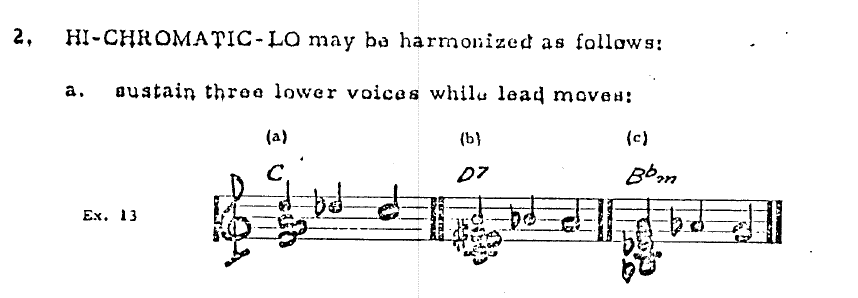
i would like to make harmonic substitutions by constructing different examples of HI-LO and/or variations of HI-LO (I also mean the relative harmonization).
In my opinion, it means writing a melody that fits well over the indicated harmonic framework. Playing with the HI-LO clearly forms altered chords. Furthermore, it is likely enough to add some substitutions: secondary dominants, tritone substitutions, etc.
If we are talking about tensions and their resolution, therefore in the field of functional harmony, the procedure applies only to V or temporary Vs that resolve... So in the succession given from F7 to Bb, and D7 to G7, G7 to C7, C7 to F, if we don't want to consider the third of Bb which becomes minor as a tension to resolve on the 5th of F...
In your example, Egidio, where do Db7 and Gb7 come from?
Hi, a couple of questions: could you explain the hi-lo concept better to me (maybe with some examples)? do you mean substitutions that do not alter the harmonic functions (I imagine)?
I really wouldn't know what to add to the initial post, in the sense that I was hoping to find some insight. It seems to be the track of a Jazz harmony exam.
As soon as I have a moment, I will look at your solutions.
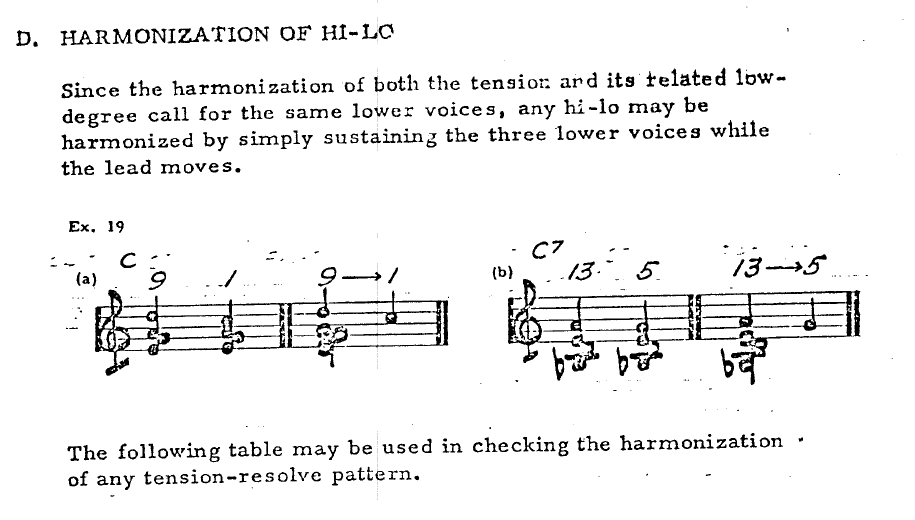
I am taking a look at: Theory - Berklee Course On Arranging. In effect, it is about the harmonization of tensions; for example, HI-LO would be a Tension-Resolve.
I am taking a look at: Theory - Berklee Course On Arranging. In effect, it is about the harmonization of tensions; for example, HI-LO would be a Tension-Resolve.
Thank you so much Frank! So we are talking about resolving 9, 11, 13 within the same chord, not on the subsequent chord... in fact, they reveal the 'appoggiatura' nature of the aforementioned ones.