

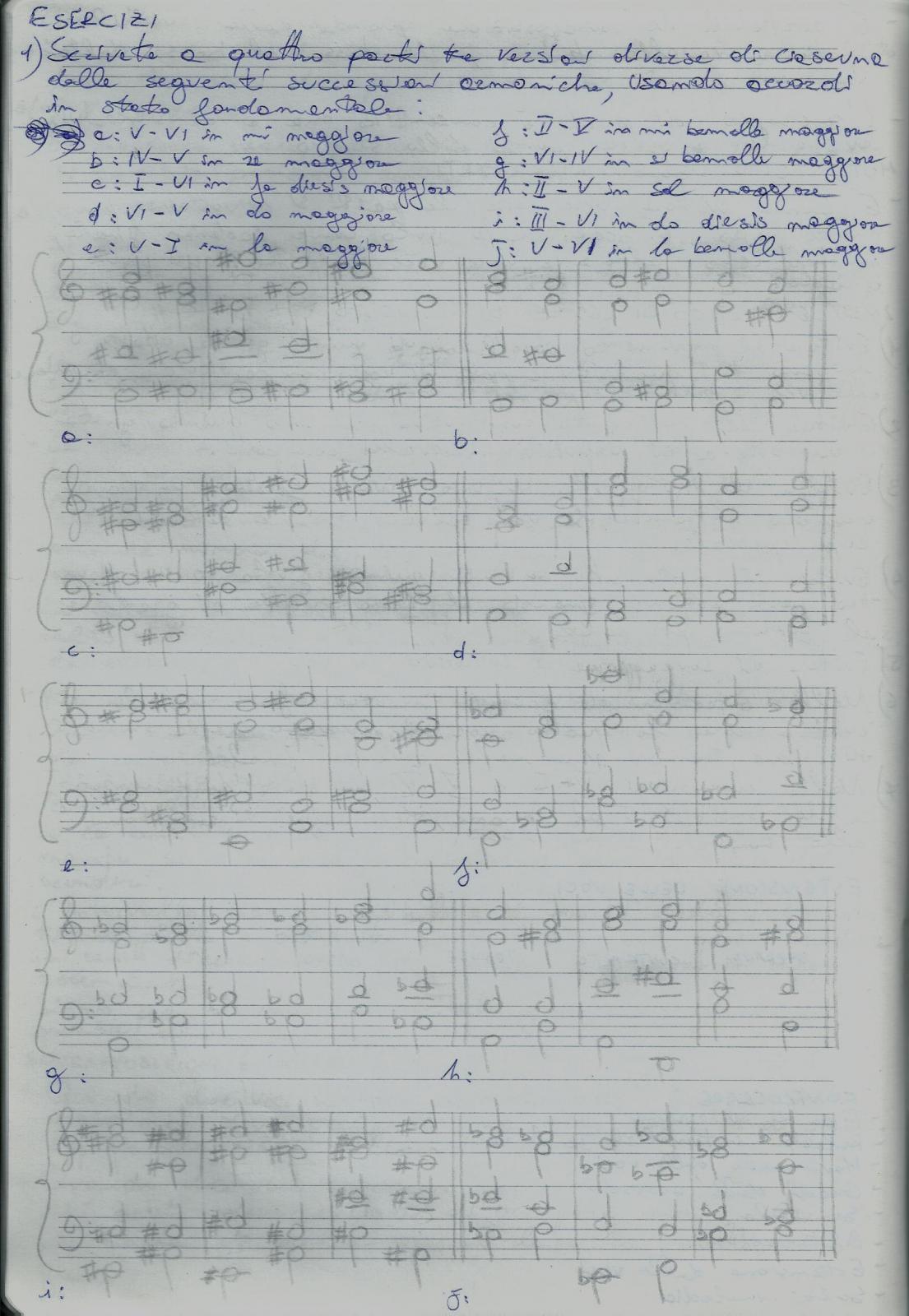
Is there anyone kindly willing to correct this exercise on harmonic successions for me?... it is taken from Piston Harmony page 37 no.1
Thank you
Started by
Member
Member
Is there anyone kindly willing to correct this exercise on harmonic successions for me?... it is taken from Piston Harmony page 37 no.1
Thank you

Member
1a-version2) Not exactly happy: Between Violin I and Viola there are octaves; between cello and Violin II there are some somewhat exposed fifths
The key lies in the management of the deceptive cadence (specifically V VI) in which, in the case of triads, there is a very simple little rule. What does Piston say in this regard?
Member
DiesIrae wrote:The key lies in the management of the deceptive cadence (specifically V VI) in which there is, in the case of triads, a very simple little rule.
I knew that in the case of a deceptive cadence one should double the third to avoid errors, therefore VI335
Member
Since l1a) has already been commented on, I will move on to case b); in the second proposal, I don't much like the doubling of the leading tone on the fifth degree and I find the tenor voice to be too low; I would have brought it up an octave by making 2 re's in unison
Member
I was taking a look ... the second proposal is the one that seems to put you in more difficulty, even in case C) you play tenor/soprano octaves c# c#, d# d#. Here even the third case leaves much to be desired for bass/soprano octaves. The parallel motion of the parts (see case 3) is better if it is not too "jumpy" and therefore with voices in contrary motion.
... perhaps in the course of the 3 proposals, it is not certain that all the notes of the triad must be used
Member
It seems intentional, so let's reopen from the example in C major
Second proposal: as someone used to say, too much distance between the bass and treble parts, octaves between second violin and viola
Third proposal: more balanced voice leading but octaves between second violin and viola
Question, do you need to develop the exercises in close position or open position?
Member
It seems to me that the prerequisites are already there to talk about a lot of things:
- Arrangement and motion of the parts
- Extensions (I referred to the quartet in the comments Vno I,II,vla and vc; but perhaps it would have been better to talk about SCTB)
- fifths and octaves
- resolution in cadences
- doublings
Doing 4 quick calculations... at least 5 topics ...
Member
Aspirante wrote:I knew that in the case of a deceptive cadence, one should double the third to avoid errors, so VI335
Exactly
Member
In fact, there are quite a few little problems; certainly, one should work by macro-areas.
Regarding the doubling of the leading tone: when a scale is given, immediately note the leading tone. If we are in D+, obviously the leading tone will be C#, which should not be doubled, otherwise it will be obvious to play octaves. The leading tone resolves on the tonic; two leading tones resolve on the tonic... therefore, an octave. A case may occur where a leading tone goes to the fifth of the scale... but in 4-part writing, it is better not to double it.
For the voice leading, I would try to favor contrary motion by striving to slur as many notes as possible when concatenating the subsequent chord.
I would start with close position; wide parts introduce other problems such as those highlighted regarding the spacing of the voices
Member
a) Version 2: I am used to calling the voices soprano, alto, tenor, and bass, but whatever....I assume from the comment, if I'm not mistaken, that you call them Violin I, Violin II, Viola, and Cello. I have indeed now noticed the forbidden fifths and octaves in similar motion... my mistake.... Piston says (as far as I have understood) regarding the V-VI progression, first of all, the general rule is that for stepwise or seventh progressions (adjacent notes), there are no common notes in the two triads, and therefore the bass moves in contrary motion to the other three voices, which will be placed on the nearest note, making the minimum possible displacement. In particular, for the V-VI cadence, he says that if the soprano has the leading tone, it must pass to the tonic even with the same movement as the bass (the rule prohibits a leap in the soprano and stepwise motion in the bass... the opposite is possible); if the leading tone, however, is in an inner voice, it can either go to the tonic or to another note of the chord.... the sixth degree in the bass takes the 3rd (I put the root because the exercise asks to construct chords in root position).
Yes, another error: the doubling of the leading tone.
c) Error, movement of fifths and octaves in similar motion is forbidden..... Piston says when both voices proceed by leap; according to this last point, therefore, es c2 should be correct and c3 is wrong........
d) Yes, there is indeed a lot of distance between the parts, but the octaves are in stepwise motion (same as c2). d3 is wrong. The exercise does not specify whether in close or open position... in both positions.
Finally, thank you for the corrections.... because why don't you assign me some other progression to see if I have understood the errors well???
Thank you

Moderator
Reading between the lines of the exercise request, I think the goal is to start from a different position (note: not an inversion) for every starting triad; in a triad, the possible positions are three: 3, 5, and 8 to be placed in the highest voice.
With this said, I would practice the main cadences (you choose the key):
- IV I
- V I
- V VI
- V I6 (here you have to use an inversion, but it's worth it...)
Etc.
Don't just do it on paper; get used to playing these cadences, make the style your own, memorize them and feel them in advance... so that you reach a point where you can crave them. You will have a lot of benefits in terms of harmonic Ear Training; cadences are the basis of the tonal system. Obviously, that's not all, but since you started from there... and it is necessary to go through it... try to do it in the most profitable way possible.
As for the rest, you have received several useful suggestions; for texture/organology I would think of a choir, so SATB in 4 parts, get used to working also in terms of range. DiesIrae thinks in instrumental terms, which isn't wrong, but perhaps it is too early to work on instruments like strings. Better an organology that forces you to be more balanced...
If you really want, instead of 3 proposals, make 6: 3 in close position and 3 in open position... starting from the 3 different possible positions for each context
Member
News Daniele? How is it going?
Member
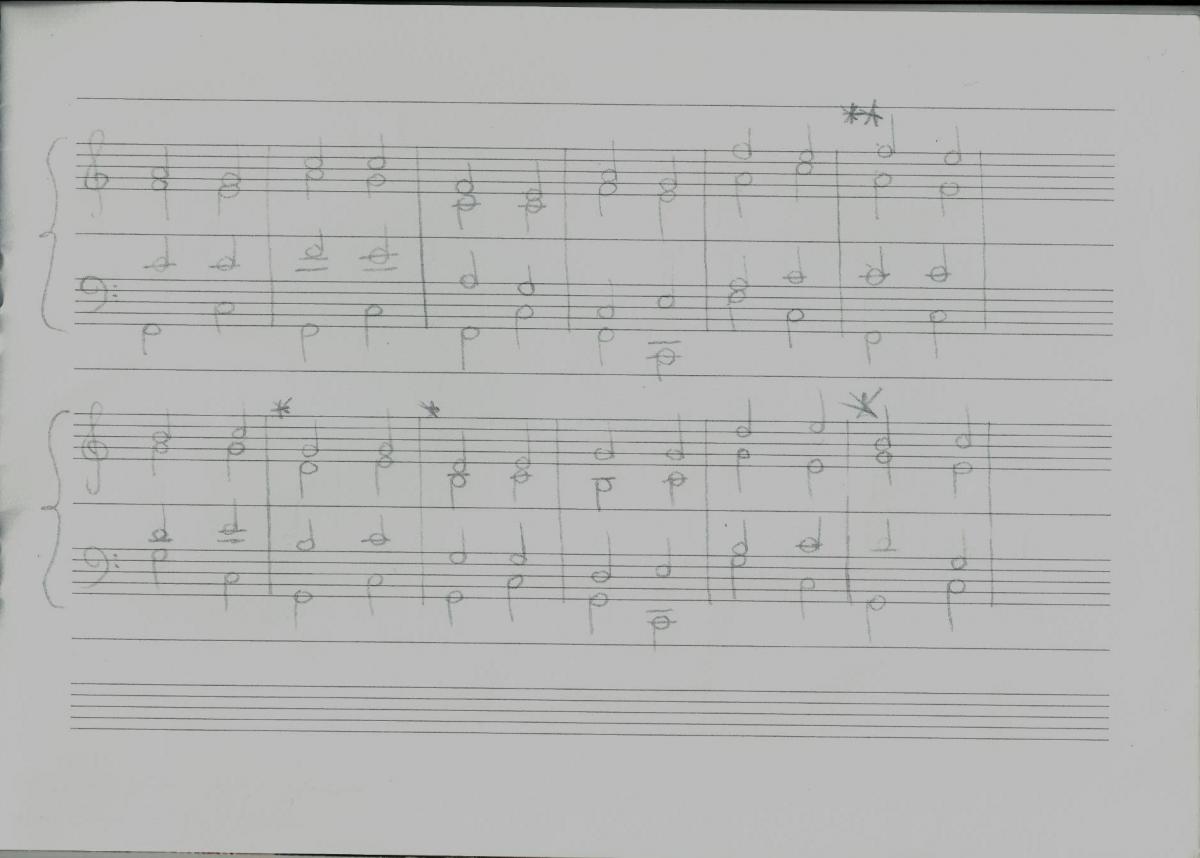
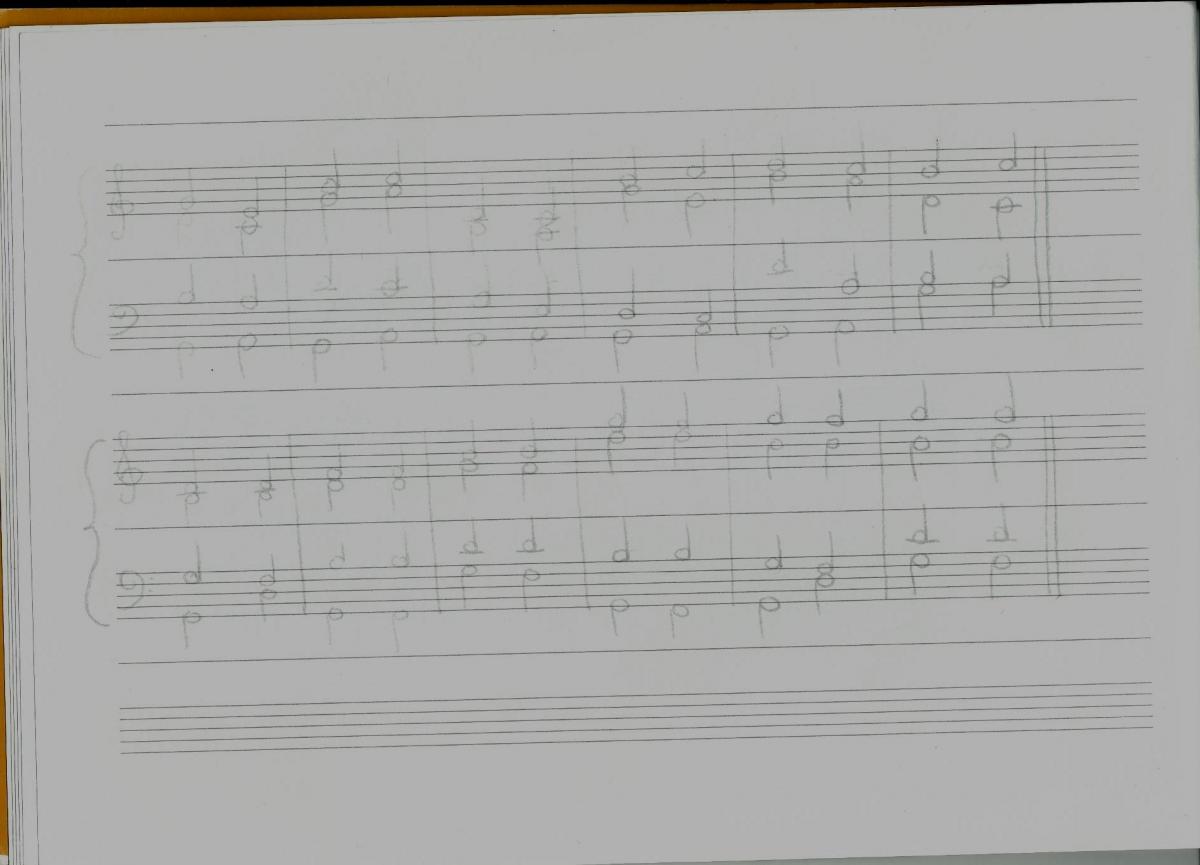
Yes AbateFaria, just now that I saw your message I was scanning the exercises, here they are attached.
I tried to pay attention to your suggestions and I also played the exercises on the piano after writing them down.
It seemed to me that in every particular succession there is a different harmonic color; for example, IV-I seems to be a succession that has a sweet, tranquil character, while V-VII is a succession in which much tension is felt.... I believe that a sensation can be associated with each different succession, I don't know, perhaps it is something subjective, or perhaps it is objective.
I put an asterisk to indicate the octave in a straight way for a semitone (which should be possible) and two asterisks to indicate that it is impossible to play on the piano.
I hope the exercises are completed correctly; obviously, correct me if I am wrong.
Thank you
Member
Hi, which extensions did you use for SCT and B? I'm asking because sometimes the tenor reaches do2, which is a bit too low based on the information I have. Another thing, the doubling of the third is last in the list to be chosen, meaning that first the octave is doubled, then the fifth, and finally the third... I don't know why... but that's how I understood it.
Member
As Aspirante says, the motivation for doublings is to be found in the harmonics. If we take the first ones from the note C, we will have in order: C C G C E
Therefore, in the case of an incomplete triad in 4 parts, it is better to double C first, then G... and only at the end E. If the doubling were at the same pitch it would be better, and indeed in the fourth measure of the first sheet, try to bring the Tenor up an octave so that it returns to its range and hides the doubling of the third on that C+
Member
I must say that you seem to have definitely improved, you should take better care of the extensions and the singability of the parts... I point out:
- second line, measure 5, octaves T and C
- ugly bits in measure 6 (second line): the leaping fifths between T and S and, quite brazenly, the direct octaves between T and C
- Third line, fifth measure, the leaping soprano over the leaping bass is an eyesore. (an extreme case of poor singability of the parts)
I suggest you raise the difficulty level regarding the harmony; start using triad inversions
Member
...I am referring to the first file. Wouldn't it be better for you to make a topic for each exercise? There is even an ad hoc section... harmony exercises... otherwise there is a risk of getting confused
Member
Of the second series, first page, last succession: sol re, do sol (B T)...they are blatant fifths. Get it?
Member
Third line, second measure, second sheet... what chord does it end on? Same for the third measure
Still second page, at the fourth and sixth measures I point out the B and S octaves and at the fifth measure, T and S octaves