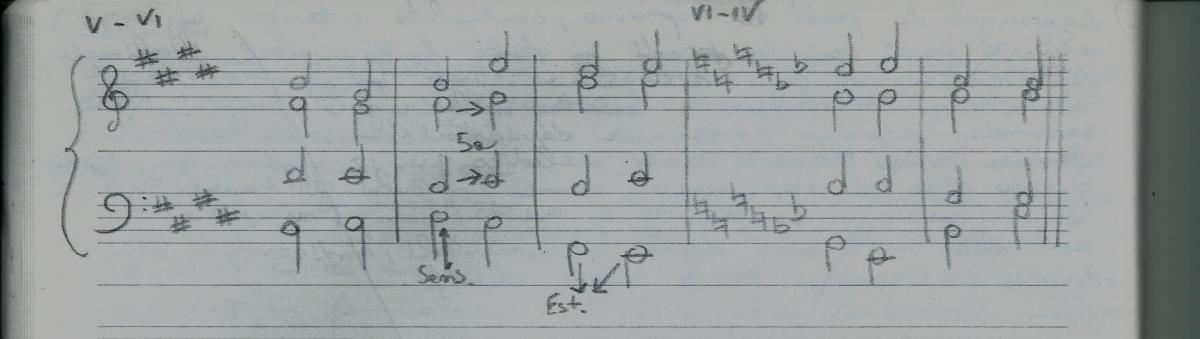
Here are more exercises on harmonic progressions that I am submitting for your kind correction.
I have written some notes in certain parts because I have doubts regarding the correctness of the transition:
1) Is the fifth by similar motion correct? (if I am not mistaken, the rule allows parallel fifths between inner voices)
2) Is it correct to have the leading tone in the bass?
3) Does the bass manage to reach the F and E marked in the 3rd measure as an extension?
4) ...and one more thing....in the last measure, is it a possible procedure to have two thirds between the SC and TB pair??
Thank you and I wish a Happy New Year to all forum users
L
Ludovica
Member
Reply 2 by Ludovica
Posts
298
Question: What is given in the exercise?
L
Ludovica
Member
Reply 3 by Ludovica
Posts
298
DanielePiano wrote:
1) Is the fifth correct for similar motion? (if I am not mistaken, the rule allows parallel fifths between inner voices)
2) Is it correct to have the leading tone in the bass?
3) Does the bass manage to reach the F and E marked in the 3rd measure in terms of range?
4) ...and again....in the last measure, is it a possible procedure to have two thirds between the SC and TB pair??
1) What is similar motion? Do you mean direct motion?
2) The leading tone can be in the bass and should resolve to the tonic, with one exception
3) Yes
4) More than anything, doubling the third of a chord is not ideal; it is better to prioritize the tonic, if not possible the fifth, and if they are truly at the same pitch and there are no other solutions... then the third
In this specific case, it is better, in order:
- mi mi sol mi
- mi si sol si
- mi mi sol (sol)
Z
Zazza
Member
Reply 4 by Zazza
Posts
250
The second measure is bad, but the progression was supposed to be V VI?
The fifths you are indicating are direct fifths ... and where does the leading tone go?
1) Is the fifth correct for similar motion? (if I am not mistaken, the rule allows parallel fifths between inner voices)
Only in one case, if we are talking about successions: 2 consecutive diminished fifths, or if the second of the two fifths is diminished, one of the two voices creating the interval must move by step, all between inner parts, in direct motion and in a descending direction.
In your case, they are 2 perfect fifths in direct motion; in this way it is not correct. The rule you are referring to perhaps deals with "relations"; these are "successions" in direct motion (they could also have been in contrary motion, but it would still be an error.)
Take into account that parallel fifths (except for the one cited between two fifths between inner parts, one of which is diminished, or two diminished fifths) are all forbidden, both in direct motion
as well as in contrary motion. Then there are the relationships between extreme parts (bass_soprano) and between inner parts (bass_tenor, bass_alto, tenor_alto, tenor_soprano, alto_soprano), which vary if they are 5ths, 8ths, or unisons (the latter only valid if created between bass and tenor when the former rises from the V degree to the tonic, and the tenor from the leading tone to the tonic).
relationships between extreme parts are valid if the bass moves from the IV_V degree to the I and vice versa, and the soprano moves by step, preferably in a descending direction, in practice only
in the presence of certain cadences.
Octave relationships between inner parts are correct if one of the two voices (the lower one) moves by a 4th, 5th, or 6th (preferably by a 4th), and the upper one by step,
it is tolerated if the inner voice moves by step and the upper one by a perfect 4th.
Fifth relationships between inner parts are possible when one of the two voices moves by step; the rest is not permitted (this is to simplify).
The unison relationship I mentioned before is valid if the bass moves from V to I and the tenor from VII to I.
O
Oracolo
Member
Reply 8 by Oracolo
Posts
317
Measure 1: V VI
I don't really like that the soprano leaps by a fifth. Since it is a motion that involves at least one extreme part, it would have been better to have the degree stepwise to the soprano and the leap eventually in the inner part.
Measure 2: v6 VI
As someone was telling you, the leading tone should go to the tonic, so you should use not the sixth in root position but in inversion, in order to have the mi in the bass. Obviously, the fifths do nothing but aggravate an already compromised situation.
Measure 3: v46 VI
In my opinion, this is a strange progression, in the sense that V46 generally goes to V35. You can find it as a passing harmony between a I and a I6 or on a pedal... going to the sixth is quite unusual; besides, you are also doing octaves between tenor and alto.
Where is such a solution suggested?
Measure 4: VI IV
Good: it is excellent to have contrary motion between extreme parts and to link (it would be better to add value slurs for Tenor and Alto) the common notes.
Measure 5: ? IV
Here the first chord is really not understandable: Bb G G C. Ok, putting the notes in thirds order we have C G Bb (?), practically a dominant seventh without a third ... mmh..
Could you double-check?
G
Gerardo
Member
Reply 9 by Gerardo
Posts
277
Oracolo wrote:
Measure 5: ? IV
Here the first chord is really not understandable: Bb G G C. Ok, putting the notes in thirds order we have C G Bb (?), practically a dominant seventh without a third ... mmh..