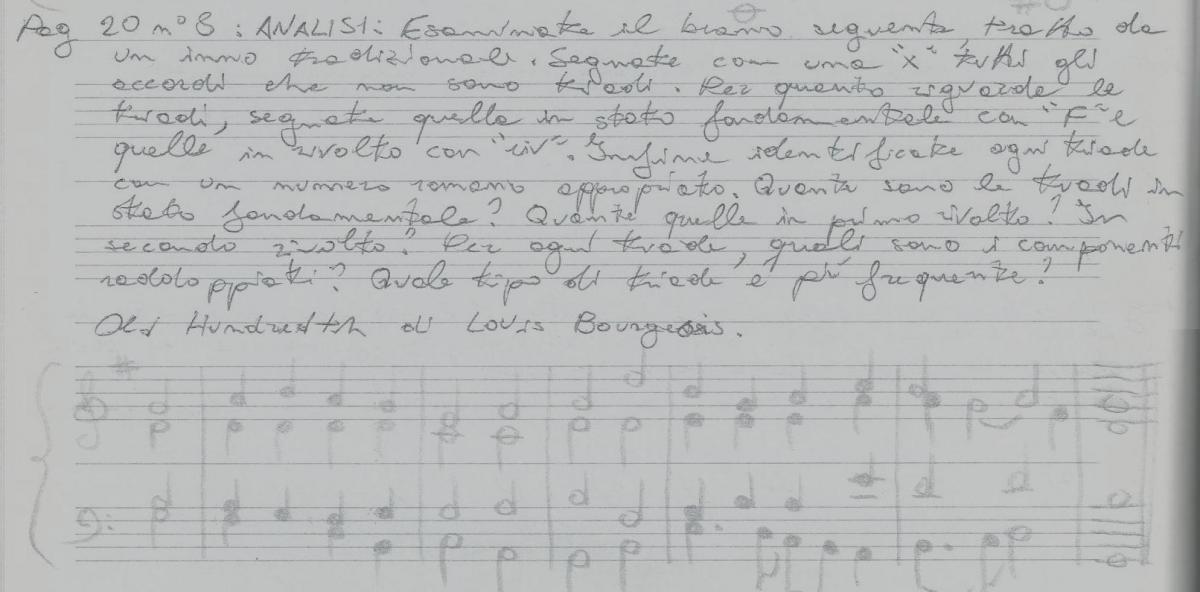
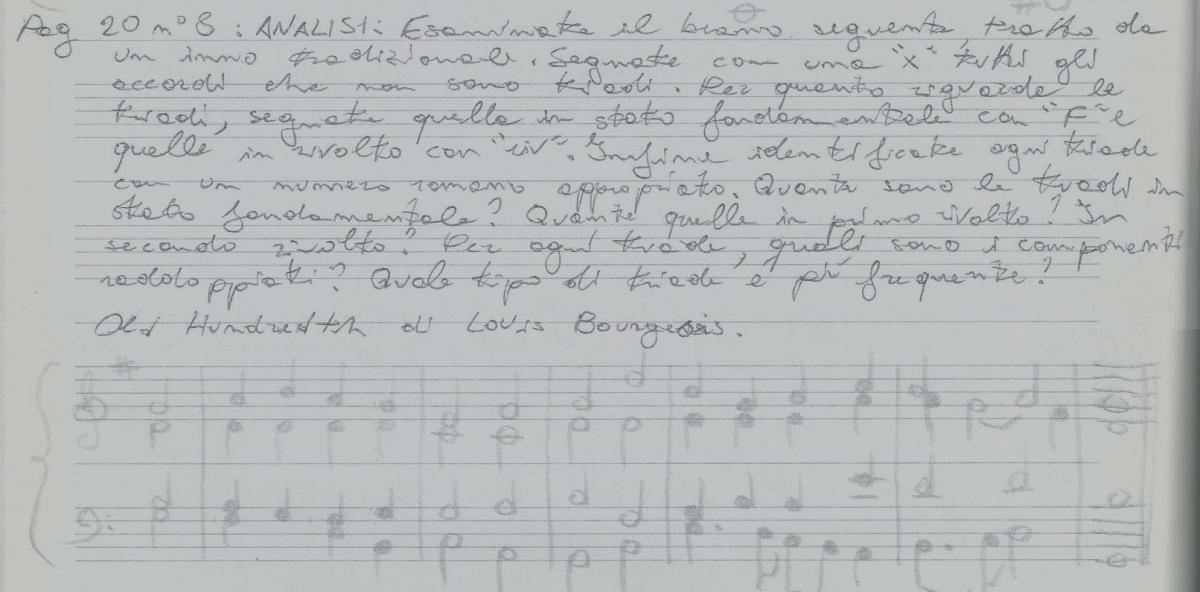
Here is a harmony exercise.
The exercise clearly asks to classify the 4 voices based on a triad, whether it be in root position or inverted.
....However, I have some doubts regarding my modest knowledge:
1) Can one say that a triad is in root position simply if it has the root in the bass, or also with another of the two notes in the bass and the upper notes in root position??
When the root note of the chord in question is in the bass, the chord itself is in root position; what changes is the melodic position of the note "performed" by the soprano. If you have an F major, you have F in the bass and A in the soprano, for example; you have a chord in root position in second melodic position. If there had been a C in the soprano instead of the A, you would have had a third melodic position (which should not be confused with the harmonic state of the chord).
Ex. C in the bass and E-G-C....is it 1st inversion or root position??....because counting from the bass note it is C-E-G which is root position, whereas excluding it it is E-G-C which is 1st inversion.
In root position: tenor III degree, alto V, soprano I degree, therefore first melodic position.
Only if you had E in the bass would you have a chord in first inversion of C major; if there had been G, a chord in second inversion.
2) In the exercise, in all cases it seems to me that there is a triad, but the exercise instructions assume there are cases where there is no triad (to be marked with "x").....can you tell me the definition of "triad" and when more notes are not called a "triad"???
On the 1st beat of the 4th measure, you have this chord: B-D-A-B (the 5th degree is omitted, which can be done in this type of seventh); in practice, since this chord is a seventh,
it is defined as a tetrad and not a triad, which only includes the root, the III, and the V degree, not the VII; which involves a dissonance with the root.
The A, if you notice, comes from the previous measure and being (even if not slurred) in the same position, and above all having a value equal to the A of the 1st beat of this
4th measure, it is prepared (the value of the preceding note must be the same as or higher than that of the following note; by value I mean duration). There is something else to say: the A descends to G in the 2nd beat, the G is not part of the chord you have in the 3rd beat (D-F-A), and if you notice, the F# reaches it
only in the last beat; however, otherwise this chord is a triad, it is "only" the F# that is reached with a suspension (a suspension of the 3rd of the chord on the V degree of G major in this case), but it is precisely different from the tetrad you "encountered" previously.
The G then seems to be an appoggiatura in the 2nd beat, becomes a suspension in the 3rd beat, and the F# is the suspended note in the 4th beat.
The D and the B with the duration of an eighth note that you see in the 4th measure, and the C that you see in the 5th measure, are passing notes.
One thing that seems "strange" to me is this seventh on the III of G major.
Thanks a lot