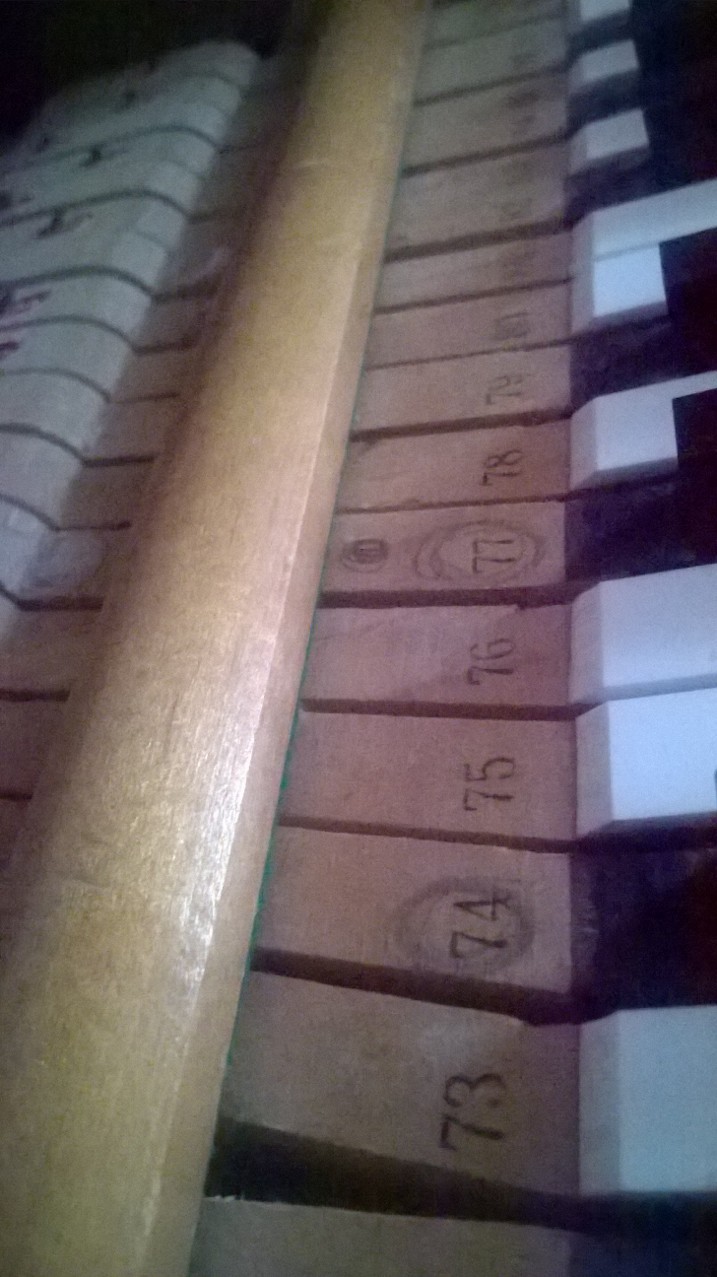
On my Kawai KG2D, in order to respect the height (and depth) parameters of all the keys, starting from the correct distance from the keybed for the whites and calculating the black key height specified at 12 mm (all parameters dictated by the manufacturer), the result is this inequality between the respective white and black keys. I don't know if it is clear enough in the photo, but all the blacks are a little over a millimeter above the whites.
I was wondering if this is normal. Thanks to everyone
It then depends on how much it emerges, give me the term, the black key once pressed above the unpressed white keys. It is fine to keep the blacks 12 mm or 12.5 mm above the level of the white keys at rest, but then the background must be such that the levers all rise to the same height whether we press a white key or a black key, meaning that black and white keys ultimately have the same aftertouch or step or afterttouch (which sounds cooler but is the same thing).
The black key must rise in the center if, when adjusted with the correct background as mentioned above, it does not emerge sufficiently from the whites (from 2 to 3 mm)...
Everything depends on where the key fulcrums (center points) are located and the tips of the front holes of the blacks relative to the whites and also, pay attention, the thickness of the white plastic which could be thicker if it has been replaced (and the question arises spontaneously: is the piano by any chance refurbished?)
Thank you Giovannig for the answer. In fact, the piano has had many things redone, including a total rebuilding of the keyboard. Your observation about the aftertouch is interesting, because in my case a bit of inequality exists but I cannot explain the reason, because the depth is identical. To explain myself better: two adjacent white keys with identical depth have a different aftertouch (and similarly, this happens for the black keys).
Regarding the bridges, I will try to check in the coming days and then I will post my reflections.
If the response is different under the same background conditions, it means that discrepancies persist in other parameters, such as for example the position of the pusher under the roller or the wear/deformation of the same.
In this case, geometric verification is not sufficient; the technician's sensitivity comes into play, which will be able to find a good compromise.
giovannig preceded me. I agree with everything. obviously, as he already stated, the white and black keys should have the same aftertouch, i.e., that very small empty distance felt when the escapement lever has released the hammer butt (or nut). This distance is dictated by the manufacturer, but it is approximately such that the hammer does not visibly rise again after the "fall" (in the coda), but allows the lever to "escape" easily even in the softest touch caused solely by the delicate fall of the weight of the fingers (jeu perlé).
Frankly, regarding the pusher, I wouldn't know if the extremely thin measurement that keeps it below the capstan is regular for all keys. It seems extremely difficult to adjust and also to verify (obviously for me, as I am not a technician). However, I wonder if this inequality, given the same key dip, could be conditioned only by the pusher (and/or the capstans) or if there are other sectors involved.
As with Piano Exert, the inequality also exists in the hammer's ascent after the "drop": in some keys this ascent is quite visible (even 2 mm), in others less so, and some approach "zero".
It is fundamental to perform measurements and sample checks with the action installed in the keyboard bed or keybed, otherwise errors may occur.
To find the correct height of the repetition lever, there are several empirical methods; one of these is to actuate the pusher with your finger to move it out from under the roller, then see if it returns by creating only a slight, imperceptible movement of the hammer. If no movement is felt, it is too high; if the up-and-down movement is excessive, it is too low.
You can also pass a stiff piece of cardboard over the repetition lever and see if, passing over the pusher, it drags it along. If this happens, the lever is too low... one can also glue another piece of cardboard onto that cardboard, narrow like the pusher, and have it protrude 1/10, 2/10, or 3/10 mm depending on the area (treble or bass) and repeat the dragging verification procedure.
Use the thickness of the washers to help determine the protrusion; otherwise, it is impossible to determine.
Alternatively, contact a mechanical workshop to construct precision files.
Thank you Giovanning: I totally agree on the fact of performing measurements with the action on the workbench because it is true that measurements performed on other surfaces (even if perfectly horizontal) often change when reinserting the action.
The discussion about the "hand-operated" pusher is very interesting. I have tried: upon its return, the hammer remains completely still, so I deduce that the repetition lever is too high (something that seemed apparent to my eye but I wasn't certain of).
Just one question please: regarding the pusher, should I only move it and make it come out of the roller without applying pressure (because with pressure the pusher reaches the bottom and pushes the repetition lever itself).
Obviously you must let it out gently. To make it return without touching the felt, as happens when playing. The exiting pusher at its maximum elongation must never touch the felt.
If you don't see any rebound of the hammer, the repetition lever is too high and in this condition you can't even level the hammers, because as soon as you touch them, the situation changes.
I know it's "interesting," but having everything handed to you on a silver platter is a bit much.
One must always verify that the repetition lever is not too low with the other method, because the condition of the repetitions and their very nature can be deceptive.
The weight of the hammer bears on the repetition lever and therefore on the spring even if for a very short time, so be careful to re-verify everything even after having equalized the tension of the repetition springs; generally, they are kept so that they are looser on the lows and progressively more loaded towards the highs. Personally, I do not like excessive loading.
In this we are the same! I also do not love excessive spring tension. But I agree on differentiated loading. Saying it is never too much, even if everyone must then put it into practice! Giovanni says everything exactly as it should be done. My compliments!
Giovanning, I believe that in any case no advice can ever replace the function of a technician, especially when one is lucky enough to find a sensitive technician who can understand the pianist's sensation (which is essentially what Pianoexpert says).
In my piano, regarding the lever and the jack, it happens exactly as you describe, meaning that the alignment of the hammers (not all fortunately, but a limited number) changes as soon as they are touched. I will try to carefully check the height of the repetition lever.