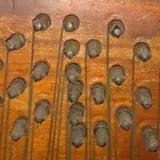
as I wrote in the title, I wouldn't know how to measure the semicircular brass bar of the compressor... since it is mounted under the strings. Removing it and measuring it, using a decimal caliper, would mean that I would have to remove (and therefore replace) all the strings in that section..... isn't there another way? By eye I would say it's 4 mm, but I don't know...
If it is about the vertical, it is not difficult. Perhaps one can reach the base of the half-cylinder laterally, at the end of the compartment. But it remains to be seen. Could I know the purpose of this measurement?
If it is about the vertical, it is not difficult. Perhaps one can reach the base of the half-cylinder laterally, at the end of the compartment. But it remains to be seen. May I know the purpose of this measurement?
Thank you. The piano is a grand, the purpose would be that of restoring the thickness of the compressor of the first four trios of the same sector, where the charge is too high... in fact, it can be seen that a modification was made (a piece of bar must have been cut and replaced with one that, to the eye, stands out as much thinner - initially it was whole for the entire sector - and the strings are newer than the subsequent ones). The sound there is indeed not satisfactory...
If it is about the vertical, it is not difficult. Perhaps one can reach the base of the half-cylinder laterally, at the end of the compartment. But it remains to be seen. May I know the purpose of this measurement?
the problem is that I would have to observe it with a perfectly horizontal gaze.... but since it is on a platform, and since there is cast iron in front of me, it is very difficult. I tried with a tape measure and with a light bulb at the end of the compartment, but it's not clear...
For the coda, it is a completely different matter. These movements modify the pressure of the soundboard. Even the compression of the bass affects the pressure of the treble. I would avoid intervening.
It might have been planed in that section where it appears thin.
For the bass it's a completely different matter. These movements modify the pressure of the soundboard. Even the compression of the lows affects the pressure of the highs. I would avoid intervening.
It might have been filed down in that section where it appears thin.
I wouldn't know the reason for the intervention; the fact is that, to my taste, the sound is more anemic where a thinner compressor was used than the one the brand had chosen... but at the same time there seems to have been a "change of heart" (or at least that's how I read it); in fact, in the section following the one we are talking about, they did change the bar throughout the entire sector (with a thinner one), but then on top of it, to bring it back to its original thickness, they added a couple of strips of felt... but if the string rests on the felt instead of the brass, the harmonics are not like before... it seems more "absorbed":..
the felt on the bridge? It would dampen the sound. ...all needs to be seen up close....If there are "zirli" [buzzes/rattles], the felts are placed on the resonator part. Which piano are we talking about?