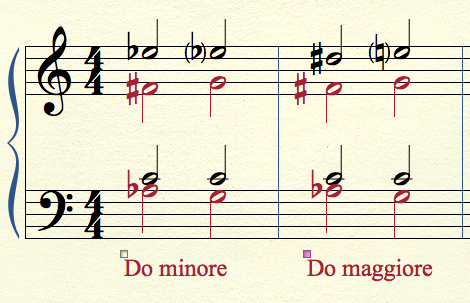
I didn't understand a damn thing about this passage from Piston, p. 412
"In the chord containing the augmented fourth, or Swiss sixth, the most characteristic component is the raised second degree, which implies a resolution to the major third degree. This augmented fourth interval, which forms between the minor sixth degree and the raised second, is the enharmonic equivalent of the perfect fifth. The chord can be distinguished from the augmented third, fifth, and sixth only based on its own resolution."
... ? ...
I might be naive but I didn't understand.... thanks in advance to anyone who wants to help me shed some light .......
The German sixth is Ab C Eb F#; having to resolve on the fourth and sixth (the bass is the dominant), the Eb:
- will remain stationary if the key is C minor (G C Eb)
- will rise to E natural if the key is C major (G C E).
In practice, Piston says, by codifying the Swiss sixth, that if the Eb goes to E natural, it is actually an D# (as if it were a French sixth, Ab C D F#, with the D raised).
In practice, however, authors use one or the other notation quite indifferently. Harmonically, the Swiss sixth would be more correct for the major mode.
I read Zedef's post, just so I could understand better too; basically the Swiss sixth is the same as the German one, except in its notation. That is, if someone indicates Eb, they are practically referring to a German sixth, whereas if D# is written, they are referring to a Swiss sixth.
In part it is a tribute, not always linked to the first use.
The oldest is the Italian sixth, which dates back to the 17th century (it is a double chromaticism of the IV6, the predominant chord par excellence; one only needs to think of the tonal Phrygian cadence): it is called this because most of the music that used it was of the Italian school, but that does not change the fact that it was used in Spain and many other countries.
The German one, which historically comes before the French one, is a common chord among Teutonic Romantic authors (however, Chopin also uses it; see the Prelude in E minor op.28 no.4 before the final chords... curiously he calls the bass Bb, because it comes from a tonicization of the Neapolitan F major, but the chord is C E G A#).
The French one is common among French authors of the second half of the 1800s (Fauré, but not only).
Regarding the Swiss one, Piston might have thought that since it is the chord halfway between the French and German ones, the name would also fit well geographically. An alternative could have been the Luxembourgish sixth..
Between Germany and France, below there is Switzerland, above Luxembourg.. it was a joke
D
Dante
Member
Reply 10 by Dante
Posts
275
The various types of augmented sixth take their name from the character they possess: the Italian sixth has a light character and is characterized by the doubling of the seventh of the chord and the omission of the tonic; the French one is the V7 chord of the V with only the lowering of the fifth of the chord; the German one omits the tonic but adds the ninth of the chord and, enharmonically, can be seen as a dominant seventh chord.
are the names given based on who ("nation") used those chords first?
In my opinion, it is necessary to make an initial distinction, namely to clarify whether one intends to refer to augmented sixths used as contrapuntal movement or with harmonic knowledge.
Since we are talking about "chords," I would say we are in the second case.
That being said, the oldest is the Italian one... used (in a harmonic sense) initially, coincidentally, by Italians: Vivaldi and Caldara
Starting with Bach is, in my opinion, an incorrect approach; there are certainly findings in his music, but they are "simply" due to the "contaminations" linked to the study of authors such as Vivaldi (precisely).
To point out how advanced Italian composers were, I can also say that the German sixth was already being used by Caldara himself.
In general, regarding the French and German sixths, it can be said that they find systematic use in the second half of the 19th century... more or less, depending on the composer's taste (Fauré, for example, used the German sixth little).
Z
Zamba
Member
Reply 12 by Zamba
Posts
8
Interesting, but don't augmented sixths actually derive from the use of chromaticism in counterpoint?
They derive or rather consolidate; but it is one thing to say I touch the 'augmented' sixth passing from turning notes, etc. and using the movement of the parts as a vector ... it is another thing to say I use the #IV with harmonic valence.
It is enough to reach an agreement; what changes is the way of thinking about music, where the vertical valence has its own identity.
If this interests you, the first to use the Italian sixth are those listed... if instead you want to go on an excursus... the scope is no longer properly tonal or, in any case, one cannot say that such a solution was used as tonicization.
Question, but at the level of scale degrees, in case someone wanted to mark them, what should they put? I am referring in general to these altered sixths?
The various types of augmented sixth take their name from the character they possess
mm
the Italian sixth has a light character and is characterized by the doubling of the seventh of the chord and the omission of the tonic; the French one is the V7 chord of the V with only the lowering of the fifth of the chord; the German one omits the tonic but adds the ninth of the chord and, through enharmony, can be seen as a dominant seventh chord.
am I the only one to have noticed how the premise and conclusion are disconnected from any logical link?
Sorry Frank, but if I want to use a #IV by exploiting chromaticisms, am I not doing counterpoint?
Probably I didn't explain myself well; even just talking about #IV means that you are tonicizing, so you are thinking in terms of harmony... if you then use it to create chromaticisms in a part, that's another matter, but no one has prescribed it... in fact, you could even use the chord by leap.
In counterpoint, the engine was not the #IV; in that context, you cannot speak of pre-cadentiality
I do not mark augmented sixths based on their pseudo-fundamental; for me, if they have that function, they are simply augmented sixths.
However, it is true that (assuming we are in C):
- Eb
- C
- Ab
- F#
- D
Minor ninth of the dominant of the dominant. Remove the first and/or last and the three sixths emerge. But since for me the diminished seventh and the leading tone seventh are not dominant ninths without a fundamental, my idea remains and I call them sixths.