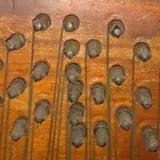
I have a 1997 Krauss upright piano, Renner action. It hasn't been used for several years, so I had to fix a few things: tuning first of all, the forte pedal which was making noise; otherwise, everything is okay.
I am just unable to resolve one last problem, certainly not serious, but still annoying: when pressing some keys, I hear—not during the press, but only during the key release phase—a squeak. Initially, I thought it was the key pins; in fact, I tried to lubricate them, but it didn't solve anything.
I then noticed instead that the creaking (similar to the sound of an old wooden door opening) comes from the area inside the action. The problem is that for days I have been trying to understand what is generating this friction, but I cannot figure out exactly where the noise is coming from: hammer, hammer rest, bridge? I can't tell... there are certainly two elements rubbing against each other and causing the squeak, but I cannot identify where it originates.
It could be some pivots, especially those of the escapement uprights. All contact points must also be checked, but never use lubricants other than Teflon micro-powder. The vertical has several springs that could generate squeaks. Gradually ruling out mechanical elements, as Gia suggests, is a good approach.
Thank you for your suggestions. In fact, by process of elimination, I managed to solve the problem: the squeak was caused by friction occurring when the escapement hit against the stop button (covered in kasimir). I solved it by spreading some wax under the stop button to provide more lubrication and softness (perhaps it is a somewhat Spartan method, but at least I didn't use chemical lubricants).
I now have one last problem to solve, but here I really wouldn't know where to start: I have a couple of keys that touch the strings twice, meaning they make a small bounce, but this only happens when playing pianissimo and with the forte pedal pressed. Do you think I could solve it myself or should I call a technician? What checks could I perform without causing damage?
graphite would have been better!!!! The other problem depends on the regulation. Anyway, remove a minimum thickness of round paper from under the two keys in the front part and put the round green bushings back in place. The keys will have more aftertouch and the problem will cease. In any case, a good technician will evaluate whether to increase the general aftertouch of the keys in relation to the hammer-string distance
In effect, by removing the paper discs the problem is resolved... thank you so much! A technical question: why does this happen? I mean, I was wondering why for 20 years I never had this problem and then at a certain point it starts to occur? What are the causes? I have never modified the regulation. How can it go out of adjustment by itself?! I noticed that the hammer felts are quite worn... perhaps I should do some shaving... although I must admit that the sound, a bit hard, metallic and bright, I like.
The regulation changes due to the compression of some felts. There is certainly no longer the correct ratio between key dip and hammer-string distance. Avoid shaving, which must be performed by experts....preserve the shape of the hammers, especially in the highs...which must not be rounded!!!!!! If they are too grooved, it is advisable to replace them