Tuning

Intoning a low-quality martelliera

5 replies 1,363 views

Started by

GIUSEPPEPIANO

Member

Member

Opening post by GIUSEPPEPIANO

Posts
49
City
COSENZA

Hello to all the friends of the forum,

I would like to make a few observations and get some clarification on what is one of the most difficult subjects (as well as perhaps the most artistic part) of the tuner's trade, namely voicing.

A few days ago, I happened to have to voice an Eterna upright with a very bright sound. Well, the hammer felt was very soft; during pre-voicing, the needles sank into the felt almost completely. It must be said that despite the numerous punctures (60 per side in the central area), once the action was reassembled, the timbre had changed very little.

Could this be attributable to the low quality of the hammer felt? Is an excessively soft hammer felt always of low quality?

Not having much experience with voicing yet, I was surprised to notice that despite the soft felt, the sound produced was very bright. To be clear, a few days earlier I voiced a Yamaha C5 that was equally bright but with a much more compact felt consistency (typical Yamaha hammer felt). It must be said that in the latter case, pre-voicing had a much greater effect.

Therefore, it occurred to me that the ease of voicing is directly connected to the compactness of the felt. Obviously, I know that the length and quality of the felt fibers also play a role. Do you find these considerations shareable?

Furthermore, I have noticed that there is an operation which, regardless of the type of hammer felt, always results in an immediate and substantial change in timbre: the pianissimo cushion, i.e., puncturing the tip of the hammer very superficially. In your opinion, is this an orthodox procedure? If so, do you prefer to do it after the actual voicing or insert it halfway through the work?

I have also noticed that it is a temporary operation in the sense that it is less lasting over time, unlike pre-voicing and deep voicing on the back, whose effects are perhaps less immediately perceptible but more long-lasting.... am I right?

Moderator

Reply 2 by pianoexpert

Posts
3,876
City
rocca di papa

You are touching on a vast subject. One must have the ability to evaluate the state of the hammers. Tuning cannot always successfully intervene on a hammer rail that might be very old, perhaps shaved down and perhaps very "dry," stiffened by time. If it is a fairly new hammer rail, one needs to see how it was pressed and how it was voiced. 60 pricks per side seem excessive to me! Based on what you are telling me, I believe something is wrong. But it is impossible to say what it is from a distance. What is certain is that a well-pressed and consistent hammer, even if impregnated, presents itself well to the voicing technician who will have to work harder but will be able to produce a good result, obtaining an excellent fortissimo and a sweet pianissimo. This is achieved not only through "softening," but by intervening on precise areas in a very cautious manner. Voicing can cause irreversible damage to the hammer rail, especially when one frantically tries to lower the tone. In the mid-low range, one should start with a maximum of 10-15 pricks per side. Bringing energy to the shoulders at the apex of the hammer is not easy. Many differentiated interventions in different areas must be evaluated, which I don't hear you mentioning. Be careful not to exaggerate! If the hammer rail is poorly constructed or has been damaged by poorly executed voicing, it may not be recoverable and you end up "deafening" it definitively. The sound may remain ringing... but the dynamic range could disappear. Naturally, I am theorizing. The concrete case must be examined. Good luck with your work.

Member

Reply 3 by GIUSEPPEPIANO

Posts
49
City
COSENZA

Indeed, the subject is very vast, and from the experiences I have had, it also seems quite heterogeneous in terms of applied philosophies. For example, the Japanese technician from Grotrian I worked with explained to me that, when talking about pre-voicing, one must perform around 40 pricks per side for ALL hammers....including the extreme high notes. Honestly, 40 pricks per side even in the extreme highs seemed like a crime to me, but I must admit that once the action was assembled, the result was not bad at all. Of course, I am talking about a hammer rail that had never been pre-voiced before... and perhaps that substantially changes the type of intervention.

Furthermore, he showed me that one must intervene only on a strip of about 1cm per side, not far from the apex... because, according to him, pricking the outermost part (the one closest to the clip, so to speak) has no effect, as the tension is not concentrated there. We worked this way on the hammer rail of an upright piano... and honestly, I don't know if he told me this because it is difficult to start from the bottom on an upright due to the presence of dampers, or if he applies this philosophy to grands as well (he didn't speak English well, so I couldn't go into more depth).

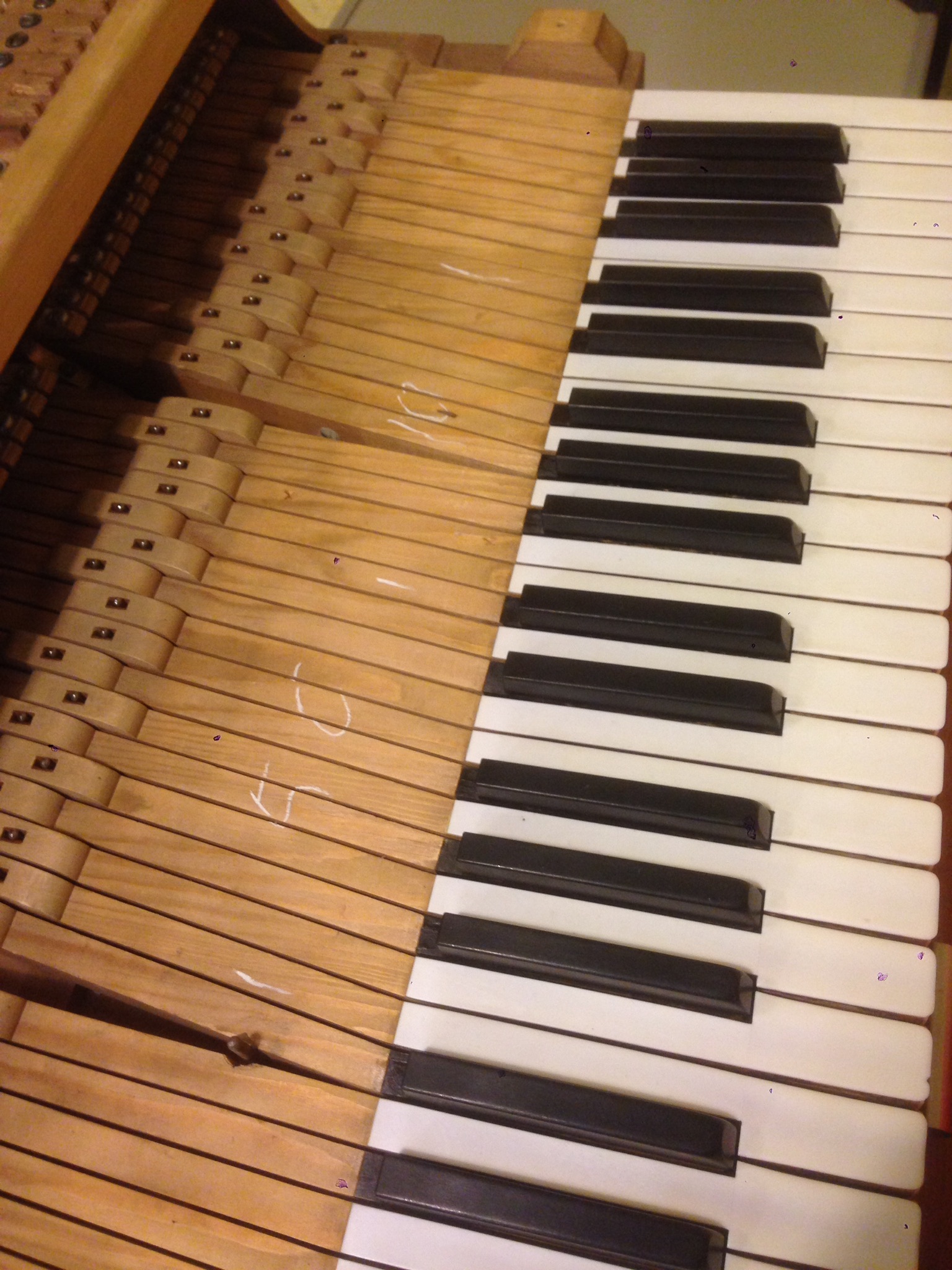
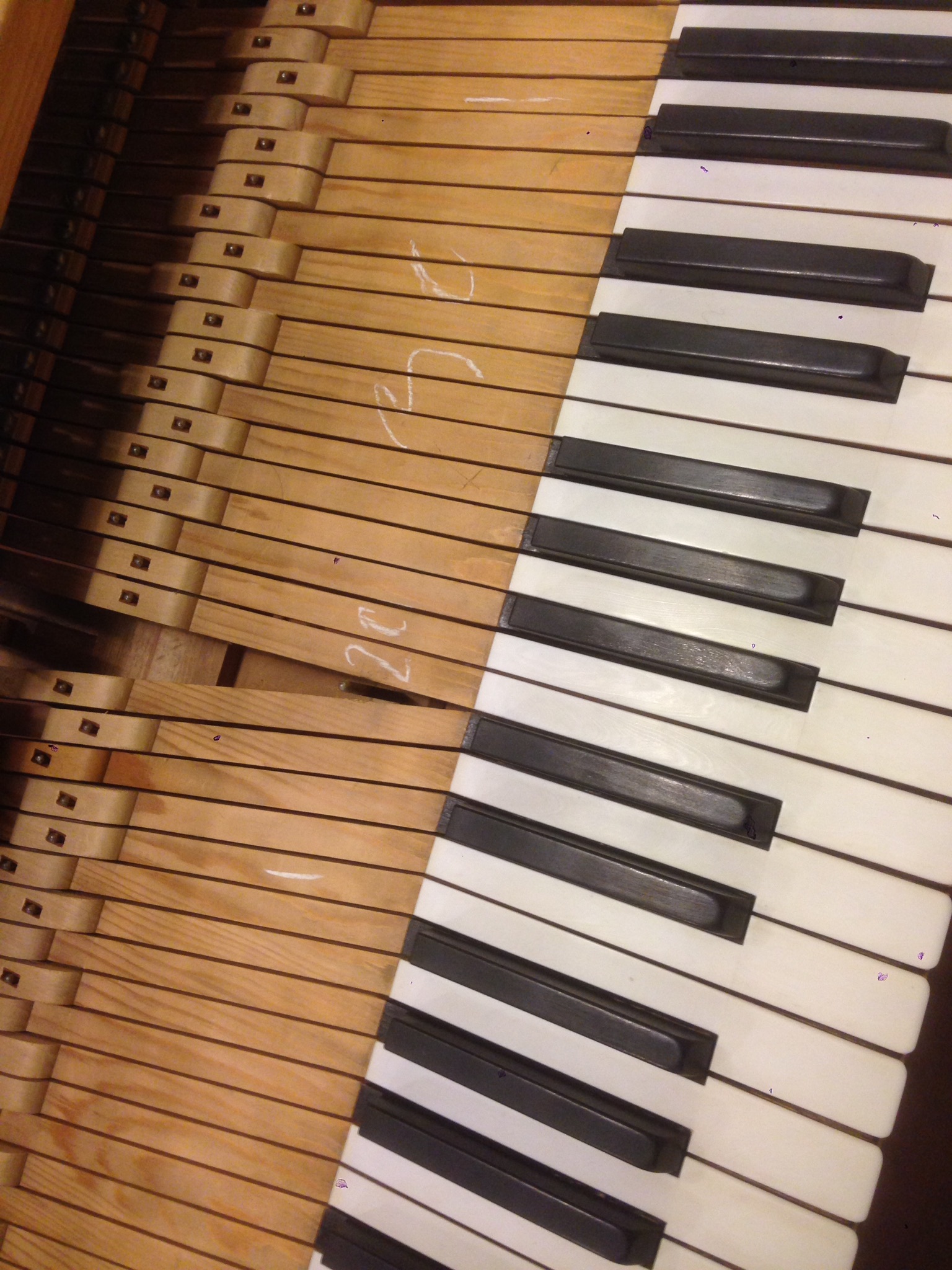
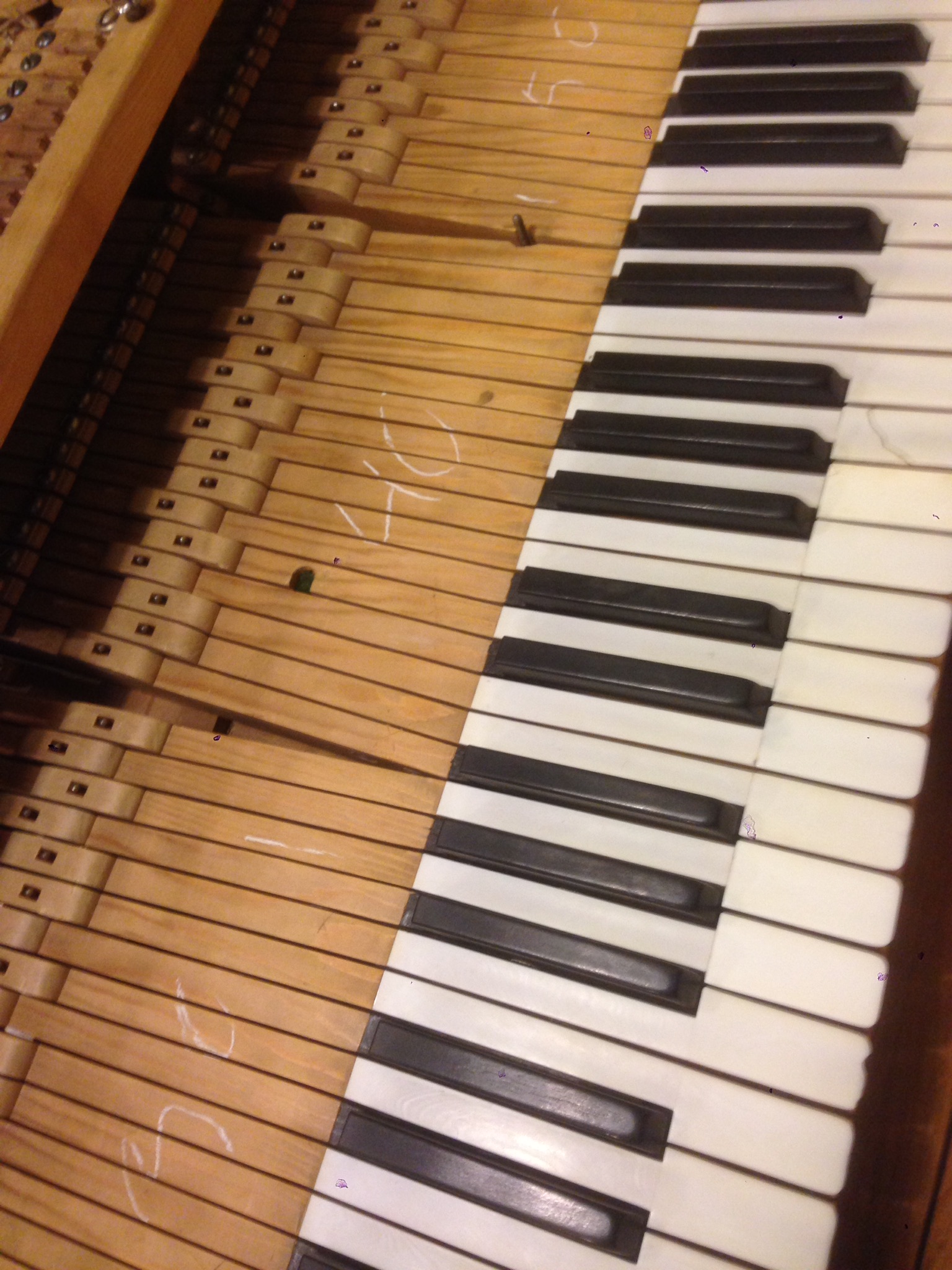
On the other hand, I had the opportunity to work with another technician who learned at Steinway in Hamburg... who proceeds from the bottom towards the apex following roughly the number of pricks that I attach in the figure....so, a diametrically opposed philosophy. It should be said that in this latter case we were not working in a factory but in a conservatory, so with hammer rails that had quite a lot of work already done on them.

What do you think? What is worth sharing, and what is not?

AttachmentAttachmentAttachment

Moderator

Reply 4 by pianoexpert

Posts
3,876
City
rocca di papa

You can't say! Because it depends on how the hammer felt was impregnated and/or constructed! Every manufacturer embraces a different philosophy! Therefore, one must see which procedure was followed to produce the hammer felt. A very heavily impregnated and/or highly compressed hammer felt will require more voicing! I disagree with not voicing the lower part of the hammers. In fact, this is a procedure called 'Battery', meaning to restore charge, and it is used especially in some extreme bass notes. Everything must be tested on a sample for each area and so, then, one can proceed cautiously, starting anyway from the lows and low-mids, where any potential "damage" can be avoided or limited. The forte must never be sacrificed! Starting from the bottom of the hammer brings energy to the apex of the hammer. But this is all theoretical. There are hammer felts that require numerous "pricking" (punzecchiature) and others that are fine with very few. Upon specific request, the manufacturer can differentiate the compression of the felt according to the registers (lows, mids, highs...).

The method for a good but dated hammer felt can be quite different. There are some Steinway hammers, for example, from the '60s, that sometimes need to be re-impregnated and re-voiced.

The method is also different for shaved hammer felts, provided that the original shape intended by the manufacturer has been preserved (for example "diamond shaped" for Steinway) (but still never rounded in the highs and super-highs!!!!).

in this case, it is necessary to consider that the apex is closer to the wooden core and the entire hammer is smaller. (personally, I am against early shaving of hammers, both for the aforementioned reason and because it also causes a change in the geometry of the action's movement)

Part of a good voicing procedure is checking the striking point and the planarity of the hammers relative to the strings. Correcting some string levels or giving a light file stroke to the apex... can improve things greatly. A hammer that does not strike the three strings simultaneously produces a timbral inaccuracy and can lead the technician-voicer astray.

Good luck with your work

Member

Reply 5 by GIUSEPPEPIANO

Posts
49
City
COSENZA

Hi Paolo, thanks for the precious advice.

However, one point is not clear to me. By "Battery" procedure, do you mean the technique used by the technician whose photos I have attached, or the exact opposite? (i.e., the fact of tuning the bass as well to restore sonority...)

Moderator

Reply 6 by pianoexpert

Posts
3,876
City
rocca di papa

the fact of tuning the basses as well to restore sonority! a procedure, however, not always necessary.

Log in to participate