

Can you recommend materials for soundproofing a room so as not to disturb the neighbors? I would also be interested in the economic aspects.
Thank you
Started by
Member
Member
Can you recommend materials for soundproofing a room so as not to disturb the neighbors? I would also be interested in the economic aspects.
Thank you
Member
What kind of sound source do you intend to isolate and how large is the room? Physical characteristics are also important.

Administrator
Sergio has already asked you some interesting questions to which you should respond to have a clearer understanding of the situation. In addition, I am interested in knowing if you only need to insulate the room or both insulate and treat (normalize) it; in any case, I will answer you as if you had to insulate the sound of a piano, since I presume that is the problem...
You have certainly already noticed sound-absorbing panels and probably fell in love with them. Well, those are not for insulation but for treating an environment; in fact, the attenuation in terms of dB for those on other floors is minimal. Complete insulation is totally impossible inside a condominium because most vibrations are transferred to other floors through the piano legs and then through the reinforced concrete load-bearing pillars. To insulate almost completely, the secret would be to build a room within a room with a suspended ceiling and a floating floor. In fact, there are some techniques to hang the ceiling using cables and special materials to keep the floor suspended high up. The whole thing would be covered by lead sheet panels. This way, the reduction would be truly significant, but how much will it cost you?
I recommend other much more economical ways.
Build some panels yourself and fill them with rock wool (please, not glass wool, which is highly carcinogenic). Even if it's not like glass wool, rock wool isn't good for you either, so make sure to seal them well to avoid the leakage of material harmful to health. During assembly, use gloves, protective goggles, and a mask. You should place these panels on the ceiling. For the floor, there are special pads for sale that limit the transmission of sound waves; they provide an initial attenuation. Finally, put as thick a rug as possible under the piano so that this also helps to limit the transmission of sound waves.
Reach an agreement with your neighbors regarding schedules. Before I bought my digital piano, which allows me to play at any hour, I did some research. The law tells us that you can play up to 4 hours a day. You have 8 hours divided into two time slots of four hours each for playing: the first in the morning from 9 AM to 1 PM and the second from 4 PM to 8 PM. The four hours can also be split between the two time slots. The dB measurement in the neighbors' apartments must not exceed a certain threshold. If you encounter a nitpicker, it might be worth making sure you satisfy this condition as well, but honestly, I don't remember the dB threshold. Do a quick search on the internet. I do remember, however, that it was very easy to exceed that threshold, but with these precautions, you should manage. Fortunately, in the end, I live in a fairly accommodating condominium, so I have never had great problems with my neighbors. Only with the one above me, who complained about the piano and how his wife would bang against the ceiling to make the beds as soon as he left the house, and the daughters would blast the stereo so loud they could be heard 2 km away. Oh well, one has to be able to live after all, so I, more diligently than he did, have never complained...
Member
Simone's advice is excellent, as he has also directed you towards DIY construction!
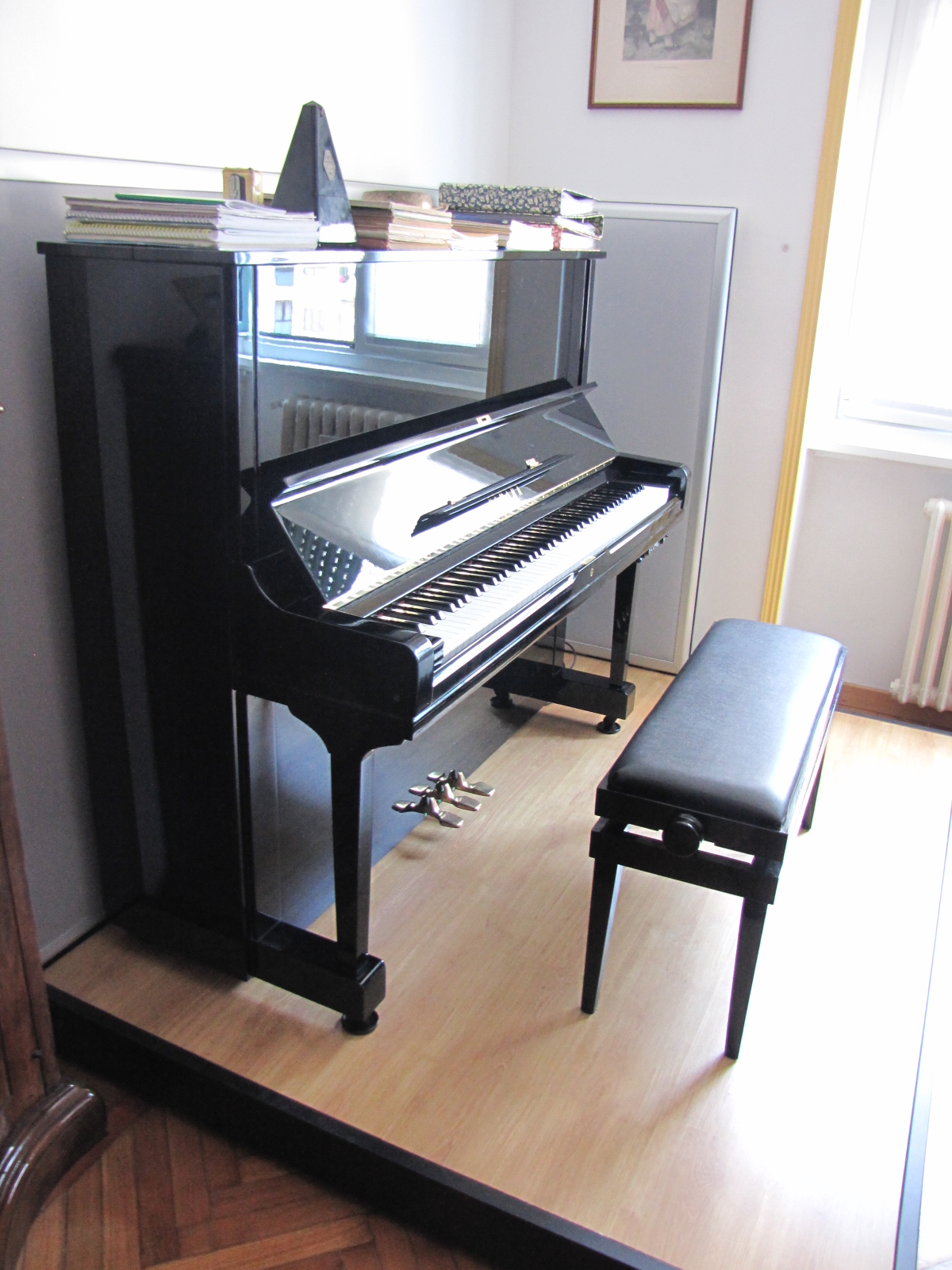
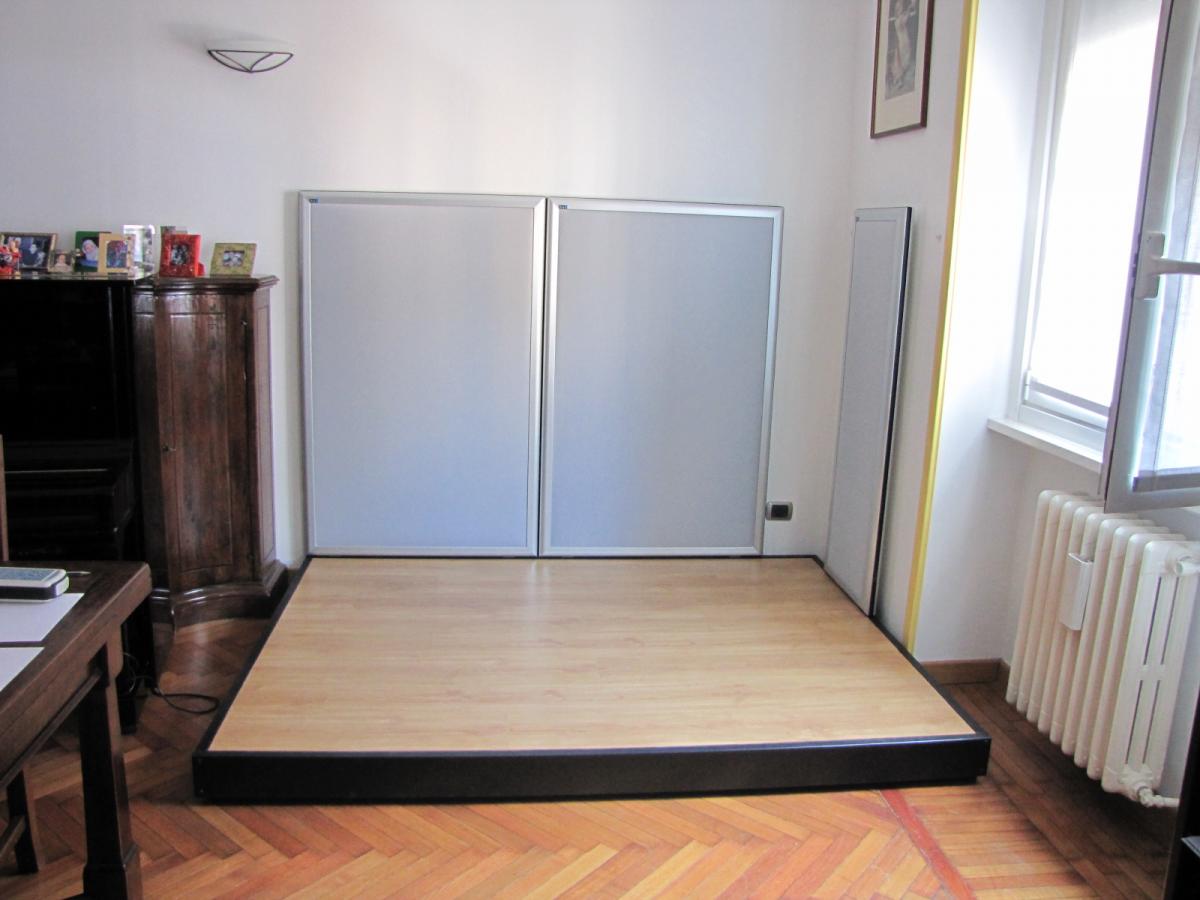
Here is an example that already helps:
the platform is also very suitable for digital pianos: they drastically reduce the annoying thumping that is mostly felt at night by the people below.

Member
I take the liberty of recommending, in addition to what Simon said, the use of specific cups for the pianoforte wheels (provided yours has them). They cost about 50 euros. The more technological ones are around 100 euros.
I am of the opinion that as long as one stays within reasonable limits, problems are minimized.
I have lived in a linear 6-story apartment building (2 per floor) since I was born and I have never had any problems (despite several changes of neighbors/tenants).
I assure you that I make a huge amount of noise :D :D .
But it takes good taste. Establishing specific practice time slots is ideal. Let's say I want to play in the morning and in the evening at most until 9 PM, with or without a mute.
If I have to do heavy technical work, I either use a mute or I use the silent system.
Also because this way we protect ourselves from inevitable tinnitus.
Tant times we neglect the opinion of the people around us. As much as they may love our music and passion, hearing the preparation day and night of a transcendental Liszt study is still acoustic pollution that isn't good. Neither in terms of stress nor hearing.
Ah, one last thing.
Watch out because by constantly insulating and insulating, in the end, the acoustics can become absolute rubbish. Two people I know have had this problem.
Administrator
foster12 wrote:Watch out, because by isolating and isolating too much, in the end the acoustics can become a real piece of junk. Two people I know have had this problem.
Absolutely right! Sound with too many bounces becomes annoying because sound waves add up and amplify each other; the bass, especially if the instrument is positioned in cornered spots, creates a thunderous rumbling effect. But also, regarding normalizing—if I may correct the term 'isolating' which in this case is incorrect, since isolating means damping the sound so that it isn't heard outside the isolated area; normalizing means making the normalized area non-reflective for sound waves and thus this also affects reverberation times. Thus, by normalizing too much, it is possible to end up with a sound that is too dry, which sounds very bad.
Even during the recording phase, the position of the microphones in relation to the source is of fundamental importance. By moving the microphones away from the source, it is possible to capture the natural "ambience" of the room. Working with the natural reverb of a room is always much better than adding reverb with machines in post-production. Sometimes it isn't possible; other times we can rely on naturalness. In this case, one always tries to take advantage of the opportunity.

Moderator
When I was desperate about the subject, several years ago, I had contacted this company
which had made a good impression on me and, having the space, a 3 by 4 meter booth would have given me good livability... then I moved house ...
What do you think of these booths?
Moderator
Moderator
For materials and other info I had drawn from here
http://www.audiorec....orizzazioni.htm
http://www.mgfonotec....com/musica.htm
http://www.insonoriz...ni.net/home.htm
Hope useful ...
Member
Thanks Frank! You never know, it might come in handy when I move house.
I really hope not.
I knew of a pianist who traveled with a scarecrow... When he changed apartment buildings and carried his baby grand with him (and saw the faces of the neighbors during the transport), he would lean out onto the balcony and fire shots into the air.
....Just, you know, to reiterate his availability to listen to the neighbors' needs.
I think he got the idea from an Eduardo De Filippo comedy "San Carlino 1900... e tanti".
Come on, let's laugh about it
Administrator
I have a dog repellent, I should probably use it on my neighbors too, what do you think?
Member
It's like putting a sign about the dog outside the gate.
A preliminary step that allows for filtering out a certain number of complaints. And in any case, it is good to remind newcomers of the concept.
Member
Sergio wrote:What type of sound source do you intend to isolate and how large is the room? Physical characteristics are also important.
A musical instrument (the pf) in a room of about 30 sqm.
Member
Beautiful idea foster, thanks to everyone for the interest, the advice and the indications
Member
Paride, take a look here too: http://www.boxy.it/
I collaborated with this company as an industrial consultant for the automation of some processing steps and I saw that they are very well-prepared and capable.
Member
Wow! So many interesting links!!!
Now I'll take a look at them.
Member
Then, playing during more or less permitted hours is one thing and teaching pf is another!
Member
I think that even an enthusiast, who listens to 8 hours a day of preparation for the Goldberg Variations, after a while might experience the "Shining" effect.
Member
Sergio wrote:Then, it's one thing to play during more or less permitted hours and it's another thing to teach pf!
as Foster says, at least every hour or hour and a half the music changes
Member
And then what the heck! Let's wander a bit ....