Hi friends, I'm taking advantage of a funny herniated disc that has me pinned down here to give an update on my teaching. I am updating the composition/arrangement course and would like to submit my notes to you. Constructive criticism is welcome. Is anyone interested?
On second thought, I'll adjust my approach: it's not appropriate for me to write a series of notions that you probably already know; of course, if I can satisfy a curiosity or clarify something, I am happy to do so—after all, the goal of those passionate about teaching, like almost everyone present, is the sharing of knowledge. But perhaps a convergence of our knowledge would be more productive, in order to find agile and accessible explanations.
I would start with a point that leaves me perplexed (paradoxically, the basic notions are the most difficult to explain simply):
Chord classification. Tetrads; triads seem approachable to me.
The doubts:
1. Do we classify based on harmonic function or simply based on construction? In the first case, I find that seventh chords of the seventh kind do not have a peculiar harmonic function of their own.
2. Sixth chords. Are they comparable to major7? Bill Russo bypasses the problem by classifying 6 types of chords: the usual 7, -7, -7b5, dim and the two triads (major and minor), for which he considers both the seventh and the major sixth as tensions interchangeably. What do you say?
I would start with a point that leaves me perplexed (paradoxically, the basic notions are the most difficult to explain simply):
Chord classification. Tetrads; triads seem approachable to me.
The doubts:
1. Do we classify based on harmonic function or simply based on construction? In the first case, I find that seventh chords of the seventh kind do not have a peculiar harmonic function of their own.
2. Sixth chords. Are they comparable to major7? Bill Russo bypasses the problem by classifying 6 types of chords: the usual 7, -7, -7b5, dim and the two triads (major and minor), for which he considers both the seventh and the major sixth as tensions interchangeably. What do you say?
...and "polyfunctional" sevenths?
re fa lab do can be the II degree of C minor but also the VII of Eb
For example, with a seventh of the sixth kind, how would you behave?
A more radical question: do we necessarily have to start from tonal harmony? Why not reason in terms of modes?
In effect... generally I start from the tonal because it is more familiar to my students and because, in harmonization techniques, the tonal approach is the most practiced one, at least in jazz.
If they have more functions, it is still worth considering them, but between a C∆ and a C∆(#5)?
A seventh of the sixth kind I would generally consider a minor I degree.
In fact, I'll say it in another way: if you had to reduce the types of chords to those essential for unequivocally defining the harmonic structure of a piece, which ones would you save?
A more radical question: do we necessarily have to start from tonal harmony? Why not reason in terms of modes?
... anyway, it is an interesting point; I would say that the harmonization of a modal piece, in the absence of cadential relationships, reduces the possibilities.
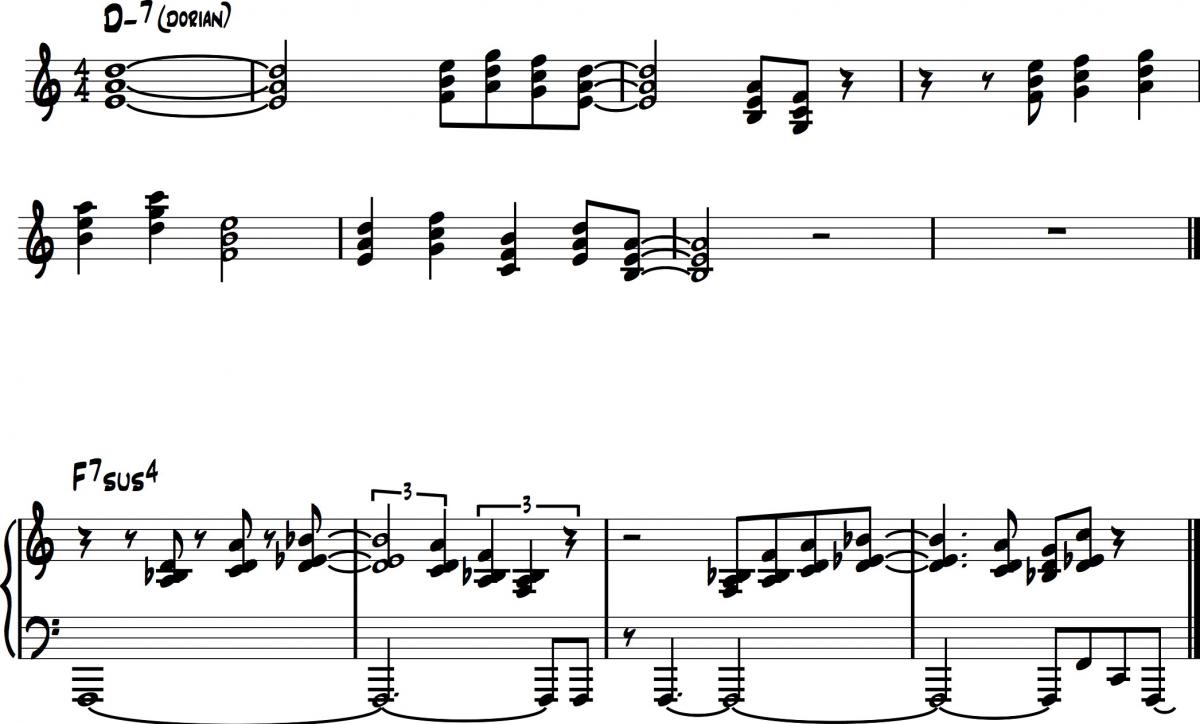
I would lean towards parallelisms. By this term, I do not only mean the parallel movement of all parts, but also a type of harmonization (which Bill Russo calls organum) in which a reference scale and an intervallic pattern are established—for example 4+4: everything is harmonized in fourths without taking into account whether the fourths may be perfect or augmented.
Examples:
#1 harmonization of John Coltrane's Impressions 4+4 using the Dorian mode as a base; see how, given equal intervals (as numerical values), we find both perfect fourths and augmented fourths.
#2 harmonization of the melody over an F7sus4 pedal; here I did not use a precise system, I limited myself to looking for sonorities that did not have a clear tonal connotation, avoiding arrangements in thirds (according to my taste).
In all frankness, I must say that I wouldn't know how to further develop this topic in an organic way.
Any ideas? (Egidio, you've put the wine in a cool place... )
I agree with DrJellyfish, but another question arises. Modal doesn't necessarily mean quartal, so this is certainly a topic, but it would be nice to include third-based harmonization in the discussion ...forgetting about tonal functions. Perhaps something comes out through the juxtaposition of colors (to be known and taught) ...but perhaps that points toward the discourse of Jacob Collier
The point is, the way I see it, that in the modal [context], relative to this context, almost everything is permissible. Let me explain: a melody can be harmonized with any set of notes belonging to the established mode; the only constraints relate to how much you want to emphasize the color of the mode itself or how much you want to remain within a certain style. Aside from that, I wouldn't know what rules to establish...
The point is, the way I see it, that in the modal [system], relative to this context, almost everything is permissible. Let me explain: a melody can be harmonized with any set of notes belonging to the established mode; the only constraints relate to how much you want to emphasize the color of the mode itself or how much you want to remain within a certain style. Aside from that, I wouldn't know what rules to establish...
Given that the C major scale is one of the modes... according to this, the issue shifts to style in the sense that even in the classical world, modality (primarily Renaissance) and tonality are studied; only by referring to stylisms is it possible to discern what is tonal and what is modal (considering that there are also "hybrid" worlds). Given that these two musical systems are completely historicized, it comes down to choosing based on one's own taste or inclination.
In my opinion, teaching must show the contents of both worlds so as to leave - later - freedom to the learner to express themselves based on their own sensitivity.
I absolutely agree, the only doubt was about how to apply the modal system to an arrangement method; it is no coincidence that all books dealing with arrangement gloss over the subject. The other doubt was whether, once the two systems (which are not the only ones) have been explained, it would be appropriate to start from the modal one.