Hello everyone and Merry Christmas... my name is Paolo and this is the first discussion I am posting...
I take this opportunity for a quick introduction, saying that I am 55 years old, I live in Genoa and I play the piano as an amateur;
this has led me to a passion for restoring antique pianos.
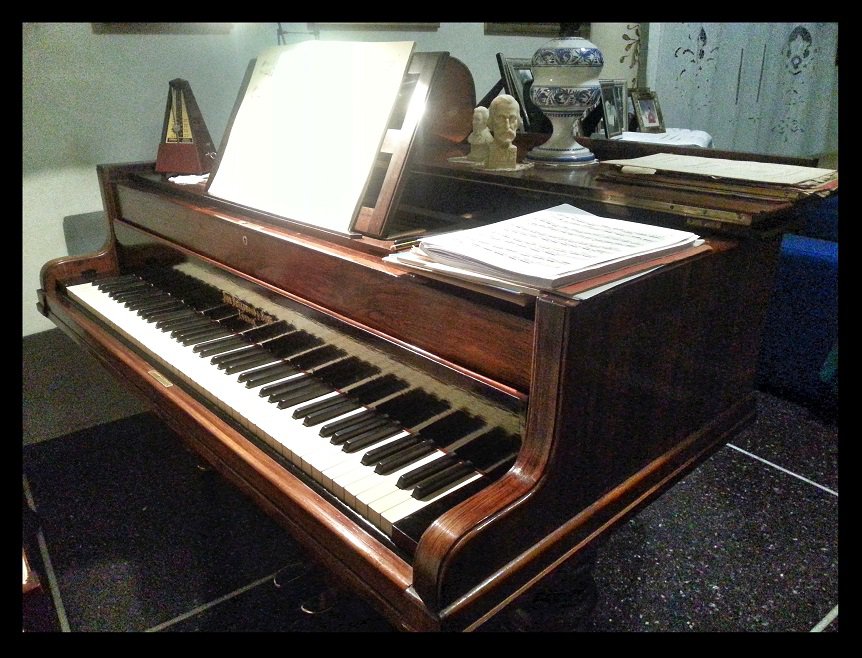
Now, then, I will get into the details of the problem related to the mechanics of my John Broadwood & Sons mod. Short Grand matr. 44417 from 1889.
The piano was purchased about 20 years ago in Boston through an importer; according to the documents, it appears to have been the onboard piano of the ocean liner Lusitania,
fortunately disembarked in the United States before its conversion into a hospital ship and tragically sunk before the end of the second world war.
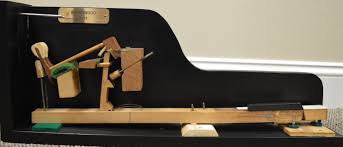
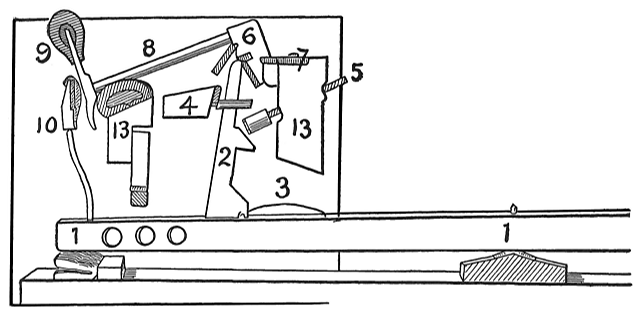
The instrument has been restored both in the wooden parts (veneered oak in bleached rosewood), and in the mechanics, to which I attach the diagram and a photo of the cross-section.
And here arises my problem: since the hammer butt pusher is integral to the key (there is no pilot screw present), how is it possible to adjust the inevitable play
that forms between the top of the pusher and the hammer butt?
I would say that there must be a minimum gap between the wippen and the capstan (as in an upright piano) that allows the pusher to return easily under it. If this play were too much, all that remains is to act first by placing a small shim behind the key rest felt (a light strip of paper) and a small washer (0.05 might suffice) also under the key at the position of the center rail. This is to avoid altering the key dip, which must remain sufficient so that the pusher "escapes" correctly when the hammer reaches the vicinity of the string.
Thank you, Paolo, unfortunately the "play" for several keys is almost at the millimeter level and your solution, besides varying the key dip, also misaligns the flatness of the entire keyboard.
I believe that at the time the piano was built, being everything new with minimal tolerances, the geometry of the action was impeccable (for as much as this type can be). The apparently strange thing is that having restored all the "soft" parts (hammer rest spring, key felts, hammer head skins, etc...) this problem persists; in practice, the hypothetical lines of all the hammer head skins that receive the thrust and those of the tops of the pushers are not straight.
Consider that the only adjustment regarding this is possible by raising or lowering the metal supports that hold the hammer rail (no. 13 in the diagram): clearly a "coarse" adjustment...
I had also thought about reconstructing the pushers (to preserve the originals) and equipping them at the top with a pilot screw. If this were possible, the problem would be solved: perfect alignment of the keyboard, correct hammer-to-string distance, and subsequently correction of the play between the pusher and the hammer head using the new pilot...
I will see what to do...
For now, greetings, I wish you Happy Holidays and I compliment you on the excellent work you do.
The double thickness (under the key rest felt and simultaneously under the center rail) serves specifically to prevent the keyboard from becoming misaligned. Do you agree? Try it. Obviously, where the play is not uniform ("for different keys it reaches up to one millimeter"), you can intervene under each key with removable adhesive paper (masking tape), always compensating at the center. This way you shouldn't have misalignments or significant changes in geometry.
First phase: general level raising
Second phase: correction of individual keys that still have excessive play
P.S. Anyway, as in an upright piano, a minimum play between the pusher and the cap must exist, such that the pusher itself returns easily under the cap when the key is in the rest position
Thanks, Paolo... genius solution... I hadn't actually thought of that:
"I raise the key from the tail (under the rest felt) until the play is eliminated (ensuring that the pusher still returns easily);
now the play is fixed but obviously the front part of the key has lowered, becoming misaligned;
and here comes the magic: I correct it by adding washers under the center key pivot, the key realigns while leaving the height of the pusher unchanged.
Fantastic. I will inform you about the intervention shortly.
Best regards and have a good day, Paolo Menichini"
Further clarification: naturally, the rosette also minimally raises the level of the key lever.....you must find the right compromise so that the keyboard is aligned and the levers do not have excessive play. Good luck and let me know
Thank you, Paolo... brilliant solution... I hadn't actually thought of that:
"I raise the key from the tail (under the rest felt) until the play is eliminated (ensuring the pusher returns easily);
now the play is fixed but obviously the front part of the key has lowered, becoming misaligned;
and here comes the magic: I correct it by adding washers under the center key pivot, the key realigns while leaving the height of the pusher unchanged.
Fantastic. I will inform you about the intervention shortly.
Best regards and have a good day, Paolo Menichini
Can you post an audio later? Who knows what a beautiful sound it must have!