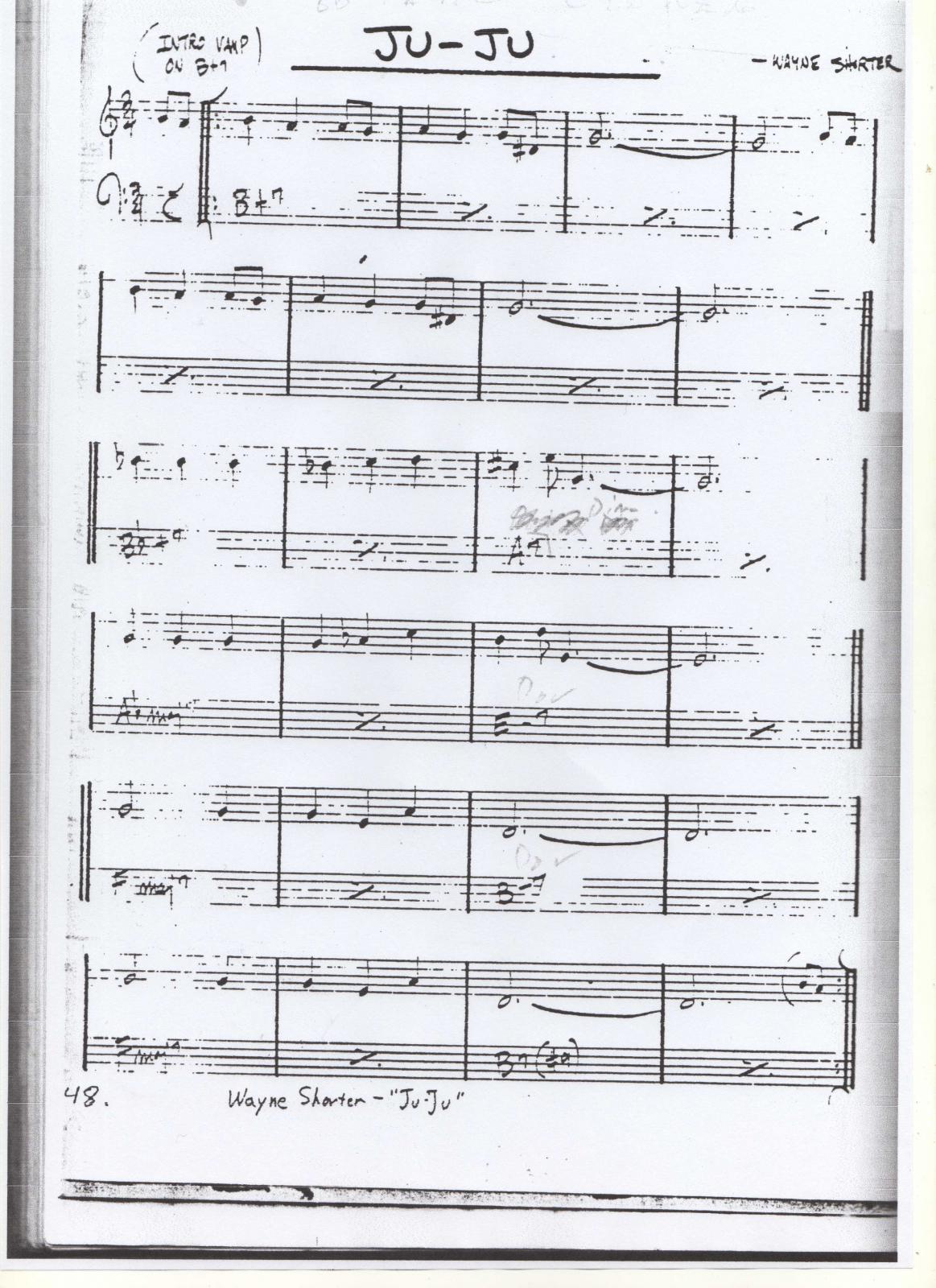
MODAL HARMONIC ANALYSIS OF THE PIECE JU JU BY W. SHORTER.
Based on the premises for which this site exists, I feel it is necessary to make a brief mention regarding the nature of my improvisation on the piece Ju-Ju. The harmonic analysis I am proposing to you strictly adheres to the modal harmonic concept, whereby in the piece the scales played by me with the chromatic harmonica are chosen based on G. Russell's theory of the "Lydian Chromatic Concept of tonal organization". It is evident that for the explanation to be understood, knowledge of the "Lydian Chromatic Concept" is required, but in this setting, for obvious reasons, it is not possible to say more. It is not possible to analyze a modal piece following the Ionian concept of tonal organization and vice versa, it is not possible to analyze a tonal piece following the Lydian concept of tonal organization simply because the Ionian scale presupposes a tonality, whereas the Lydian scale does not presuppose one; and in modal harmony, there is no tonality in the piece, but rather a prevailing mode around which accessory modes orbit. It is evident that the analysis is schematic and the musician can exercise their creativity using chromaticism, side slips, harmonic "out", Coltrane changes, and more, or with anything else that is not written anywhere but is felt by the player.
The chords of the piece are:
BVII +5: Modal Tonic B - G lydian augmented scale
BbVII +5: Modal Tonic Bb – Gb lydian augmented scale
AVII: Modal Tonic A – G lydian scale
Ab: Modal Tonic Ab – Ab lydian scale
E-: Modal Tonic E – G lydian scale
F: Modal Tonic F – F lydian scale
B-: Modal Tonic B – D lydian scale
BVII #5#9: Modal Tonic B – Eb lydia augmented scale"}