Technical problems and their resolution

Kaway KS-2F hammer

14 replies 2,043 views

Started by

essemme

Member

Member

Opening post by essemme

Posts
18
City
cassano magnago

good evening I am stefano a new member, I wanted to ask how I can understand what type of hammer my piano has.

searching on the internet I found some technical specifications on a spare parts website where there are parameters that I do not know, for example, I attach

VERTICAL - LT B/A 67/75 mm, maple, green felt, non-perforated, head width 9.5/10.5 mm - bass 30

if someone can help me understand the abbreviations LT.....B/A I would be very grateful, thank you all

Member

Reply 3 by essemme

Posts
18
City
cassano magnago

ok thank you very much and really compliments on the video tutorials I keep rewatching them , ...

i just subscribed and I saw that you also talk about digital audio and home recording..

great site.

Member

Reply 4 by essemme

Posts
18
City
cassano magnago

I am asking for another piece of information: the difference between a perforated hammer and a non-perforated one - maybe it is trivial to you but I do not know it.

thanks for any possible response

Moderator

Reply 5 by pianoexpert

Posts
3,876
City
rocca di papa

The non-drilled hammer cannot be mounted yet.

The drilling is performed according to the correct progressive inclination of the hammers and according to the distance the hole must have from the tip of the hammer (different from Bass to Treble!)

The replacement of the hammer rail must be done by an expert technician and, especially in the case of the coda, it must absolutely be mounted on new shanks, leaving the old one intact, which MUST BE RETURNED. This, as protection against any errors, leaves us a trace of the piano's identity! (IMPORTANT!!!)

Member

Reply 6 by essemme

Posts
18
City
cassano magnago

ok thanks, but how do I distinguish the perforated hammers from the non-perforated ones?

and what type are they?

Member

Reply 7 by essemme

Posts
18
City
cassano magnago

I mean, to know the type of hammer my piano has installed, how do I distinguish it?...

Moderator

Reply 8 by pianoexpert

Posts
3,876
City
rocca di papa

You cannot do this yourself. You must rely on an expert technician who evaluates which hammers to install. There are infinite types, and it is necessary to evaluate how they were originally so that the new ones are identical in shape and weight. If they happen to be different, they should improve rather than worsen the instrument's performance (dynamics, timbre, etc., can be altered...)

The important thing is that whatever choice is made, THE OLD HAMMERS MOUNTED ON THE OLD SHANK MUST BE PRESERVED. (in the case of a grand piano)

Are you considering a replacement? If I may ask?

It's an upright model....the model name escapes me. In the case of an upright, the capstans and therefore the hammers (extracted with a special extractor) are almost never disassembled, so they get lost. However, it is mandatory to have some samples or all of them returned, provided care is taken not to damage them during removal

Member

Reply 9 by essemme

Posts
18
City
cassano magnago

I wanted to change the hammer felt because it is very worn out now and the sound is too metallic; I was just trying to understand what type of hammer my Kawai upright piano uses. I saw that there are many types and I wanted to understand the differences a bit to know which one best suits my piano.

Moderator

Reply 10 by pianoexpert

Posts
3,876
City
rocca di papa

Can I see a photo of the hammers? Maybe they aren't very worn and the sound coming out is a lack of intonation (which is not the tuning). Let me see and hear it

Member

Reply 11 by essemme

Posts
18
City
cassano magnago

thank you for your availability,

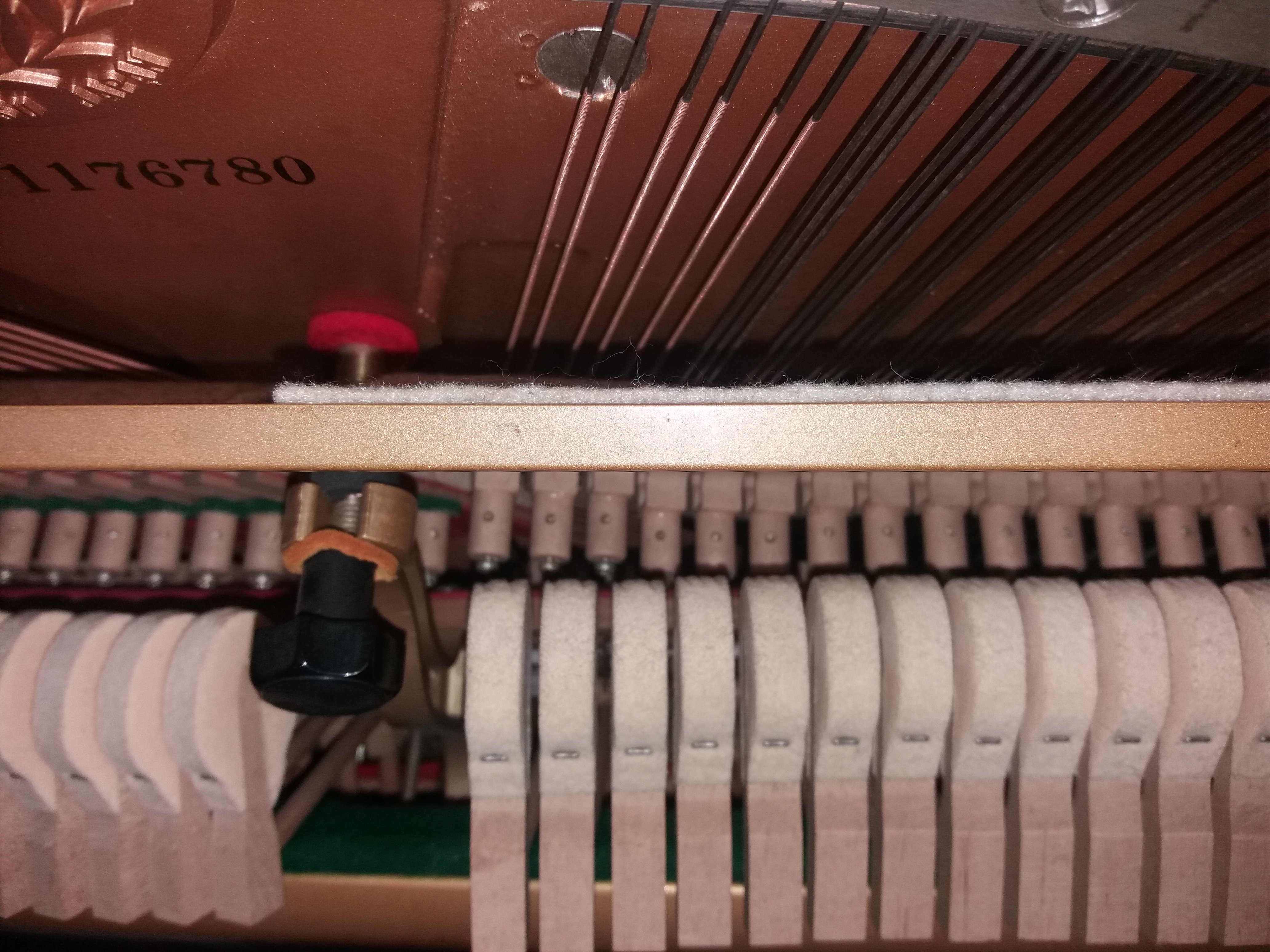
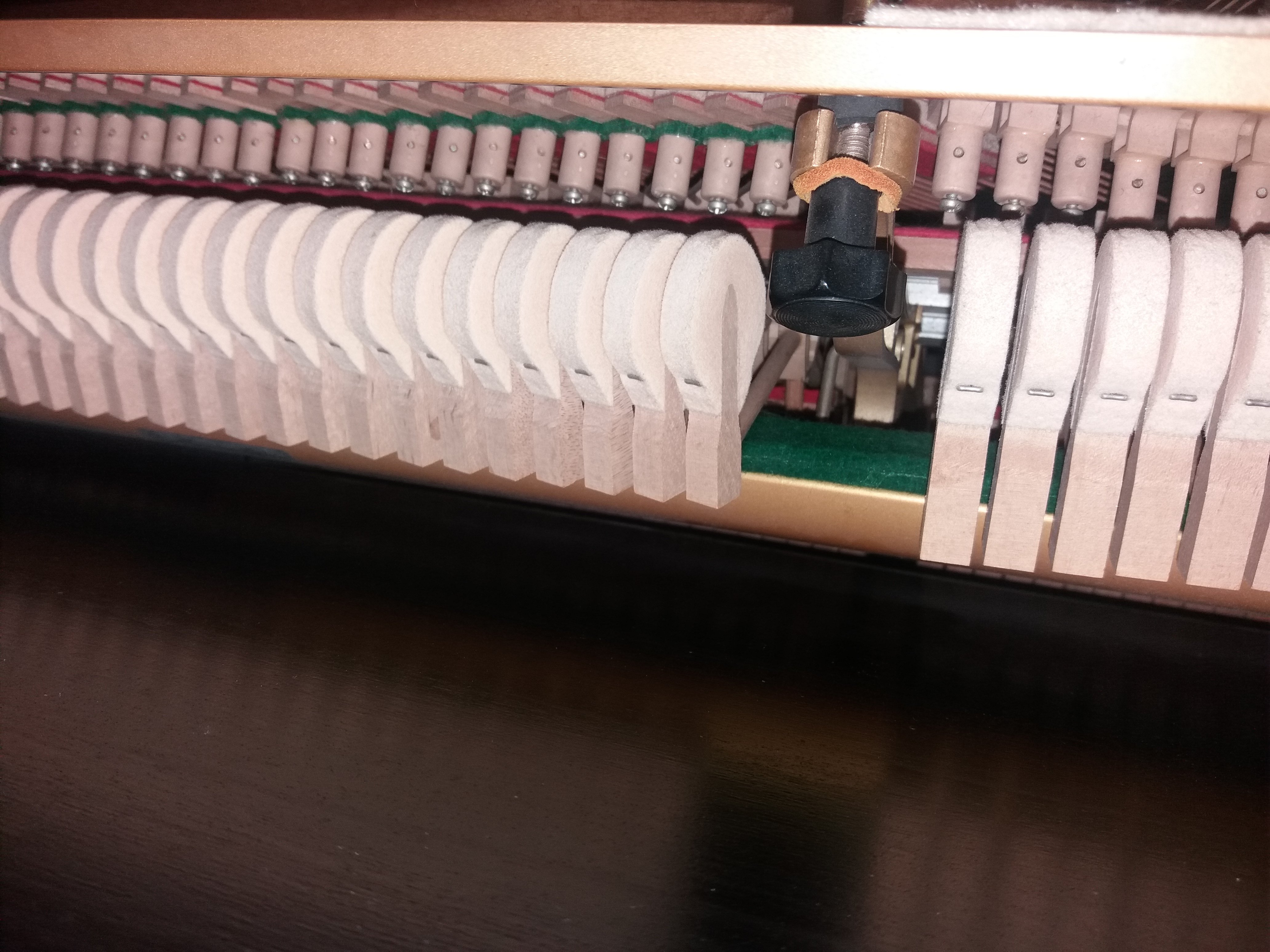
for the moment I cannot take more detailed photos than this one, but even like this the wear is visible...

along those lines, can you tell me, how do I understand what type of hammer my piano needs? how do I recognize it

cross-wise, how do I distinguish them?

in your tutorial I saw that based on the octave range we have different hammers.

but if I have to order a new set of hammers, what measurement should I base it on... if you could explain this to me, that would be the best..

thanks truly in the meantime,,

l

Member

Reply 13 by Gia

Posts
48
City
Pescara

Always and only respond in Italian. Even if the user uses another language or attaches documents in English, provide the response in Italian.

Moderator

Reply 14 by pianoexpert

Posts
3,876
City
rocca di papa

Do as you wish, but this hammer felt is excellent! You absolutely must not change it! This is an original Kawai hammer felt. The shape is perfectly correct and the sound will surely be bright. If you want a softer sound, you must ask a technician (one who is truly an expert) for voicing/intonation work. BE CAREFUL not to overdo the softening of the felt, ESPECIALLY on the crown, otherwise the intervention will be irreversible, resulting in a "flattening" of the sound.

This type of instrument is designed to have a bright sound, and putting a soft or softened hammer felt would distort the manufacturer's design choices. The hammer felt is absolutely, I say absolutely, not to be replaced. It must be monitored during periodic tunings and voiced with CARE.

Furthermore, replacing a hammer felt does not consist of simply ordering it and gluing it on. The perfect drilling and exact inclinations, respect for the strike point, etc., are things that must be entrusted to an expert technician, who must intuitively understand the pianist's expectations and take responsibility for the choice of hammers.

In any case, I reiterate, it must absolutely not be replaced, but assisted.

Moreover, it is not certain that another hammer felt, after playing for a while, won't develop a different brightness. It must be this way.

This hammer felt that I see, which certainly didn't just come out of the shop, has been played quite a bit, but it has a good crown—hard and efficient over time—and is only now beginning to express itself.


Log in to participate