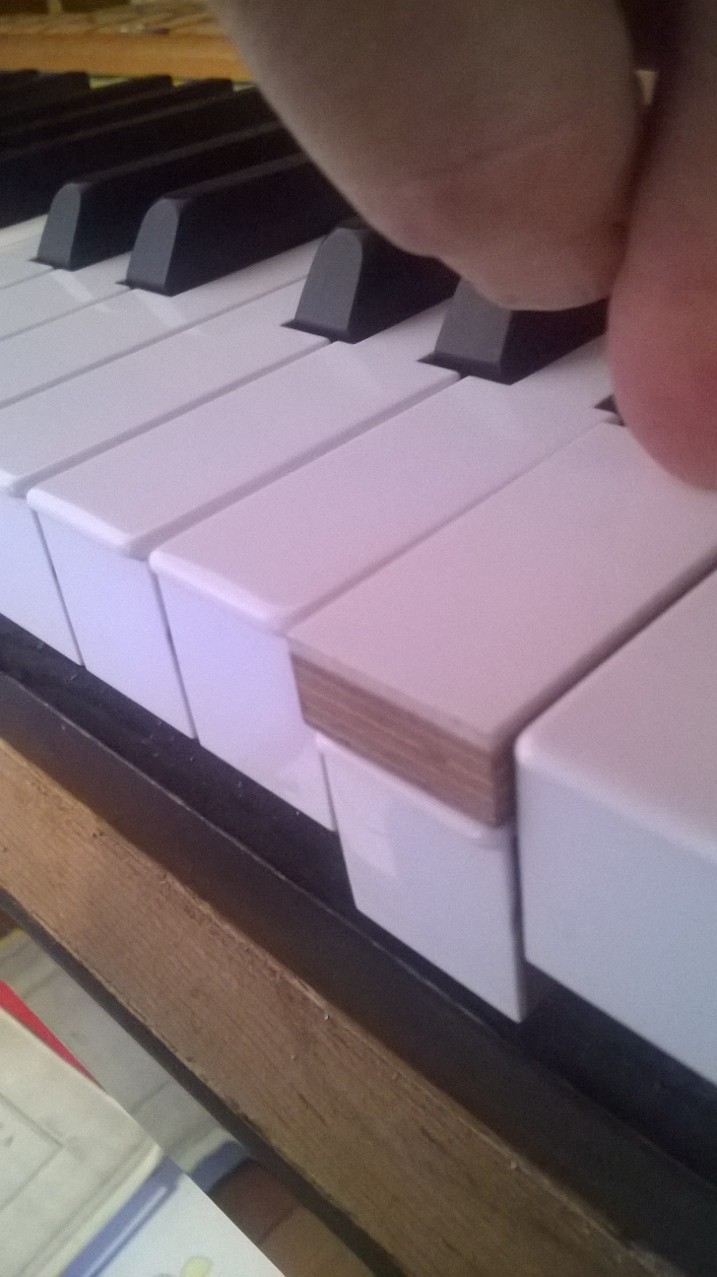
Hello, on my piano some keys, particularly a couple of them, have a depth of 10mm, but there is no uniformity on the same key. To explain: on one side the gauge coincides perfectly with its neighbor, but on the other side it turns out to be higher than its other neighbor (even though the alignment is correct). What could this depend on?
Hello Francescopianist, this is a Kawai KG2D that has undergone gasket replacement and keyboard leveling. I find these key "bubble holes" strange. Thank you
But did you find anything after this "defect"? I am not a technician, but a shorter key lever should mean a steeper inclination of the same, as seen from the template.
I looked closer at the image. Indeed, the key on the right seems lower to me. It needs to be corrected with some paper shims placed under the keys. Pay attention to the proportionality between the key dip and the hammer-string distance.
I probably didn't explain myself well. The key in question (B) is level on one side (with the A underneath) but not on the other (with the C above), so if I were to add a shim, the two sides would respectively always remain at different heights. I believe it is the pivot (if that's what it's called) of the central fulcrum of the B key that is slightly tilted. Thank you
You explained yourself well .. See if the key is slightly more tilted on one side along its entire length; if so, check the center keyboard mortise bushing with its pin, you will surely find the defect there and then adjust the dip. Bye
The horizontality of the keys is corrected by acting on the central pins of the keyboard, and leveling by acting on the paper washers of the same central pins. When the keyboard is perfectly leveled, then the dip of each key is determined. If the central pin of the B, as you state, is slightly tilted, you must correct it by giving a lateral tap to the pin, so that the horizontality of the key itself is restored. Unfortunately, when the felts are changed, everything must be rechecked, key by key. You see the true leveling after having returned all the keys to perfect horizontality (check with a straightedge placed on the surface of the keys). Only Steinway makes an exception because in the center of the keyboard the keys are about 2 mm higher than at the extremes.
Naturally, if you notice that this phenomenon repeats in other areas, call the technician and ask for the entire keyboard to be releveled.
Steinway has certain refinements that set it apart. The Company maintains that this slight difference in leveling ergonomically facilitates the pianist's gesture.
Effectively, the arm travels along a curve by moving it laterally. The Steinway is recognized by these particularities, rather than on the general design.