Restoration

Key travel in 2 segments

45 replies 5,929 views

Started by

mike

Member

Moderator

Reply 21 by pianoexpert

Posts
3,876
City
rocca di papa

I only allow myself to intervene again to clarify that Mike's plan has nothing to do with Renner. At that time, Petrof could not install Renner material. They have only done so recently. Those Petrofs, in fact, were well-made and well-designed, but they lacked quality mechanics and hammer felt, which was produced in the East, perhaps by the House itself. Recovering 10 gr. with the correct and still aesthetic as well as functional new shape of the tails is something to be seen, in my opinion. In any case, a slight recovery of weight reduction is in favor of inertia (less lead). Instead, the hypothesis of hammers that are too soft may be possible. Regarding the quality of the hammers and their execution... it remains a matter of respectful opinion. Renner is a great and glorious House. Abel has also demonstrated to be a builder attentive to quality, the construction process, and the peculiarities required by the client. Sometimes even a different impregnating agent can change the general timbre of the hammer felt. It is true, inside the hammers there is a "situation" much more complex than one might believe. In replacement, however, especially in cases like this, it is appropriate to respect the identity or similarity to the original, if ever, as, I repeat, in this case, by improving the overall quality.

Member

Reply 22 by Davehammerklavier

Posts
149

Naturally, the mechanisms from the East were a direct copy of Renner; I don't think they can cause particular problems.

If Mike updates us with further impressions, or perhaps some photographs, we might be able to better understand the situation.

Member

Reply 24 by Davehammerklavier

Posts
149

Maestro, look, I thank you for the compliment, but I fear it may be misplaced...

I would nonetheless like to clarify that I have nothing against Abel; relations have always been peaceful and invoices have always been paid as requested.

The fact is that there are companies that convincingly choose a path, which may or may not be consistent with the conceptions and the result they wish to achieve, and they must be respected as such.

Once they told me clearly: "WE DO NOT DO AS STEINWAY DOES". I believe this can be worth more than a thousand words.

Before Abel, I had never used Renner because, as I believe often happens today in many fields, I had been indoctrinated in my initial inexperience with the thesis that: "today Renner works poorly, makes unsellable products, and only Abel works well."

(With more colorful and convincing language)

Consequently, over time I used all the Abel models available, without ever being satisfied or convinced by the result. Not even half the time. Others might have liked them, but for me, one could always get more; it was certainly not a distinguished tone or sound, and for me, the unfortunate piano was not to blame, despite others' opinions always easily maintaining that, in short, nothing more could be done.

I piled up several hammer actions, others thrown directly into the trash when I began to no longer know where to put them.

Until, not knowing what else to do, I switched to Renner.

From there, it was a short step and I obtained without particular difficulty what for me is the sound and behavior of a repertoire piano.

It may be that there is an 'elective affinity' between me and Renner, but I am truly sorry to see a company that uses excellent raw materials and carries out accurate workmanship lose itself in philosophies that are not very functional in practice to pursue the: "WE DO NOT DO AS THEY DO."

Member

Reply 25 by Fra

Posts
266

The mechanics of the Petrof from this period should be Schwander, with a single-leaf spring and the adjustment screw for tension.....to be clear, of this type:

http://www.asahi-net.or.jp/~lt9y-smym/petrof/schwander.gif

Schwander (German) then transferred and became Herrburger, which also made keyboards recently in linden wood for several European manufacturers. It also made the hammer felt, with Irish sheep wool.

But I continue not to understand what there is to discuss regarding trifles of a few grams, on such an old piano....provided that the components (rollers, skins, and felts) have been replaced respecting the characteristics of the originals. If then the hammer felt is unable to transmit the force applied to the key and if it forces "too tight" adjustments because it is geometrically wrong, the category of technicians should ask themselves some questions and provide answers.

http://www.asahi-net.or.jp/~lt9y-smym/petrof/schwander.gif

Member

Reply 26 by Davehammerklavier

Posts
149

Unfortunately, technicians (often in good faith) rely on the spare parts dealer, who very gladly offers them what "might do" rather than the correct replacement part. Technicians trust the "good stuff" that the guru has found for them among the shelves; moreover, the price is always excellent and, without thinking twice, they buy it and install it.

However, this approach leads to a thousand problems that are added to the pre-existing problems they were trying to solve.

Member

Reply 27 by Fra

Posts
266

today hammer heads are already requested pre-drilled from the supplier, sometimes even drilled without samples... I've seen it done and it doesn't surprise me. Probably based on the length of the instrument, it can be done.

I have also seen someone who drills the hammer head themselves in the laboratory.... calmly and patiently, without checking the clock, it depends.....

Member

Reply 28 by Davehammerklavier

Posts
149

Sometimes they make (voluntary) mistakes even when they have the parts. A while ago, when I still depended on the "technicians," they installed a set of trestles with the heels in an offset position instead of being centered on the rider.

They had certainly been sitting in the warehouse gathering dust for quite a while (the date on the packaging was from ten years prior) and since the problem wasn't visible, they just threw them on and off they went...

Member

Reply 29 by Fra

Posts
266

Heels off-center? On an instrument where they were supposed to be centered perhaps? Who is the luminary this time?

Member

Reply 30 by Davehammerklavier

Posts
149

One who is truly very, very, very well known... But they say sin the sinner, not the sin...

The action was a standard Renner with central interlocking heels. Magically, with the new trestles, the player found himself pushing almost against the edge of the heel wood, piquing the technician's curiosity regarding the fact that the piano would no longer escape even if begged on its knees. (He would start pushing with his full body weight on the key to see if the hammer escaped)

Naturally, I had to solve the problem myself... He merely said that over time the underkey washers would compress and the piano would return to escaping. Beautiful, isn't it?

Member

Reply 32 by Fra

Posts
266

In short, it's a bit like when they redo dampers that don't work: "eh, over time it will take its shape"—yes sure, but the damper must work immediately....

Member

Reply 33 by Fra

Posts
266

In short, it's a bit like when they redo dampers that don't work: "eh, over time it will take its shape" yes sure, but the damper must work immediately....

Member

Reply 34 by Davehammerklavier

Posts
149

The cost of the supports was plus 800 euros I believe, but I don't remember exactly how it went due to a certain tendency to do random calculations with a calculator on the fly and various levelings, all obviously in a "black" [unaccounted for] that was also hard to decipher.

What could cause a completely packaged piano to be returned because its geometry has been compromised?

Even if something were to move, you would have an aftertouch of a tenth of a millimeter at best. Who would play on it?

Member

Reply 35 by mike

Posts
41
City
Bologna

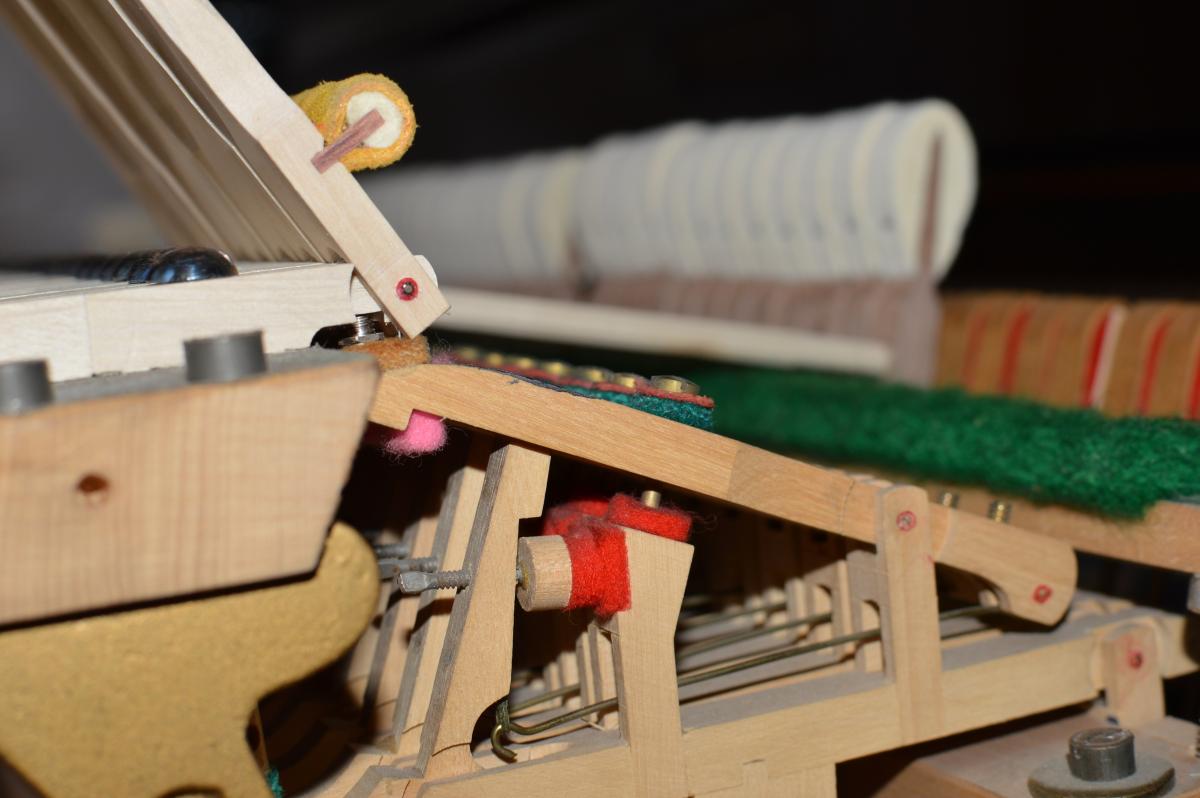
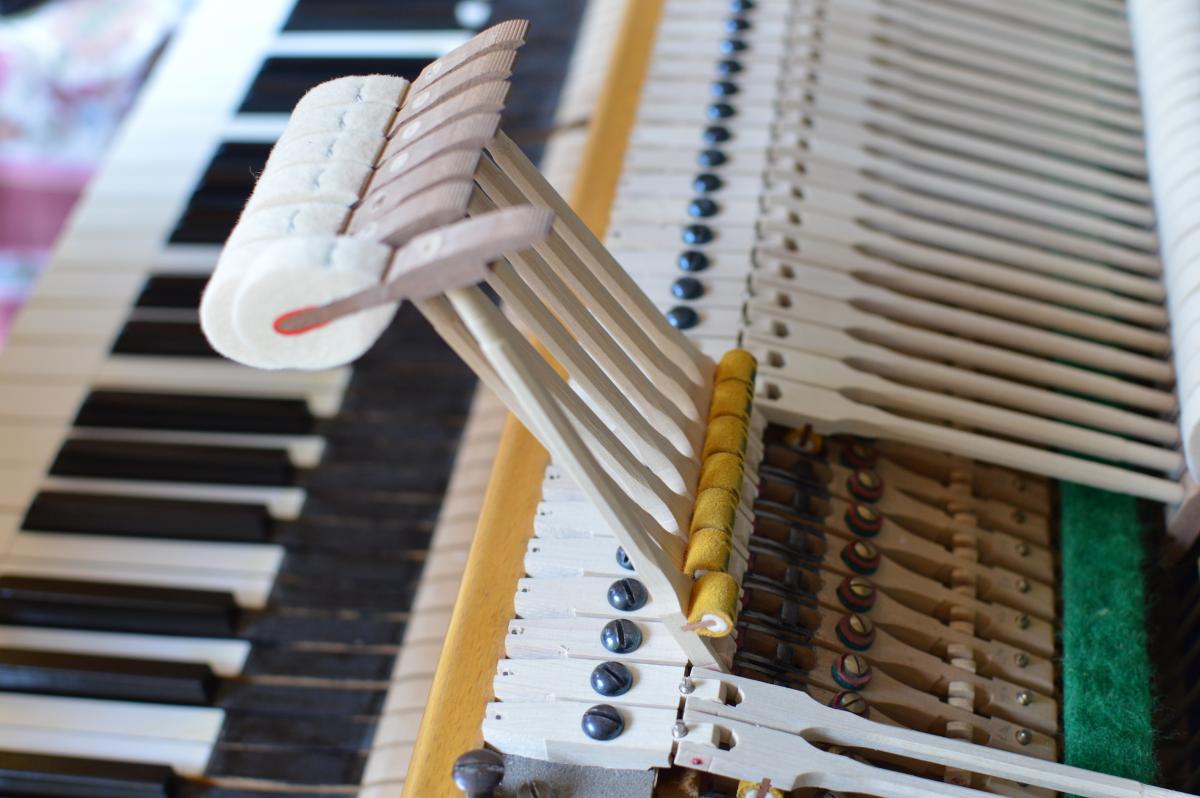
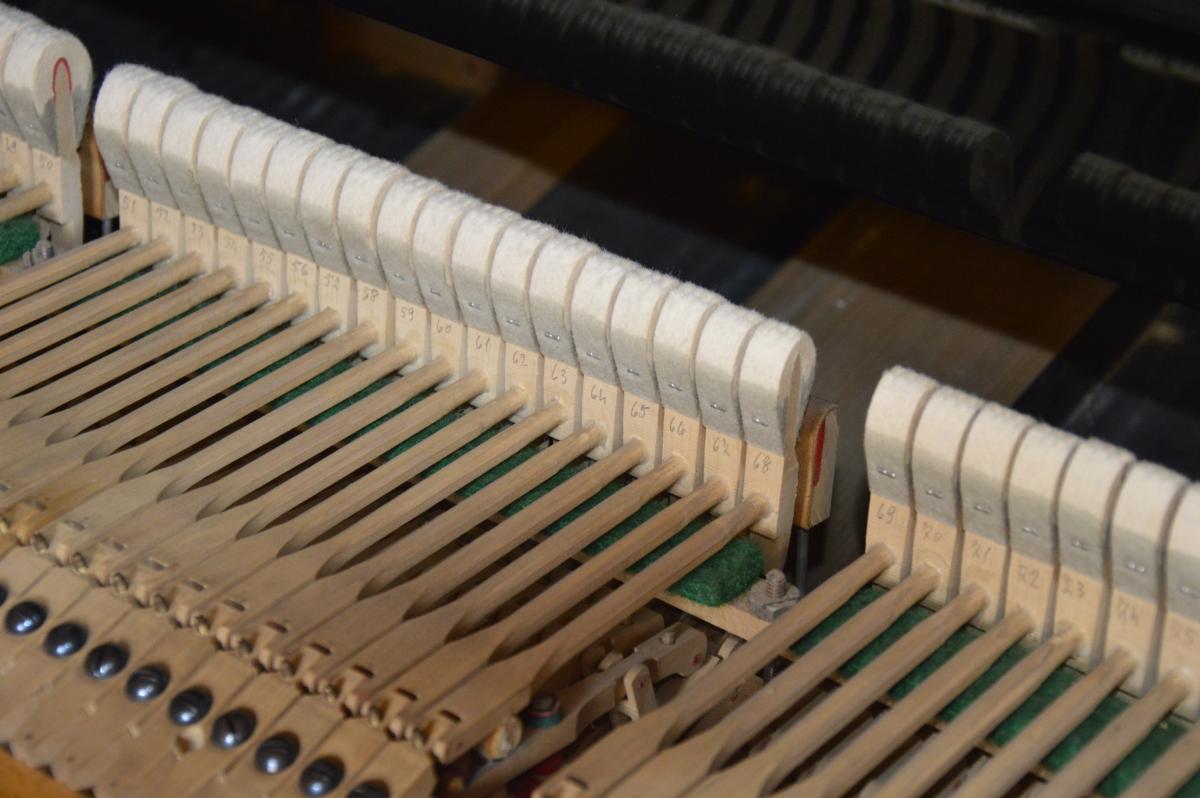
I am attaching photos of the action frame (which seems to be a Schwander type), the repetitions (Renner) with new hammers (Abel) and the old ones (I don't know if they are original).

After the intervention, the piano has improved greatly, especially in terms of sound; the mechanism of the treble satisfies me quite well, but that of the bass leaves much to be desired.

I often hear people in the forum talking about 'good technicians', but who are they in the Bologna area? Is it possible to get names and surnames, perhaps via private message?

For me, it would be a dream to be able to benefit from a checkup by Maestro Ferrarelli, but unfortunately, the distance is truly great.

The piano (Petrof from 1939) is located in a ground-floor garage; I absolutely could not use it in the house.

I thank everyone for their interest and for the precious indications.

AttachmentAttachmentAttachment

Member

Reply 36 by Davehammerklavier

Posts
149

It doesn't satisfy you on the lows because there has been a transition from notoriously "powerful" Renner hammers (weight, density, impregnation... everything is different) to light, low-compression hammers that (to put it simply) do not have the capacity to impart the force necessary to move the low strings of your piano to an acceptable degree. This also explains the poor mechanical behavior.

In my opinion (it's just my personal view), if before proceeding with a full replacement, they had thought about shaving and adjusting the original hammers (even just to hear how it behaved), perhaps you wouldn't have been disappointed.

Member

Reply 38 by Davehammerklavier

Posts
149

While the original hammers were perfectly sound and might at most require replacement of the hammer felt and usual maintenance interventions, with significant cost savings, is the Renner brand present on the new hammers on the left, at the base of the shank?

Member

Reply 39 by mike

Posts
41
City
Bologna
Davehammerklavier wrote:

While the original action parts were perfectly fine and might have only required, at most, the replacement of the repetitions and standard maintenance interventions, resulting in significant cost savings, is the Renner brand present on the new actions on the left, at the base of the jack?

No, the Renner brand is not present on the jacks!

In fact, I also suspected (afterwards) that a complete replacement was not necessary, but rather a good regulation; unfortunately, ignorance (mine) comes at a price!

In any case, I have kept all the original jacks complete with repetition and hammer.

Member

Reply 40 by Fra

Posts
266

Of course they don't have the Renner brand, they come from the same shelf as the hammers, they are "Renner type"

Log in to participate