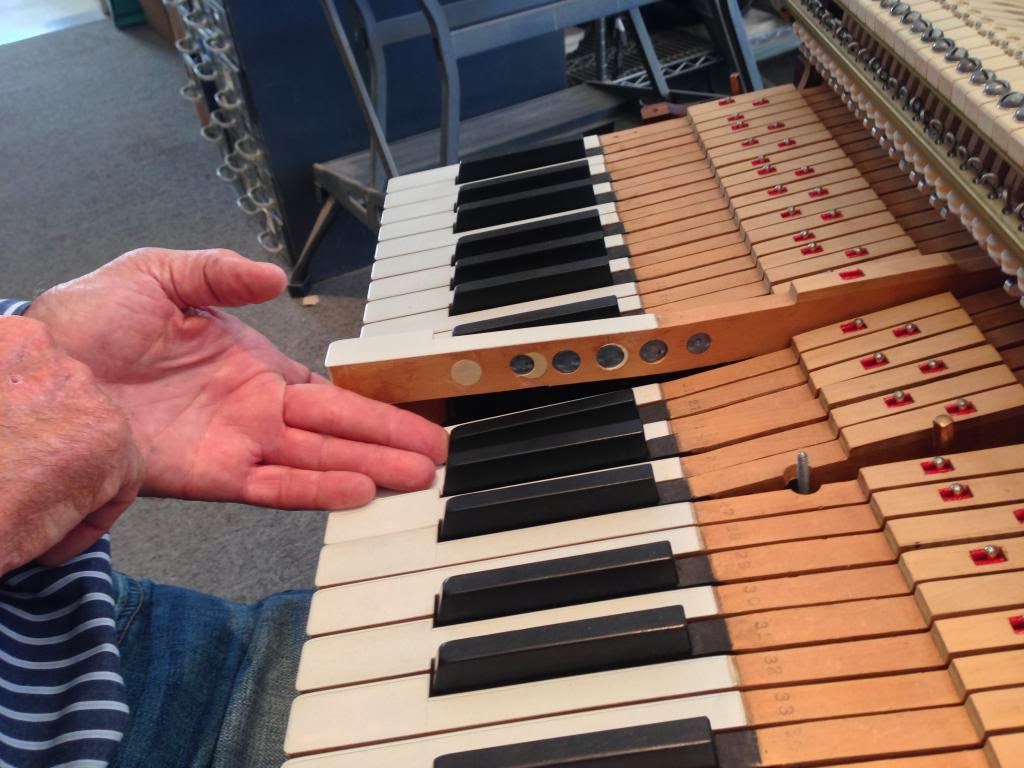
the question is:
if I want to obtain a descent weight of 50g and a return weight of 24g, how (where) should the weights be positioned?
Started by
Member
Member
the question is:
if I want to obtain a descent weight of 50g and a return weight of 24g, how (where) should the weights be positioned?

Member
Good question..
We must wait for pianoexpert...
Many pianists weigh their keys differently but....why this interest in weighing?
Member
curiosity, "personal culture".
Probably, I would like to weigh down my piano. I don't know!

Member
And here I am, always wanting to lighten it....But beyond that, I can't ahahah
Member
No no ...I was just saying... I know that in effect every pianist has their own requirement regarding weight.
For example, many love heavy keyboards.
When I tried the Steinway, I was seriously left... it felt like I had to press down some immense weight...
Surely in terms of speed it becomes worse, but one must also take into consideration the fact that in cantabile phrasing and at the bottom of the keybed (a fondotasto) it sounds incredible.. precisely the fact of having a certain resistance gives the idea of being on the string.. and this for a pianist...
Furthermore... I wouldn't want to be boastful, but from what I seemed to notice, light keyboards also have a slower return and therefore, for example, in repeated notes.. one should have more problems.
It would be nice to hear Paolo's opinion.
@antares. ...keyboards getting lighter and lighter? In effect... maximum performance with minimum effort.. what do you say?
Member
It's not that....Having become accustomed to the harpsichord and the fortepiano, which are decidedly light and have a decidedly short key travel...On the piano, it always feels like I'm struggling three times as much for nothing ahahah and then the type of staccato that I need is more difficult for me
Member
Yes, this is logical; in fact, in detached and fast performances (for example Giga etc.), I often use the "una corda" pedal, even though in an upright piano it is a pedal that only brings the hammers closer to the strings, reducing their stroke and therefore attack speed (due to the shorter distance to travel) and lower volume due to the lesser distance (less momentum) of the hammers, with a consequent reduction of force/weight discharge on the plate.
Are the keyboards of harpsichords and clavichords much lighter? And the fortepiano?
Member
Definitely... And the levers are shorter.. the Grimaldi sounds as soon as you touch it... And it has a travel of 4-5 mm at the moment
Member
Are you joking? Only 4/5 mm?
Member
6 when there is a lot of travel... Anyway, the width of the keys is usually similar or slightly less, but they are definitely shorter so you have to play on the edge and you have little space; either you center the key well or you play something else haha
No really, let's say that on average it is between 2-6 mm, maybe 7 if the bar has been placed higher or the harpsichordist wants a bit more travel, but no more than 7... Never seen more than 7 in any case. The keyboard is very light compared to a piano if well set up, but it must be played on the edge; you cannot play on the inside or between the chromatics.
I'll give you the example of the clavichord I am making: the pin bar is 2 and a half centimeters from the bottom and the strings are about 5 and a half centimeters from the bottom, 6 maximum towards the treble

Moderator
I believe I have already posted a response to this topic... anyway... The weights must be positioned as far from the key pivot as possible. However, too much weighting could alter the inertia too much and make the action too slow, especially in the key return. The weight of the hammers must be considered and must be duplicated when they need to be replaced.
To make a long story short, the manufacturer has calculated and experimented with what the normal masses of the action should be, and any alteration could upset these balances. Furthermore, the friction of the pins, as I have already maintained in numerous discussions, significantly affects the downweight and upweight, as do other sliding frictions.
It is not a matter of "light" or "heavy" keyboards, but of more or less dynamic keyboards. The proportion between key length, action weight, and weighting creates this dynamics. In some major brands like Steinway, optimal values have been reached that make the keyboard "easy." Key length affects the weighting, for example, so that a grand piano will be much more performant than a baby grand. However, the proportion between downweight and upweight will be equally respected.
In short: start by measuring the friction and checking the hammer weight (this is why I always say to keep the old hammers, because in case a replacement error was made, you can trace back to the original weight) and then add weights. If the friction and weights are uniform, the weighting will also be uniformly decreasing from the bass to the treble.
Member
Thanks Paolo, as I can see I didn't have a very clear idea about the weighting. In fact, I thought that with a greater weight, the return of the key to its seat would also be faster. From what I am reading, it seems I was wrong.
If you could shed some light on this point, thanks in advance.
Member
Generally in a grand piano, the weights are in a favorable position for the attack and an unfavorable one for the release (at the front), while in an upright piano (with some models being exceptions), they are in an unfavorable position for the descent and a favorable one for the release (at the back of the key).
Perhaps this was not clear. The greater the amount of lead, the greater the inertia of the key, which in a grand piano results in a slowing down of the return, and in an upright piano, a greater resistance to the descent.
The correct proportion between descent weight and return weight can be achieved with different weighting: it is important that the added lead results in an amount that makes the keyboard controllable, as well as sufficiently fast. In fact, there is a link between inertia and controllability.
For this reason, it is important to start with a hammer of mass adequate to the type of piano, which therefore does not require excessive lead counterbalancing. Implicitly, when we have these discussions, we are referring to the grand piano as it is more sensitive to this issue. The synthesis of everything and the correct advice to avoid entering an endless cycle is to respect the weight and shape characteristics of the original hammer rail as much as possible, in order to avoid significant modifications to the factory regulation.
Member
Thanks Giovanni. Do you happen to have images as well to better understand the weight positioning on the levers? If not, I'll take a look in the dedicated section.
Member
https://www.google.it/search?q=piano+key+balancing&espv=2&biw=819&bih=234&source=lnms&tbm=isch&sa=X&ved=0ahUKEwit-azhnJLSAhXDwxQKHRQbCdwQ_AUIBigB#imgrc=f908-le2BtoTSM:
http://www.sailhome.org/Solutions/SayWhat/Piano_files/keyleads1875Stnwy2.jpg
https://www.google.it/search?q=lead+weights+piano+upright&espv=2&biw=819&bih=367&source=lnms&tbm=isch&sa=X&ved=0ahUKEwiJs-GQnZLSAhURkRQKHWwFAtgQ_AUIBygC#tbm=isch&q=lead+weights+piano+upright+key&imgrc=iThhJoq7-0KY5M:
https://www.google.it/search?q=lead+weights+piano+upright&espv=2&biw=819&bih=367&source=lnms&tbm=isch&sa=X&ved=0ahUKEwiJs-GQnZLSAhURkRQKHWwFAtgQ_AUIBygC#tbm=isch&q=lead+weights+piano+upright+key&imgdii=VNpZMZgc-9tvLM:&imgrc=iThhJoq7-0KY5M:
the web is full of images, of well-done jobs and poorly-done jobs......things that are seen in everyday life....
http://www.timhendy.co.uk/img/pianoworkshop/workshop-action-title284.jpg
in the upright they are at the back.
Member
Thank you for the completeness. I noticed that the weights in the key levers are numerous and placed at a certain distance, enough to make one think that it is set up this way to distribute their weight in a homogeneous dispersion along the lever, avoiding, for example, placing the weights only at the ends. Furthermore, in some drill holes, I saw repairs with metal or wood putty... is that possible? Doesn't this series of patches somehow create confusion in the equal and precise distribution of weight? Patches due to the need to "recreate" a well-centered seat, since it is no longer possible to use the old one for inserting the weight due to corrosion or abrasion of the existing hole itself?
When you have time, I would be very interested [in hearing from you].
Member
The repairs are probably due to the fact that some larger holes were closed to be replaced with a lead weight of a smaller diameter. But this is post-production work, certainly not factory work.... by rule, they can be closed with wood and re-drilled; putty should be avoided.
The concepts of spatiality and symmetry, or anything related to visual characteristics, have nothing to do with the balancing work and do not fall under any rule; the spacing being at least equal to the radius of the lead weight is due to the fact that the wood cannot be weakened too much by drill holes that are too close together. Obviously, you also cannot place weights too close to the slots of the front pins.
Weights near the fulcrum subtract little from the striking weight, affecting it by a gram or slightly more, but they serve to find the right weight ratio and the correct inertia.
Member
Perfectly understood; we are talking about weights and their relative distance from the fulcrum (naturally, the further the weight is from the fulcrum, the more incisive and important its inertial prowess will be). As for the putty... I don't like it, wood is much better.
Thanks again.
Member
No, perhaps I didn't explain myself correctly.
The further the lead is from the main fulcrum, the greater the weight force applied to the key by the lead will be, which will become driving force during the descent added to the force exerted by the pianist and will be a resistant force during the ascent of the key.
Inertia, on the other hand, depends on mass; the distance of the lead from the fulcrum has nothing to do with it, but rather the fact that the lead is present or not.
Member
Sorry, I meant that but I was talking about inertia and I got things mixed up.