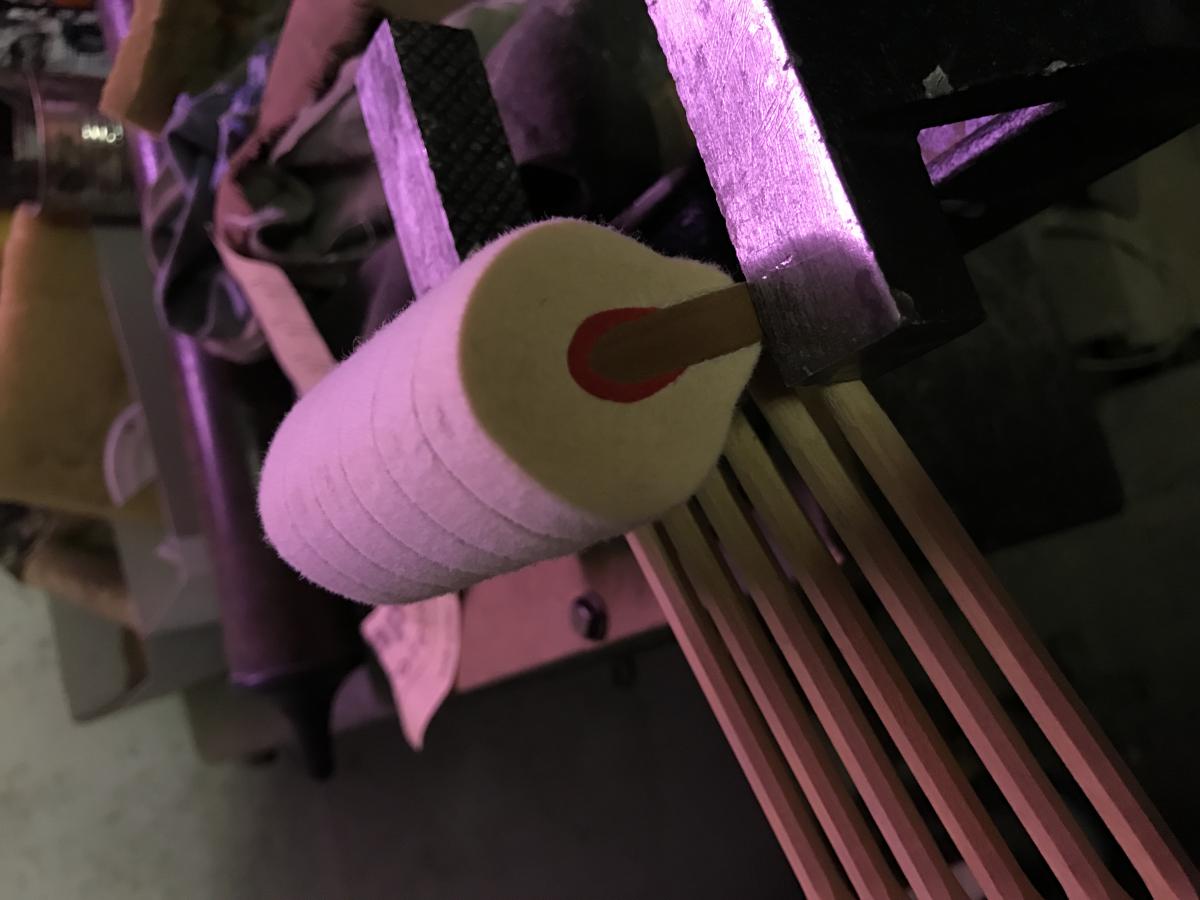
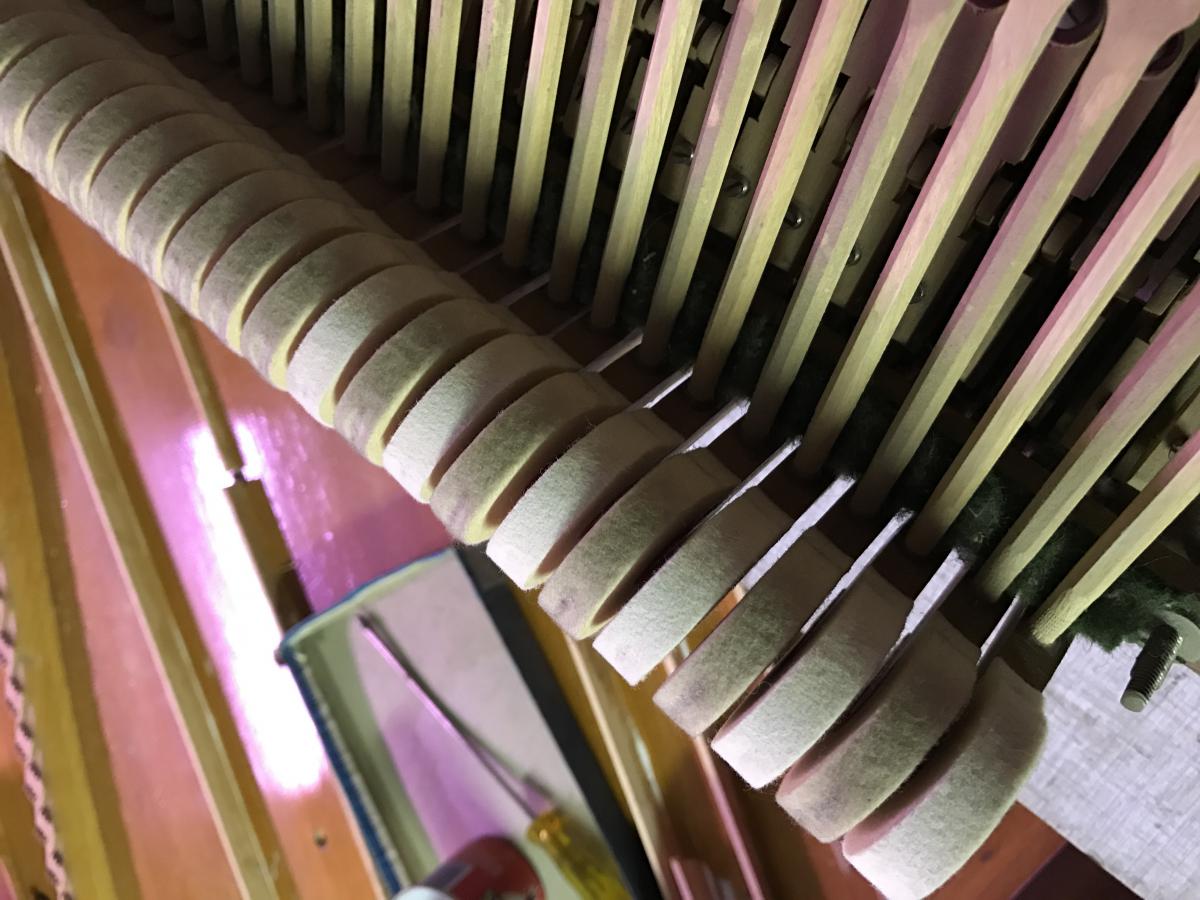
Hello everyone, I was recently wondering whether it is always necessary to rebalance the downweight and let-off (rebound) of the key in a grand piano following hammer shaving, or if this intervention is only necessary in the case of very substantial shaving. Furthermore, I was wondering if this intervention could increase the keyboard inertia, consequently decreasing smoothness. I am speaking about the grand piano because I believe it is not necessary in an upright, considering that the hammer movement is not directly mediated by gravity, and in this way, the weight the hammers lose when they are shaved is more negligible and reflects less on the overall keyboard movement.
No, the amount of felt removed by shaving does not produce appreciable effects on the keyboard.
One must remove a lot of felt to feel a lightening. At that point, it is better to replace the hammer felt (martelliera). An amount equal to half a gram of removed felt corresponds to the removal of a slice of felt half a millimeter thick from the hammer head. We are talking about hammer felts with medium density.
A 9-gram hammer, a high-density bass number 1 from a grand piano, is composed of approximately 3.5 grams of wood (we are talking about the lightest walnut cores) and the rest is felt and underfelt. What can we remove with a shaving that should only correct the flattening of the felt? Warning: never completely remove the string indentations with shaving; besides losing too much felt, the piano will no longer sound as it did before.
When the hammer is unrecoverable, it is better to replace it. Constant maintenance and good preparation of the hammer itself extend its life.
I agree with you. I am against "substantial" shaving. The geometry of the action is altered, or one has to alter the hammer-string distance by about two or three mm. This affects the key dip... and so on. Furthermore, that flattening you are talking about leads to hitting the treble strings on a segment of the hammer that is too wide, which can generate harmonic inaccuracies. A substantial shaving, moreover, modifies the striking point, which must be precisely rediscovered.
Thank you both for the precious insights; indeed, I hadn't thought of all the implications that shaving entails. However, I am doubtful about one point. It is true that the geometry of the instrument is altered because, given the same hammer-to-string distance, the shaved hammer rail is actually a few mm closer, precisely because it has less felt. This increases the aftertouch distance dictated by the manufacturer and everything that entails. I agree. But what about the striking point of the hammers on the strings? Intuitively, I would think that once the hammer-to-string distance of the shaved action is re-established, the striking point of the hammers would be the same as before the shaving, since the length of the arc described by the hammer will be the same.
As for the discussion regarding weighting, I had read here on the forum that one gram on the hammer affects the key downward weight by about 6 grams; this is why I thought a re-weighting intervention would be necessary..
But a shaving certainly doesn't remove a gram from the hammer... otherwise it's not a shaving but cannibalization.
If you have to remove 2 mm of felt, it is better to change the hammer rail; the adjustment measurements compensate each other, but on the highs, if not proceeded correctly, there can be a minimal variation in the striking point because the hammer rises towards the strings not in vertical motion, but along a circumference where the center is the pivot of the capstan, simple.
Giovanni, you beat me to it. I like the "cannibalization".....right term. You found an excellent explanation of the shift in the strike point! Naturally, in the upright piano, the shift occurs in the opposite direction (upright - shaved hammer strikes further from the hitch pin; grand - shaved hammer strikes closer to the hitch pin)
The term cannibalization made me smile, but it is perfectly accurate in my opinion. What I cannot really understand is what constitutes a situation where a shaving wouldn't hurt and, on the other hand, what a limit situation is, in which it is preferable to change the hammer rail.
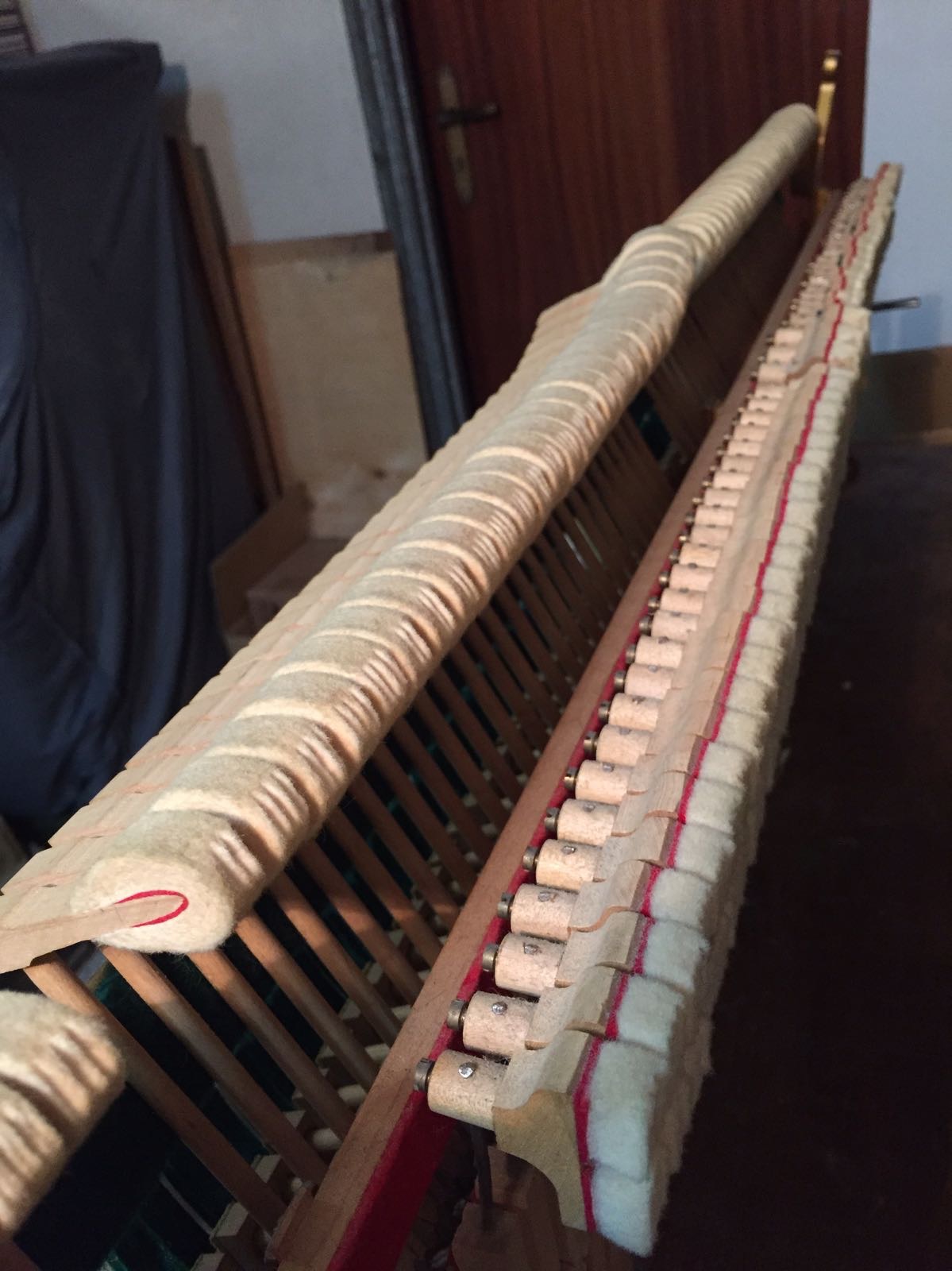
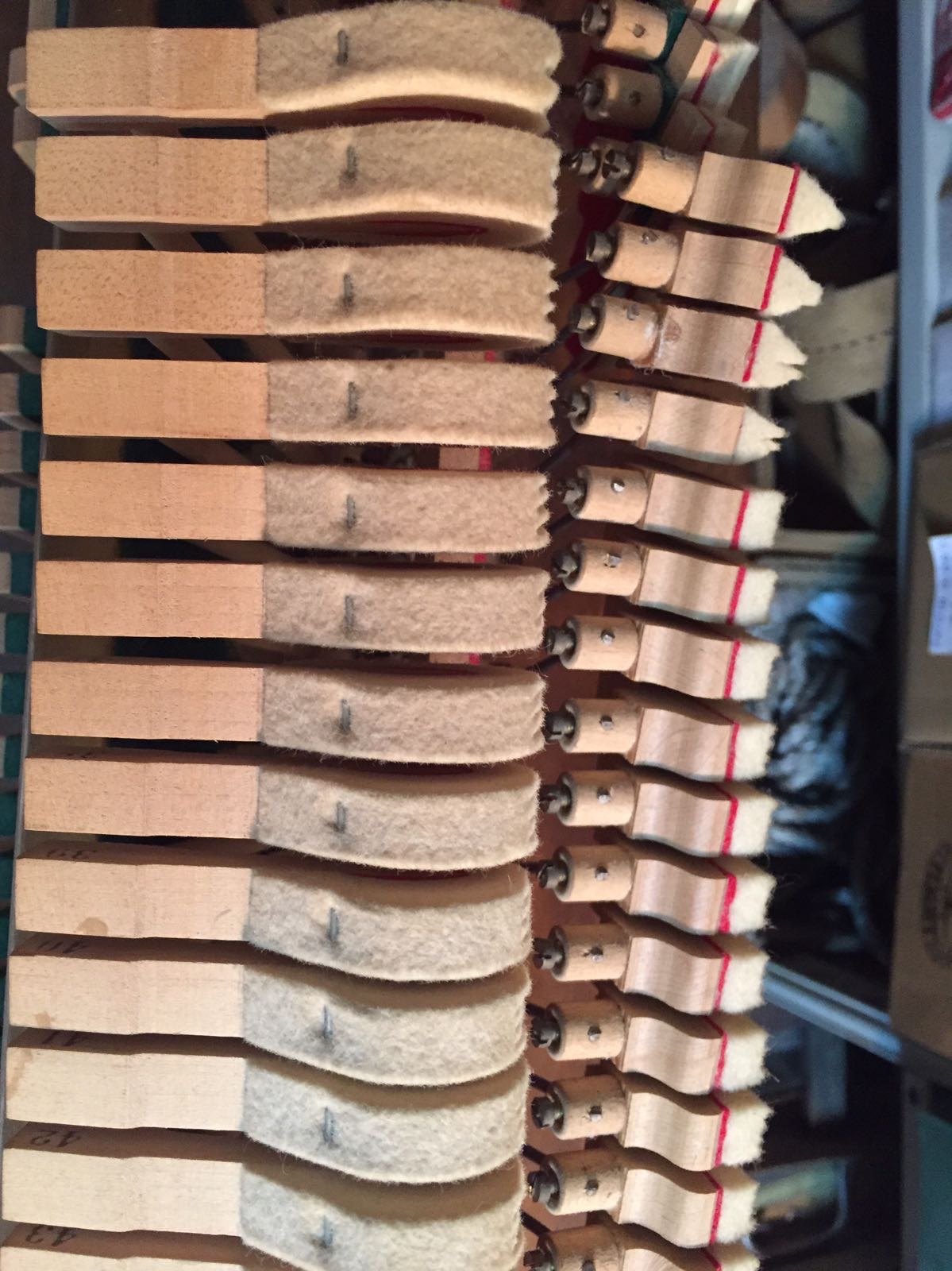
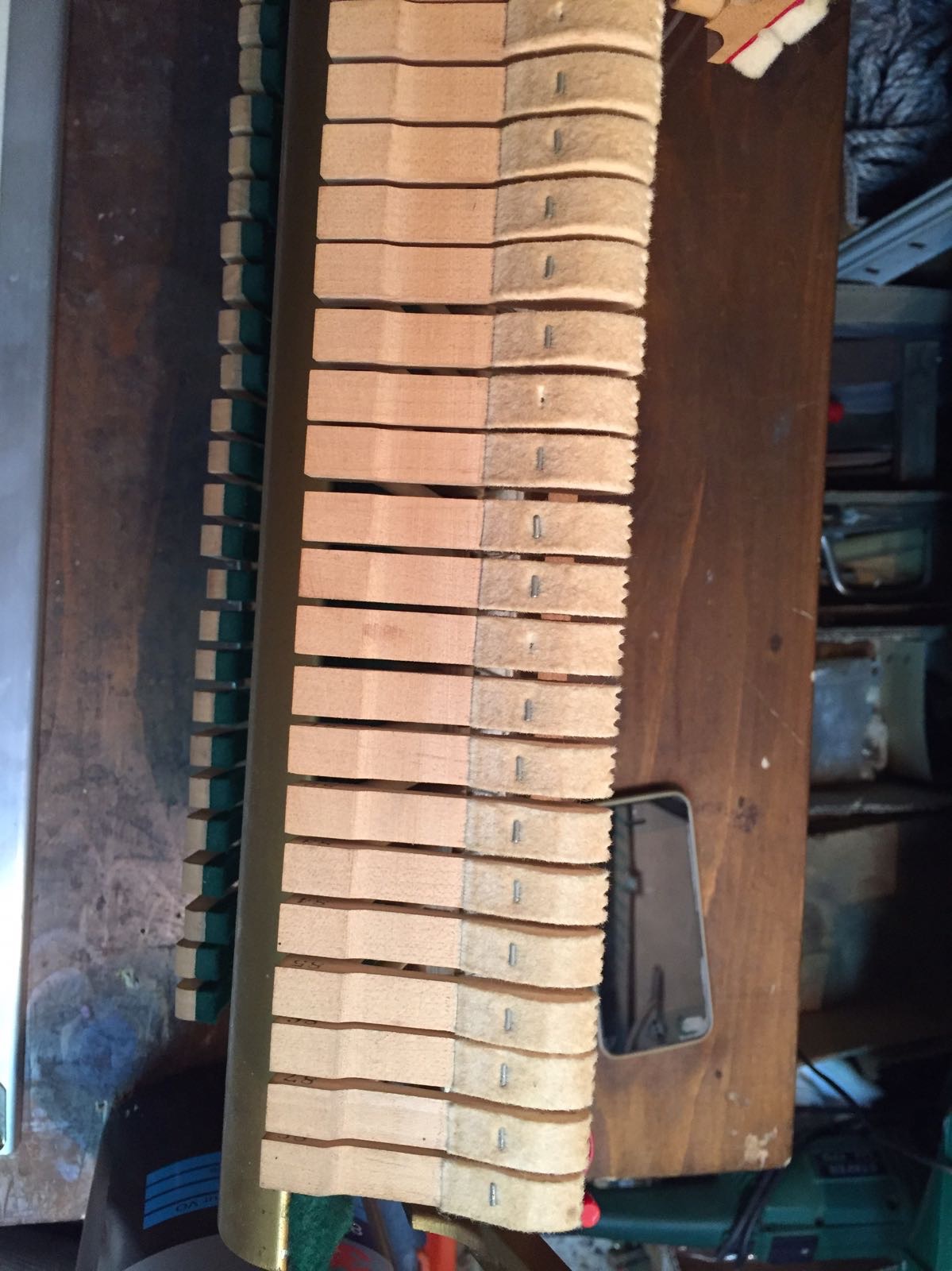
I am attaching photos of the action of an upright piano, in the hope of hearing your opinions.
The hammers are at their limit; for an upright, if one doesn't want to spend money, one can also attempt shaving them, trying to compensate for the change in stroke with the hammer shape... although the mechanics of an upright piano can undergo height adjustments by acting on the support rests which are generally screw-based, but it is an operation for the brave...
Giovannig, in the end I decided to shave... I will reimpose the hammer-string distance by applying felt under the hammer rest (adjusting the wippens accordingly, etc.) and I will raise the action via the screws, just enough to find the old striking point again (which I have marked).
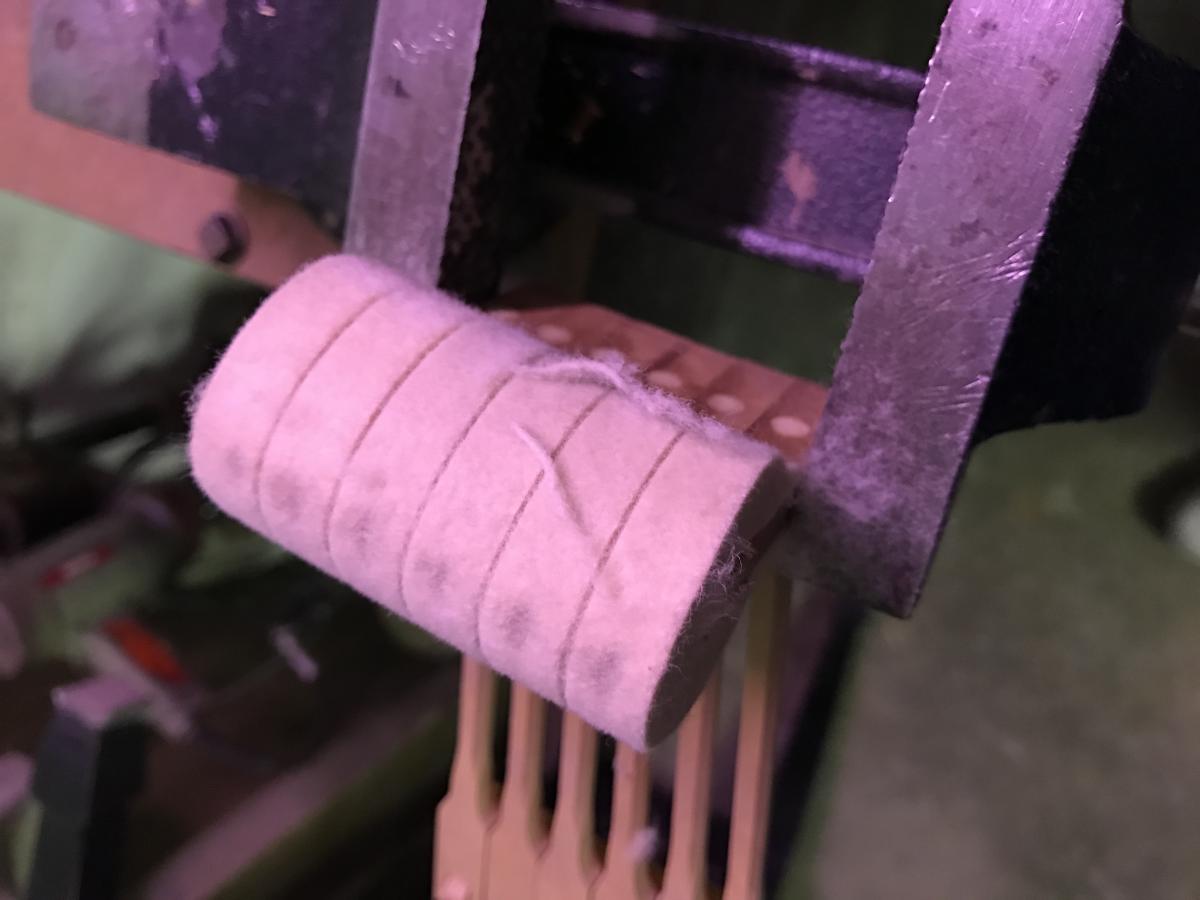
As for your modus operandi regarding shaving, I find it very valid... especially the trick of not completely eliminating the grooves is effective. In this regard, however, I have a doubt that only takes shape in one particular case...
In the event that the fork ends of the capstans need to be reoriented (because they have changed position due to wear) or simply because one wants to use a slightly different portion of the hammer.... wouldn't it be better in this case to eliminate the grooves entirely?
So as not to end up with 5 or 6 grooves on the hammer and likely create some sonic asymmetry...
They must not then strike the same spot; obviously, it makes sense if the hammer throughout its life has always been correctly centered under the strings.
Furthermore, do not confuse the "groove" which is what you see in your photos, with the impression...
If you make the hammer completely smooth, besides losing more felt, it will be necessary to repeat the voicing procedure from scratch.
And anyway, on the grand piano, it is intended that the hammer can strike in different positions to create different effects, now even on some uprights... it is called the una corda pedal, so I don't think one should be too scandalized if a hammer strikes at a slightly different point than before following an adjustment, provided that the timbre is properly checked.