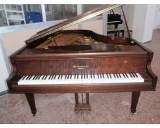
Wandering around the web, I found a used Knabe grand piano, dating from around 1934. I read that its timbre is compared to a Steinway! 😆
I would like some more information, for example on the quality of the action, the hammerhead, and the manufacturing in general of this brand. If any of you has tried it or heard it played, etc.
One detail that also caught my attention is the presence of three pedals. How is that possible in a piano from that period???
Its serial number is 110***, I contacted the seller who told me that its length is about 1.63 m, it has never been repaired/restored, it has all its original components and has always been tuned, and the cabinet is in excellent condition. The price is 4000.00 Euros.
I am almost intending to go see and hear it, partly to gain experience since I have tried very few pianos in my life, partly for the charm that these instruments of a certain age arouse in me, and finally because I would like (with no small sacrifice) to bring it home! 😉🙂
The Knabe is an American piano from Baltimore. The factory was founded in 1837 within the Aeolian American Company. The serial number falls around late 1933-1934.
Keep in mind that these instruments arrive, to be restored, by ship after a long journey. They are restored, but one must see the condition of the soundboard and the action......and how the work was carried out. Do not be deceived by "good appearance"
I doubt that, at that price, the action could have been replaced or made efficient. Many times I have seen such pianos with a "sandblasted" action! Under the sandblaster, everything dirty becomes new, but the sand kills the mechanism!!!!!!. And the condition of the strings? They too can be sandblasted. A nice polish......In short, I don't want to be pessimistic. You must start with the sound. Play a chord and wait for the sound to decay. It must last. Furthermore, check that there are no cracks in the soundboard. Ensure the tuning stability and the quality of the strings. The bass strings, generally, are only cleaned and reassembled...but if their sound is dull.......Take a small piece of wood or something else about 7 centimeters long and place it sideways on various areas of the bridges. The piece must rock, meaning the strings must have a good vibration angle. Take a look at the action and see if it seems very old....perhaps cleaned, specifically with sand. If so, factor in replacing it. However, if the strings and the sound are good, you can consider installing a new action. In the end, you won't have spent much, but you will have an efficient piano. Check each key to ensure it doesn't have too much lateral play and that it descends without impediment; if so...then you also need to check the state of the Kasimir bushings....but no harm done. In short, give it a good inspection!!!!!!!! Try to determine if it holds tuning well....and that the hammers have not been shaved too much or with too rounded a shape.
I tried to contact the seller again but nothing ... maybe they sold it.
It would be interesting to understand what to check when about to purchase a used piano, a sort of guide with all the tricks so as not to be cheated!
The checks you advised me to do are truly interesting and useful, even if I didn't quite understand how to position the piece of wood on the bridge and make it tilt.
Another thing: I believe it is possible to check the soundboard, whether it is damaged or not, but I cannot identify the system to evaluate its tension, which I believe is very important.
Thanks again to everyone, especially Maestro Ferrarelli 😆
I will try to make a small tutorial on the subject. Thanks for the suggestion. I hope to be able to provide a checklist of controls that everyone can perform. It is, however, appropriate to call one's own trusted Technician... I say... trusted... if one has to purchase a piano of considerable value. There are some checks, as I will explain, that must be performed and evaluated with experience.
Thank you for the interest!! It will surely be appreciated by everyone:
You see... it's fine with me to call a trusted technician (if I lived in Rome I would surely call You 😆) but the fact is that not everyone has the possibility of finding one they can trust blindly. I am always of the opinion "learn the art and set it aside" then the help of an expert technician is always needed, undoubtedly.
I am truly looking forward to another one of your magnificent tutorials.
Go away!! There are good people in Italy!!!! We have good Technicians!!!! Anyway, agreed, the purpose of this Forum is to provide pianists with the tools to understand their own instrument. Even professionals in the field will thus be warned that they are facing demanding musicians who are also a bit more prepared regarding the technology of the instrument. The step towards the "clothing" of a Technician is welcome!!!!! It takes time and dedication. If only all pianists were a bit more Technicians!!!! I say it and I truly mean it! Dialogue with one's own technician would be more exhaustive and some requests could be more understandable to both parties. Even the disappearance of a few "Bluffs" would be beneficial.
As soon as my partner and administrator Thesimon has passed his piano diploma exam (next Wednesday the 5th), we will resume with the Tutorials.
Go!! There are good people in Italy!!!! We have good Technicians!!!! Anyway, agreed, the purpose of this Forum is to provide pianists with the tools to understand their own instrument. Even professionals in the field will thus be warned that they are facing demanding musicians who are also a bit more prepared regarding the technology of the instrument. The step towards the "clothing" of a Technician is welcome!!!!! It takes time and dedication. If only all pianists were a bit more Technicians!!!! I say it and I truly mean it! Dialogue with one's own technician would be more exhaustive and some requests could be more understandable to both parties. Even the disappearance of a few "Bluffs" would be beneficial.
As soon as my partner and administrator Thesimon has passed his piano diploma exam (next Wednesday the 5th), we will restart with the Tutorials.
Thank you for the esteem and compliments.
Of course there are good technicians... of course. But how can pianists or students evaluate them if they don't have a minimum level of knowledge? Let's return to what was wisely said in the post: "If only all pianists were a bit more Technicians".
Thank you again and a big GOOD LUCK to Thesimon for the exam!!!! 😆