

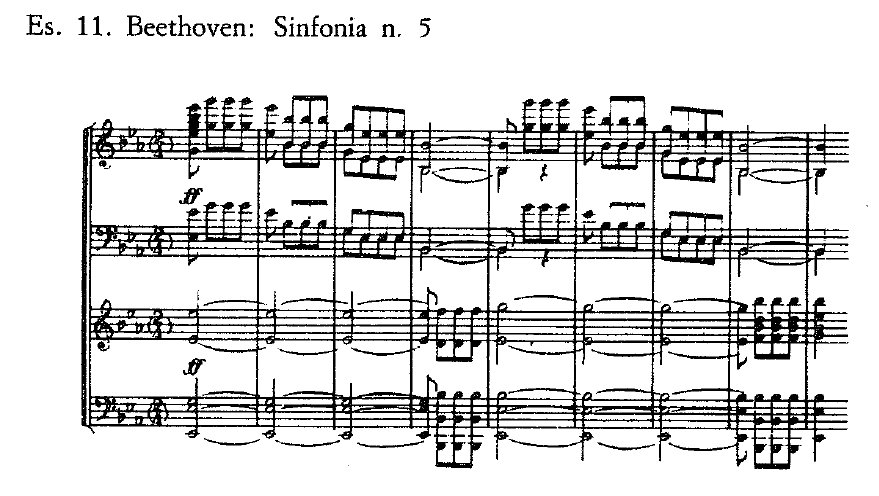
here we are again with Beethoven's 5th, so:
double woodwinds
2 horns
2 trumpets
timpani
strings
es 11 beethoven audio.mp3

Started by
Member
Member
here we are again with Beethoven's 5th, so:
double woodwinds
2 horns
2 trumpets
timpani
strings
Member
...I thought you wanted to rip me off this time
Member
I made the long bridge
Member
here is mine, how are you guys doing?
Member
As expected, I should arrive on Wednesday
Member
AleGozzo wrote:here is mine, how are you all doing?
As you asked me and, naturally, pretending not to know how LVB did it, I will tell you what I think exclusively from an instrumental point of view, namely: resource management
1) Timpani: if you use them, why don't you have them play the entire thematic cell sib sib sib mib the two times they play that isolated e-flat?
2) Flutes: those two interventions sound in the orchestra (because they are in the high register) completely isolated from the rest: I would have them do the entire descent, like at
3) Clarinets: why don't they also play sol sol sol mib?
Dilemma: either you completely break up the three fragments (sol sol sol mib | sib sib sib sol | mib mib mib sib) or there must be more homogeneity, in my opinion...
Member
Well done Carlos, I am glad you did not decline the invitation to intervene :)
i had to say that this method sometimes causes difficulties because one has to navigate between how someone would do it seeing only the reduction, and then listening to a real performance.
x e.g. the timpani seemed like a crime not to include them, but in the mp3 they cannot be heard (and I thought that at least the Eb was there even though it doesn't come out in the audio);
of the 2 hypotheses you propose, I would have certainly opted to break it up, but you can hear that it does not reflect the mp3.
now that you point out the flute issue ... eh yes, they are truly exaggerated
hope to see you next time
Member
AleGozzo wrote:Well done Carlos, I am glad you did not decline the invitation to intervene :)
I am also pleased that Carlos hangs around these parts, but so are those interested in the subject who perhaps do not start "transcribing the record" (hihi).
I hope to post my version this evening
Member
AleGozzo wrote:I must say that this method is sometimes difficult because one has to struggle between how one would do it seeing only the reduction, and then listening to a real
performance.
I fear I am not clear on the method followed. Are you telling me that you listen to the original version and have to reproduce it?
AleGozzo wrote:x e.g. the timpani seemed like a crime not to include them, but in the mp3 they cannot be heard (and I thought that at least the Eb was there even though it doesn't come out in the audio);
At that point Beethoven simply did not include them and, strictly speaking, one had to intuit why because the timpani are tuned in C and that conclusion is in E-flat major but, in my opinion, thinking from a more modern perspective, one can foresee the use of pedal timpani, therefore contemplating the modulation even in that case. Of course, if the "rule" is to reproduce what seems to be heard in the mp3 (which I evidently hadn't understood...) then the timpani are simply not wanted.
AleGozzo wrote:hope next time
With pleasure!
Member
My
Member
Eagle wrote:Mine
Are you absolutely sure you want to do without clarinets, bassoons, and horns?
And to use flutes and oboes in unison? Even visually, in my opinion, you should notice that something isn't quite right...
PS: regardless of everything, assuming your orchestration is good, by moving the oboe from the middle octave to the high octave (and there being no one else remaining in that octave), the result is the "decapitation" of an octave and it is very noticeable, because only that high one remains
Member
Carlos wrote:I fear I do not have a clear understanding of the method followed. Are you telling me that you listen to the original version and must reproduce it?
Leibowitz does not specify doing it this way; I accepted a suggestion from Frank who has already studied this method and finds that, without an audio reference, everything can become too abstract, so to speak ...
A useful approach for me even like this, but certainly making one's own version before listening to the mp3 would be more complete.
if Eagle agrees, tomorrow I will post the new ex. and I will look for the audio around mid-next Sept., perhaps it is a system that works.
bye

Moderator
AleGozzo wrote:Leibowitz does not specify to do it this way; I accepted a suggestion from Frank who has already studied this method and finds that, without an audio reference, the whole thing can become too abstract, so to speak ...
Let's make some necessary clarifications; first of all, like all teaching methods, it is not immune to criticism—in fact, it must be subject to the same.
However, the book is titled: “Orchestral Thought”. In my opinion, this is not a coincidence and should be sought within the text. I understand that those who do not possess the text may find this difficult (I have it in PDF for anyone interested), but by its very design, it involves retracing the various types of orchestration in a historical sense in relation to the original instrumentations.
To know how the orchestra has evolved—many perhaps do not know that the book starts from the classical orchestra and goes all the way to the modern one, proposing significant examples from various authors.
The procedure to be used is inherent; it arises precisely from its setup ...
AleGozzo wrote:It is useful to me even like this, but surely making one's own version before listening to the mp3 would be more complete
Perhaps it would pursue another purpose, although legitimate—I want to play devil's advocate:
For me, a fragment of a symphony is insufficient to establish its musical sense in a broader context, and if one does not know the original piece....
Which instruments should be used? We were talking about the timpani and current possibilities. Fine, but if Beethoven had had modern instruments, would he have written those notes? The same notes that are framed within a specific aesthetic context.
Is orchestration not part of the creative act? Those notes are as they are because they take the orchestra into account—that specific orchestra.
Why start precisely with those transcriptions that also include doublings? (... that someone else chose?)
Etc.
Tudo to say that although that method is debatable, it has its own coherence; taking a part of it and doing something else is not guaranteed to lead very far.
Member
AleGozzo wrote:Leibowitz does not specify to do it this way; I accepted a suggestion from Frank who has already studied this method and finds that, without an audio reference, the whole thing can become too abstract, so to speak...
Well, let's say that having the framework and the orchestration available can instead be a good exercise in personally managing the resources put into play and then comparing and seeing how much one deviates and, above all, whether one's own version is credible. For example: your idea for the timpani is beautiful and I believe that if LVB had chromatic timpani, he would have included them at that point as well... so why limit oneself?
Member
Frank wrote:Let us make some necessary clarifications; for starters, like all teaching methods, it is not immune to criticism, and in fact must be subject to them.
However, the book is titled: "Orchestral Thought." In my opinion, this is no coincidence and should be sought within the text. I understand that those who do not possess the text may find this difficult (I have it in PDF for anyone interested), but as it is designed, it involves retracing the various types of orchestration in a historical sense in relation to the original ensembles.
Knowing how the orchestra has evolved—many perhaps do not know that the book starts from the classical orchestra and goes all the way to the modern one, proposing significant examples by various authors.
The procedure to be used is inherent; it arises precisely from its setup...
Objection, Your Honor! Pretentious! Knowing "the orchestral thought" of Beethoven, Mozart, Rimsky-Korsakov, etc., does not necessarily have to mean "I take a fragment of a piece (see above), listen to how they did it, and reproduce it": the way I see it, it should mean "I study their scores (perhaps not all, but many), assimilate their style and, when faced with a fragment, I try to orchestrate as they would have orchestrated. Then (eventually) I verify...". This exercise is much more productive and allows for an additional "step," namely: "I take a fragment (any!) and try to orchestrate it in several different ways: à la Beethoven, à la Brahms, à la Mahler...". Too much fun!
Moderator
Carlos wrote:I try to orchestrate as they would have orchestrated. Then (if necessary) I verify...
On this, I am in strong agreement and it is one of the objectives that a good composer or arranger should pursue … however, I omitted a detail in my previous description (and who knows how many others I have omitted, too much stuff )... the idea is also to train the ear, and for someone who knows little to nothing about orchestration, it is a very effective system... I believe there is no better way than listening.
Analyzing the score (I mean the full score and not various reductions) even if supported by audio only does part of the work … I say that "pulling down the notes (the texture) from the record" helps a lot.
Besides, the educational tasks to be done in terms of orchestration are manifold … one just needs to establish the objectives.
Carlos wrote:This exercise is much more productive and allows for an additional "step", namely: «I take a fragment (any!) and try to orchestrate it in several different ways: à la Beethoven, à la Brahms, à la Mahler...". Too much fun!
It’s fun, but if I have to change the original, I do it my way … I know that mine is more a composer's approach than a conductor's/arranger's … and then it would be anti-philological, I can already see Thallo sharpening their claws.
Anyway, in the '60s this was the organ practice (continued until a few decades ago); if you listen to recordings from that period, the pieces had a completely different flavor due to the recording choices (meaning the instrument's stops) and you found Bach in a million different styles. Today it wouldn't be acceptable, and precisely for this reason I consider it more effective in general (for composers and others alike) to also read with a historical perspective.
It serves the performer, it shapes the composer … what they have in common is precisely the ear.
Make no mistake, while I also love and especially value everything else, this methodology is fundamental, a starting point for those who are more or less at zero, for those who do not know what the history of orchestration has done, for those who find themselves facing mountains but have a significant and precious selection.
One should carry out at least 3 different types of seminars … I am interested from the start
Member
Frank wrote:It’s fun, but if I have to change the original, I do it my way …
But of course! The two things can coexist, but having to learn various styles... in the end, it is exactly like being faced with a fugue subject: even if the subject is by Bach, you don't listen to his fugue and try to reproduce it: you try to write it "as he would have done". Then, logically, if YOU have to write a fugue, you write it how you want... do you understand my point? So, I think, if the exercise is to train the ear, as you said, the goal must be to arrive at writing exactly what is on the score; if instead it is to learn the style of a composer, the result may even be different, but still "in style": however, you must institutionalize one of the two positions...
PS "you must", in the sense that I, as an external participant, wish to know how to orient my opinion. So far I have ignored the fact that there was a prior listening and I have limited myself to observing the management of the ensemble, but you tell me exactly what you are aiming for.
Moderator
Carlos wrote:... do you understand my point?
Yes, the only thing that perhaps seems limiting to me are precisely Leibowitz's "sketches" which essentially provide a "complete" drawing to be colored in... therefore already including doublings and thus the composer's choices in this regard.
In my opinion, an experiment costs nothing; let's do as Ale says and handle it in two phases next time.
Time 0: Ale proposes only the Leibowitz sketch
Time 1: the first free work is submitted without considering the audio; at this point Ale proposes the audio
Time 2: the second work, which takes the audio into account, is submitted; at this point Ale proposes the author's solution
I don't know about the deadlines; I have noticed that on average 2 weeks pass between one thing and the next, I would only participate at time 1
Member
yes let's do it this way
i will try to hurry with my personal version, so as to publish the audio as soon as possible, since you can download it whenever you want.
at that point in the personal version one is also free to interpret the sketches without respecting the doublings or the suggested families.
the matter is getting intriguing
Member
Everything is fine with me, I am finding it very useful to compare with the mp3 and I think I will participate in the reconstruction by ear