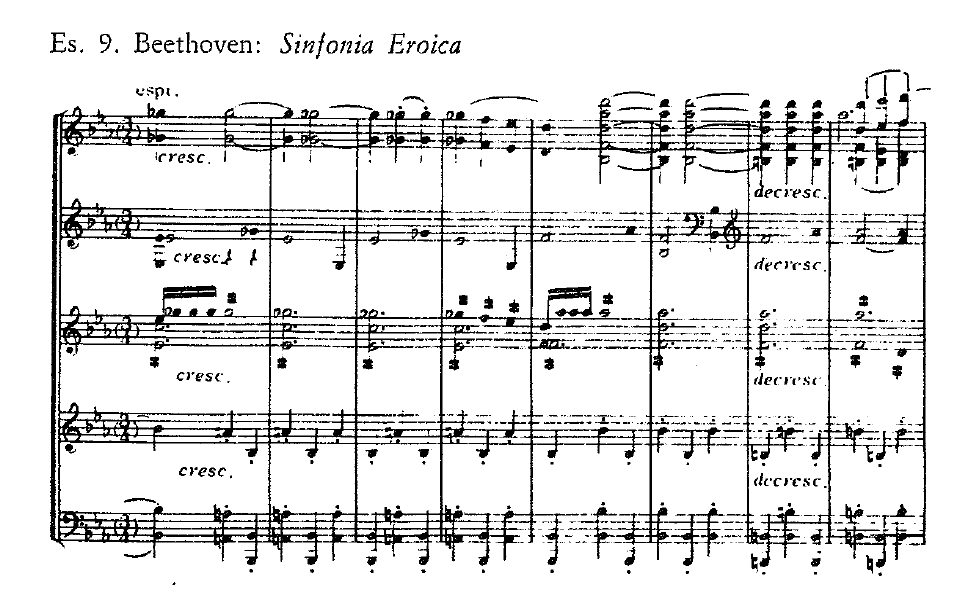
I propose that we work through the orchestration exercises from the Leibowitz method together:
ORCHESTRAL THOUGHT by Renè Leibowitz and Jan Maggire -
Edizioni musicali Salvati-Bari
(purchase is recommended for those who can find it....)
in reality, everyone does them on their own and then posts them to discuss the choices and doubts that arise together...
the method consists of re-orchestrating a fragment by an author, starting from a reduction written by Leibowitz, and then comparing it with the original.
let's begin with ex. no. 9; if anyone is interested in the previous ones, they can ask me for them.
The cadence of the exercises is one every 2 weeks, however flexible based on the needs of the participants.
you really have an eagle eye, you saw it immediately 😃
E
Eagle
Member
Reply 4 by Eagle
Posts
264
Well, come on... it's like shooting at the Red Cross.
As soon as there is a new topic, it appears at the top right 😉... I don't know if you noticed, compliments to the administrator for the usefulness of this technological find 😃
I love this book, I own it and I recommend it to everyone. It is, moreover, also fun and makes us understand how a Great composer arrived at "brilliant" solutions.
I love this book, I own it and I recommend it to everyone. It is, moreover, also fun and helps us understand how a Great composer arrived at "brilliant" solutions.
Since I am a fan of pedagogy and it seems to me that I have understood that you are a pianist and not a composer, in what form was it proposed to you or why did you decide to get it?
The fact of getting a hands-on feel for the findings of great musicians is even truer if we find ourselves doing the orchestration ourselves and then comparing it with the original solution 😉
E
Eagle
Member
Reply 7 by Eagle
Posts
264
Wait for me Ale, I'm a bit caught up with escapes and some proposals in "this is what I wrote"
take your time, in the meantime I'll put mine down.
I don't want to intervene on how close or far you went from Ludovico's solution, assuming it is of some interest, but, a question:
are you absolutely sure about the writing for the horns? I think that if you want to divide the part between the 1st and 3rd, you should put a common note and not let the 3rd play only that low E
dictate away that I missed the mark completely, and not just on the horns eheh
anyway thanks for the observation, I imagine it would be a problem for the fluidity of the line (difficulty interlocking with a legato effect) and maybe also in controlling the correct strength in the articulation (a single stroke that sounds a bit like a trombone/tuba). Am I right?
to me, in reality, the idea of closing the upbeat part on the 3 instead of on the downbeat of the following measure seemed strange, but evidently .....
ps
if you have time, don't let us miss some comments even on the next exercises, who better than a conductor ....
C
Carlos
Member
Reply 15 by Carlos
Posts
759
AleGozzo wrote:
hi Carlos, how's it going?
just say that I missed the mark completely, and not just in the horns eheh
Hi Ale, everything is fine.
Look, actually, the fact of seeing how close or not someone is to the original personally interests me very little (but I can understand that the exercise was aimed at "guessing" Beethoven's solution). In any case, it seemed to me that in general you "had it".
As for the horns, yes, that is exactly the reason. Beethoven even divides the two parts according to the measures, as you will have seen, but, following your idea, I would have the III do the octave jump, "hooking" the I on the high E-flat, for two quarter notes. The most likely effect that could result from the passage written as you orchestrated it (I'm only talking about the horns) is that a caesura would be heard (unless the I horn sustains its sound, and then "bye!") and anyway that low E-flat taken alone would likely not result in being phrased as it should (in dim.), so you would hear, most likely, Eb_ G Eb_ E! (with an added "crack")
AleGozzo wrote:
to me, actually, the idea of closing the upbeat part on 3 instead of on the downbeat of the next measure seemed strange, but evidently .....
No, why? The design is two measures, so a conclusion every two [measures] is coherent...