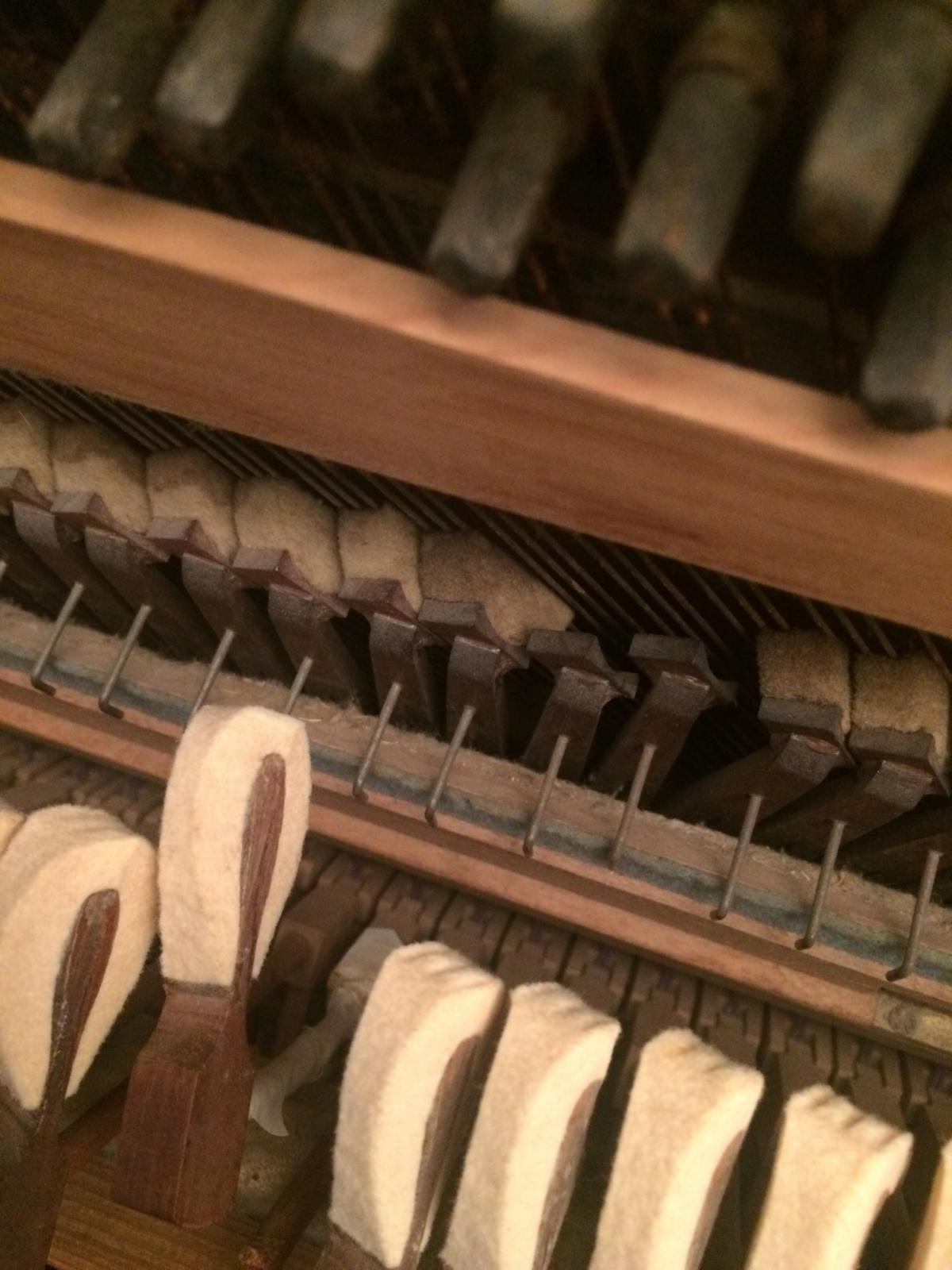
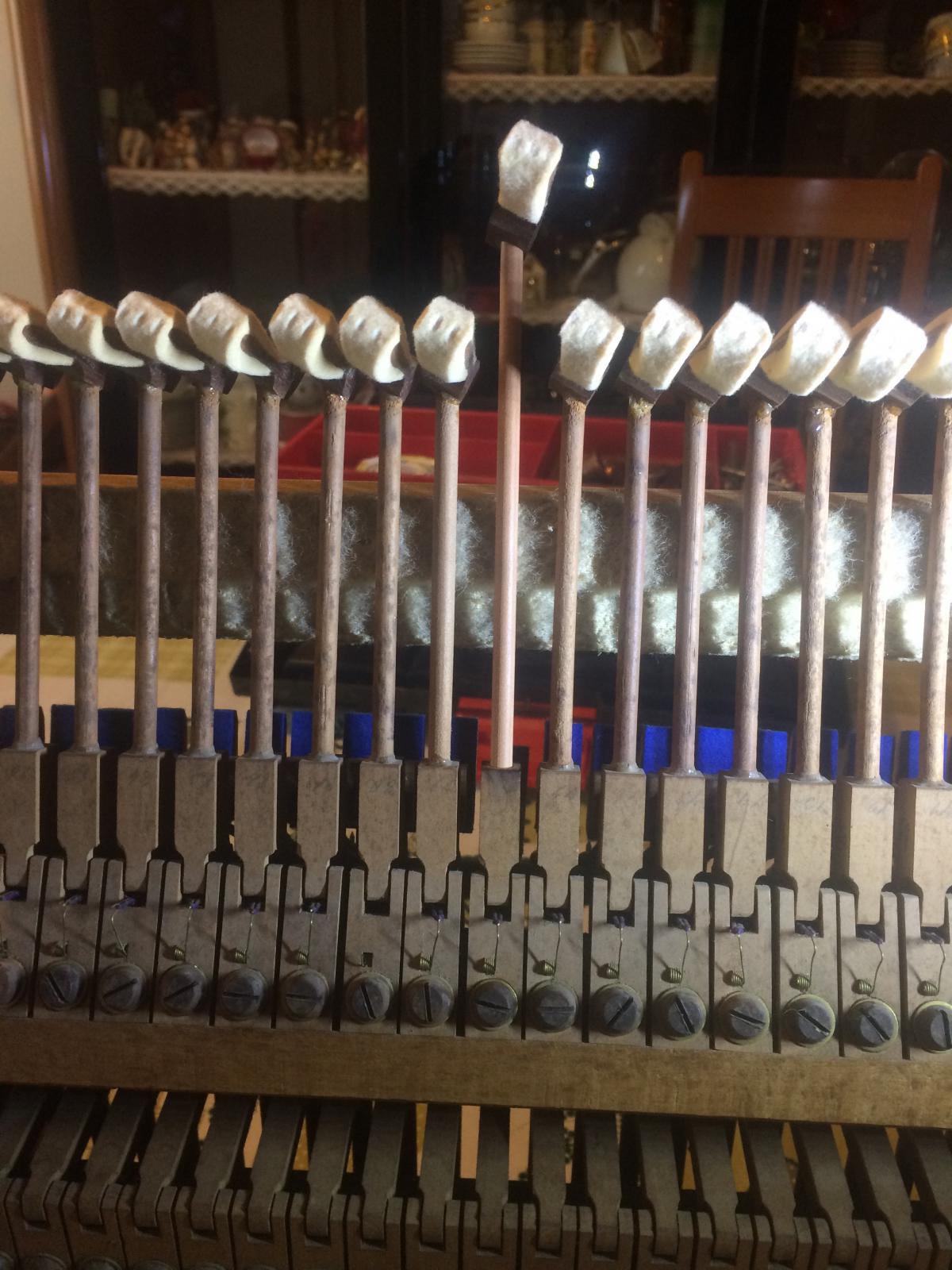
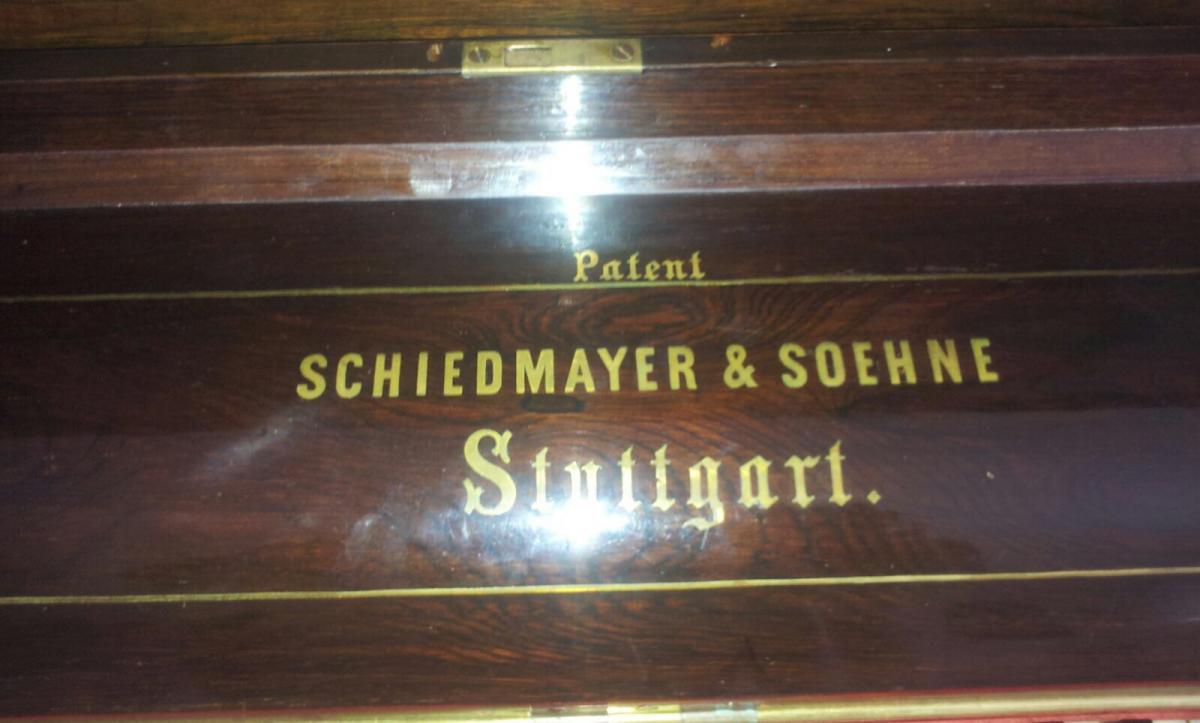
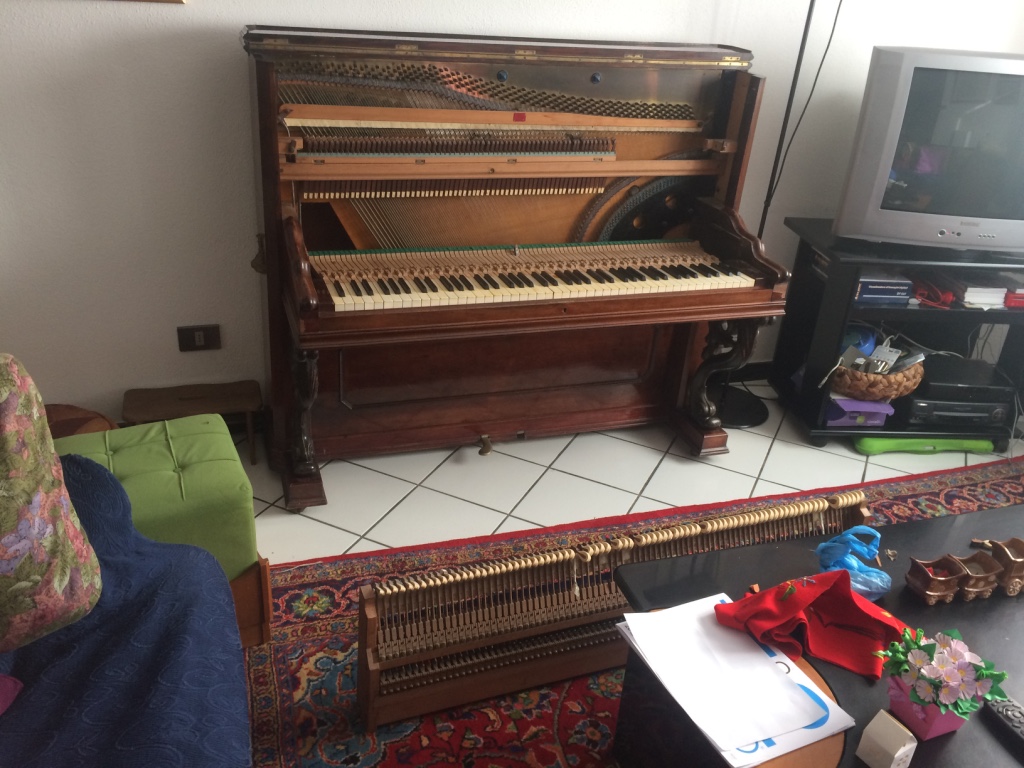
As introduced in the presentation, I find myself with the piano in question. Despite its venerable age, the old fellow is in excellent condition; it has a bayonet action with separate dampers only in the mid-low notes. It has several keys that do not sound or do so poorly; it is out of tune and has never been repaired because (almost 30 years ago) the cost of repair was requested to be more than its value. Since my daughter recently started playing the piano and since I am an enthusiast of woodworking and more, I decide to take a look at it (...because I did). From a first glance, without taking anything apart, I notice several broken wippens; I think to myself that it can be done. I reach an agreement with the owner (an aunt of mine) who proposes that I "try" to fix it using materials at her expense. In the following days, I start watching videos on how various pianos work, learning a bit of nomenclature and mechanisms and operation. One morning, armed with calipers, I return to the old fellow, take it apart, and clean off the dust to try to make a list of the essential things to replace. The sound is beautiful, full, and powerful despite having old and out-of-tune strings, much more beautiful than other pianos played or heard in music schools, churches, and other places where I have had the chance to press a few keys in this recent period. I disassemble the action, carefully observe any broken parts, and prepare a very short list; I look for the serial number, take several photos, and go home. I knew it was more recent than the 50s, but I didn't expect it could be 147 years old!!! This filled me with great trepidation and respect. I return, disassemble it again, and begin to reflect; in the end, to make it sound again, it is enough to replace the 7 broken wippens, replace some missing felts in the dampers, and replace the broken right pedal with a similar one. Despite flattened and grooved hammers, worn felts and skins, the play in the movements does not seem excessive; in fact, in these last 60 years, this piano has played very little, perhaps saved by its own neglect. Now, restoring it to new and disassembling it is a professional's job, but as long as it involves replacing a few broken wippens, I can manage too. I have bought the wippens; I have a good drill press that allows me to drill the broken wippens with good precision, but is it possible to remove the leather glue? From what I have read and seen, wippens are removed with specific extractors (when they are intact); is there a system to remove the glue? (Steam? Heat?)
Try warming it up first, if that's not enough use steam.. but direct it only onto the piece, back in the day I believe they still used the... It should unstick.
Anyway, wait for pianoexpert too, but I think he should agree with me (I am an apprentice organ builder)
Anyway, I have seen some copies of Schiedmayer clavichords from the late 1700s, very beautiful
Steam is perfectly fine. Caution: do not use a drill because the hammer hole is made with a slightly conical tip, unless the pins are cylindrical (sometimes they used them on instruments of that era, especially Schiedmayer)
Naturally, you must be in possession of new pins. Otherwise, you can try to repair the old ones by gluing them with a diagonal cut and reinforcing them, like a clamp, with sewing thread, which will be removed once the glue has set and hardened. Natural hot glue must be used, heated in a bain-marie without exceeding 60 degrees Celsius.
With that type of adhesives, I think it is the only method. I am waiting to listen to a recording.
The voices that certain antique pianos have are wonderful; on newer models, sometimes one doesn't find as much charm and beauty.
I took a look online and saw some models; truly beautiful. The company has been manufacturing since 1809 according to the information I am finding; if yours is 147 years old, it was produced around 1870 and therefore, not having an early 1800s action, it is already more interesting in terms of power/sound output.
An intervention by Paolo on this type of "archaic" actions would not be bad.
Shiedmeyer and sons, yes... But the first Shiedmeyer was born in 1711, the head of the family... So they started building in the 1700s but perhaps only two or three instruments from that era remain, among them a clavichord from around 1780 belonging to the son.
Some photos... in the second one the new pin replaced (in 5 mm walnut), it still needed to be shortened.
Thanks for the advice, the new pins have a cylindrical head so I drilled with a simple bit; to be sure of the precision, I started from a point marked with a nail, then a 2 mm hole and increasing to 3, 4, 4.5 mm and 5 mm diameter for the pins that go in with a bit of force. For now, I have only made the hammers. I have to drill the walnuts; so far I have only drilled one, now I will properly set the drill press and the vise to make them identical. Extraction is out of the question; even if I manage to remove the glue they don't move, I tried to grip them with an M5 bolt sawed in such a way that it could tighten well on the pin but they don't move, they just break.
Even if the piano were completely rebuilt, and even if it were "restructured," it could not offer much technically; it would be a waste of time and resources that could be employed on an instrument of equally zero value but technically more interesting and modern (i.e., from the late 1800s or early 1900s, with exposed action and cross-stringing). I certainly would not entrust such a piano to a young girl starting her studies; it would mean driving her away from the instrument for good.
If the goal is DIY, that's understandable... provided you are prepared to undertake radical work for which, in any case, much more extensive knowledge than mere carpentry is required. If the goal, however, is to obtain a musical instrument from this work, I would avoid proceeding further.
The piano would need to be completely remade, and even if "restructured," it could not offer much technically; it would be a waste of time and resources that could be spent on an instrument of equal zero value but technically more interesting and modern (i.e., from the late 1800s or early 1900s, with open action and cross-stringing). I certainly wouldn't entrust such a piano to a young girl starting her studies; it would mean driving her away from the instrument for good.
If the goal is DIY, that's understandable... provided you set your mind on doing radical work for which, anyway, much more extensive knowledge than mere carpentry is required.
I fully agree with you, I quote you completely; the goal for now is only to make it playable in its entirety (meaning all the keys); technically I know it offers little and a complete restoration is certainly not cost-effective, and I don't believe I have the skills. If my daughter continues to play seriously as she is doing (she has a Casio CDP-200R with which she practices even 3 hours a day, just because she likes it), I won't delay in purchasing a modern piano.
Not running shoes but... comfortable slippers. Every instrument, however, in my opinion, is like a living being and I have always felt sorry for the carcasses of pianos abandoned in warehouses; they seem like old singers without voices who will never be able to live again.
For a young girl's studies, without a doubt... it would not give her the right idea of touch nor an adequate sound quality.
As a true romantic... I would still want to hear it sing, though.
Fantastic!! Especially with the clear chromatics... to be able to see mine, you'll have to show me how you finish yours; I have never made an instrument; I need to see it finished. Now only the soundboard, keyboard, strings are missing and voilà.
Anyway, the diatonic keys in the second half of the 1700s were standard almost everywhere... The chromatic ones used bone or often even ivory; the Silbermann from 1775 uses ivory, for example, I wouldn't know about this one, I would have to take a trip to Boston, where it is preserved haha