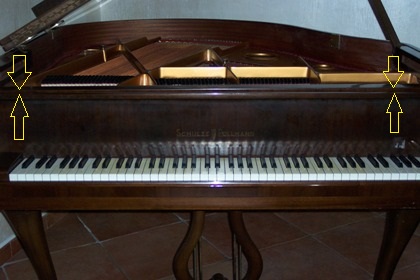
I noticed that my Schulze Pollmann 1/4 grand piano has a small problem!
Many of the treble keys (right side of the keyboard) make noise when they are released! I removed the fallboard and the defect does not manifest itself!
I checked with a level and noticed a slight (about 8 mm) unlevel position of the instrument. The left side is a bit lower.
the so-called "key thud" can depend on many things. Regulation, hammer rest felt too hard, springs too heavily loaded, repetition levers too low compared to escapement levers, hardness of the rollers ... etc.... it is not a matter of "leveling"
Excuse me Paolo, but it's not a mechanical noise! You can really hear a "Tac" when the key is released. It's actually right under the fallboard; if I remove or lift it, it can no longer be heard! Furthermore, putting my eyes at the level of the keys with the fallboard raised, you notice that its edge on the right is a few millimeters lower! I also thought about wear and tear of the hardware, but I have my doubts!
it could be that the key dip is too low and the key return makes noise. There must be one or two mm of play between the key dip and the keys. Maybe that's it?
I really think so! Before doing a bit of hand planing on the area concerned, I need to find a way to precisely mark the points where the keys touch the keybed! Naturally, I want to rule out any other possible problems... 90% it's this!
My intervention was done on the key because the key lever was perfectly parallel to the keyboard.
The "planing" seems excessive and irreversible to me.
In what way did you act on the key?
In the end, I think the key lever is just a piece of wood! Currently, I take it apart when I play so I don't hear the clicking sounds 🙄 :rolleyes: 🙄
I think a little touch-up even with a well-sharpened chisel could solve everything! If you didn't fix the key lever, it would always remain as it is because the point to be touched up is not visible! 😉 ;) 😮
Yes, the problem is identical; I replaced the felt that edges the wooden flange to increase friction with the through metal pin (I don't know what it's called).