

How do you approach the topic of memorization?
Thank you
Started by
Member
Member
How do you approach the topic of memorization?
Thank you
Member
In my personal experience, I memorize through numerous repetitions, also with the aid of variations, and very, very slow practice.
Even performing in "staccato" helps a lot, provided it is not abused as it is very tiring.
However, I am aware that other methods exist, perhaps even more effective, which besides developing memory help to maintain steady concentration. Perhaps someone else from the forum can give you advice even more useful than mine.
Bye
Member
http://www.libreriauniversitaria.it/si-suona-pianoforte-sandor-gyorgy/libro/9788817124737
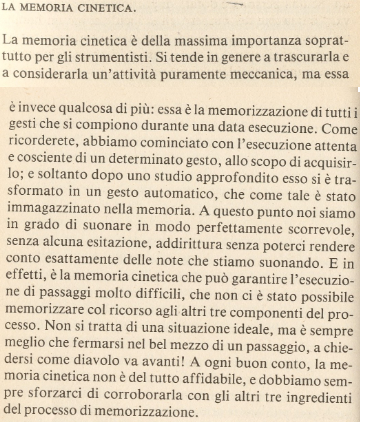
Sandor dedicates a nice chapter to memorization. It involves practicing 4 types of memory verses
Visual memory
Acoustic memory
Kinetic memory
Intellectual memory
without specific exercises, kinetic memory is commonly used, which is the most fallible...
Member
Interesting... kinetic...?
Member
Gianni22 wrote:Interesting... kinetic...?
Member
Very interesting
Precisely because I do not trust kinetic memory, I devote a lot of time to very slow and attentive study, so that when memory betrays me, I can exit "kinetic mode" and enter "visual-intellectual mode."
It is impossible to exclude kinetic memory entirely; it would be impossible during the performance of a piece, perhaps a particularly articulated one, to have everything perfectly under control. Too many components simultaneously contribute to a successful performance.
Member
ivanricciardi wrote:One cannot completely exclude kinetic memory;
In effect one cannot, but as you rightly do (and with good results from what I have heard), one cannot leave it alone
Member
ttw wrote:In fact, it cannot be done, but as you rightly do (and with good results from what I have heard), it cannot be left alone
Thank you
Moderator
I am sharing this text recently proposed by Prof. Laureto Rodoni. It speaks of conducting, but it can be useful
CONDUCTING FROM MEMORY
by Herbert von Karajan
This ability to take black dots on white paper and transform them into impressions and emotions within your intimacy, in your soul or in your heart or whatever it is, requires a lot of time. Then the orchestra performs them and something different emerges.
This is one of the reasons why I do not use the score when I conduct: the continuous shifting between seeing and hearing is impossible. After having learned a score by memory, in the end, I try to forget what I have seen. Because seeing and hearing are two very different things. I have particular antennas for continuity. When I am in the middle of an opera, I actually hear all the other parts in advance until the end. That is why I only conduct an opera when it has so deeply penetrated my system that I no longer need to think about it. The average individual does not think while singing the national anthem. It is automatic. One could say that my entire repertoire is a national anthem.
We can bring music to almost everyone and this is a great achievement. It is amazing how simple people react to music. Sometimes I go outside Salzburg, into the beautiful countryside where I encounter a farmer on a tractor. He knows me. I ask him: 'Do you listen to me?' And he replies 'Oh yes, when we hear that it's you, we sit there quietly listening'. It is something that strikes one, without a doubt. Even in the theater, for the most part, one witnesses a repetition of the unhappiness and uncertainty of which the human race suffers. The theater does not contribute to lifting man from these sufferings; it reiterates them. Dramas concern drunks and suicide. Whereas music, I only know two pieces that conclude in an entirely negative manner: Sibelius's Fourth and Mahler's Sixth, which ends with total destruction.
Herbert von Karajan