Technical problems and their resolution

Metallic sound/buzzing problem on some consecutive keys of the 5th octave of a grand piano

16 replies 7,631 views

Started by

theonlyfly

Member

Member

Opening post by theonlyfly

Posts
7
City
Verona

Hello everyone,

I am here to submit a technical problem that my tuner, while performing the first tuning intervention about a month ago on my Yamaha C3 (serial number approx. 4 million), was unable to resolve.

Simultaneously with the tuning, a small voicing intervention was performed on those keys, slightly reducing the annoyance.

As mentioned in the title of this topic, there are some keys that have a rather metallic and quite unpleasant sound compared to the others, which seem quite homogeneous.

To better convey the idea of this problem, which is difficult to describe in words, I am attaching a file that faithfully reports the annoying sound I mention.

While holding down the sustain pedal, the problem is much more pronounced.

The keys that clearly exhibit this start from Eb and go up to F#, although those nearby also exhibit it but to a lesser extent.

I thank in advance everyone who wishes to weigh in.
Reply 2 by Historical author

Hello,

I listened to the file.

In small domestic environments, it is quite frequent to encounter annoying sounds or chirps in the cantabile area as you indicated.

This can be caused by various factors, including poor adhesion of the strings to the bridge, the duplex scale, hammer voicing, string coplanarity, or hammer repetition lever pins.

Usually, it is more likely that the duplex scale (the metal strip placed between the bridge and the plate tip) is causing this issue.

It was invented to enhance the harmonics of the high notes but, I repeat, in domestic environments it can cause disjointed sounds.

To solve the problem, it is possible to place felt "cavalieri" (sliding felt strips) between the string segments of those registers that have this acoustic disturbance.

However, this solution has the disadvantage of removing exactly that timbral brilliance for which the duplex scale was invented.

Member

Reply 3 by theonlyfly

Posts
7
City
Verona

Hi James,

first of all, thanks for the reply.

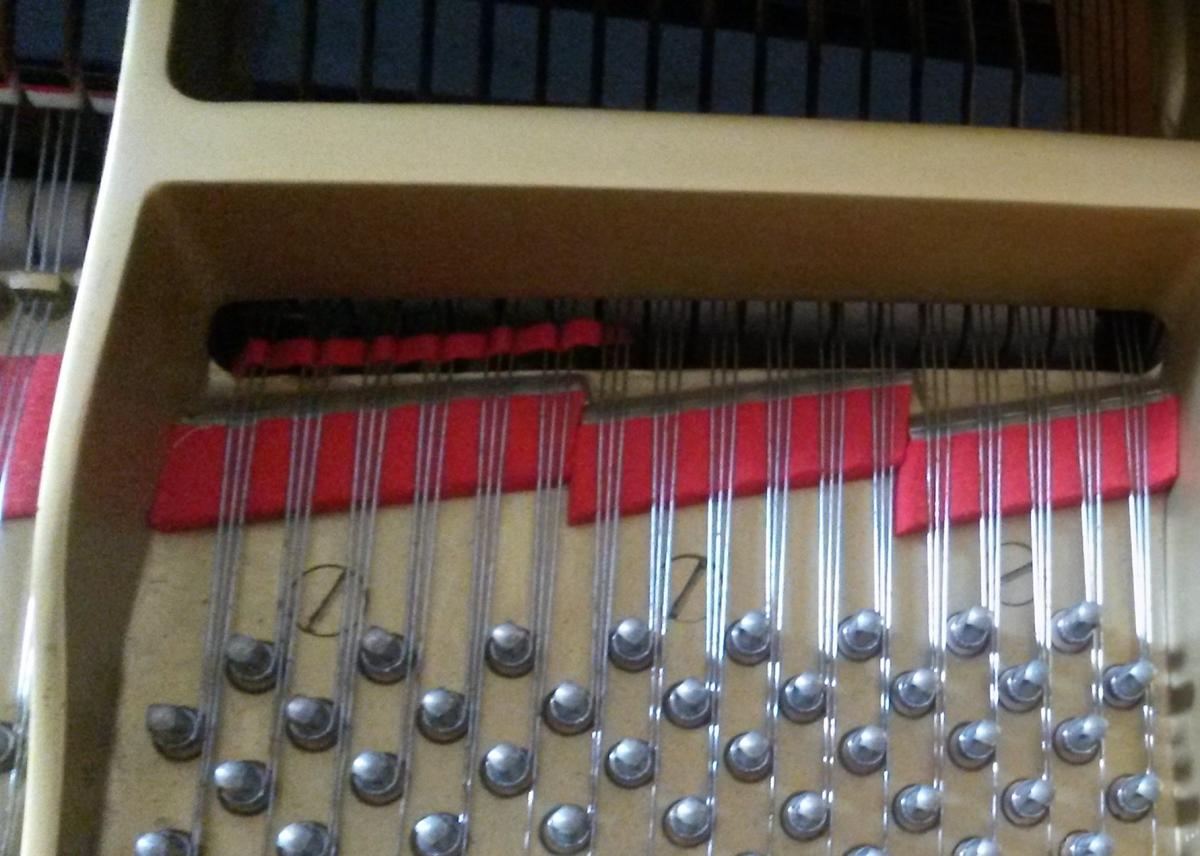
In fact, when I got the piano about a month ago, the felt strip you are talking about was already there. The tuner who did the tuning promptly removed it, saying that it shouldn't be there, and the problem clearly increased. He performed a small voicing intervention, improving the sound slightly, but then, when he left, I put the red felt strip back exactly in that spot.

Yesterday, when I recorded the sample, I removed it thinking that indeed it shouldn't be there and also to make the sound stand out better in the recording.

I have currently contacted another tuner who is much more meticulous and patient; he came by to take a look to evaluate what the problem is and has planned an intervention in a few weeks.

He performed a first small intervention on just one key since there wasn't enough time to carry out the full job, and he checked and adjusted the hammer rail (I don't know if I am expressing myself correctly here; basically, he checked if the strings were being struck linearly by the hammer and intervened with sandpaper/abrasive to level it and make the head flat), a voicing job on that hammer, and the sound improved for that note (E in this case).
So, are you suggesting that I should leave the felt strip anyway, otherwise that resonance of those harmonics remains?

Reply 4 by Historical author

For the moment I would say to leave the little felt knight on those choruses with a metallic sound.

Then your trusted technician will solve the problem.

Member

Reply 5 by RogerP

Posts
1
City
Cento

Good morning theonlyfly,

have you tried to "stop" the portion of the string that goes from the aglets to the bridge?

In 3 notes of my "C3" (serial number approx. 3300000) there was a metallic vibration, a sort of resonance, generated by the vibration of this portion of the string; I don't know if this is the case, but I wanted to share my small experience regarding it.

I eliminated the problem by inserting a strip of felt in the affected strings; I am unable to technically explain the reason for this phenomenon, probably related to a "sympathetic" vibration accentuated by the age / use of the instrument.

Greetings to the whole forum, Roger

Member

Reply 6 by theonlyfly

Posts
7
City
Verona

Hi Roger,

in effect, this is exactly the case: a bothersome resonance of some high harmonics which, compared to the other notes, were not at all homogeneous but deviated from the timbre.

The felt was actually already there, it's just that the sound anyway is not, in terms of timbre, aligned with the other notes; the felt reduces this sonority a little but does not completely correct it.

I am attaching an image, perhaps it makes it clearer what we are talking about.

Thanks for the reply.

Attachment

Reply 7 by Historical author

Make another test.

For every note, try to move the felt forward or backward and try to find the right and best point for each note.

Member

Reply 8 by theonlyfly

Posts
7
City
Verona

Hi James,

in effect, I had unintentionally moved the felt from its original position that you see in the photo, and I had noticed a difference in sound, also depending on how it is passed between the strings.

Could one consider replacing it with one of greater thickness to increase its effect?

Reply 9 by Historical author

The felt must be 2 mm thick.

However, I would focus more on finding the optimal position of the felt.

Moderator

Reply 10 by pianoexpert

Posts
3,876
City
rocca di papa

I'll give my two cents as well. I have read the right things and advice. I would start by evaluating the correct striking point of the hammers. Then observe if the hammers in that area are rather marked and/or with a slightly "worn" striking point. Have the hammers been shaved? It is right to check the string bed. It is better to intervene on the leveling of the strings than on the hammer. The hammers in that area must strike the strings at the correct point and must have a rather pointed shape (so-called diamond shape) and not rounded. Felt cap replacements are fine, but only as a last resort! Try to re-examine everything and observe. Keep in mind that a very grooved hammer head that is no longer compact at the striking point can cause the hammer to "drift," especially in forte and mezzoforte. If these were the reasons (perhaps the hammers have been voiced over time by poking the apex!!!), you can evaluate shaving them. I would prefer replacing the hammer heads. Be careful to find and, if necessary, recalculate the perfect striking point. It is extremely important. That's my belief.

Bye and let us know

Member

Reply 11 by theonlyfly

Posts
7
City
Verona

Hi Pianoexpert and thank you for your input first of all.

I am providing some more elements here based on the considerations you reported.

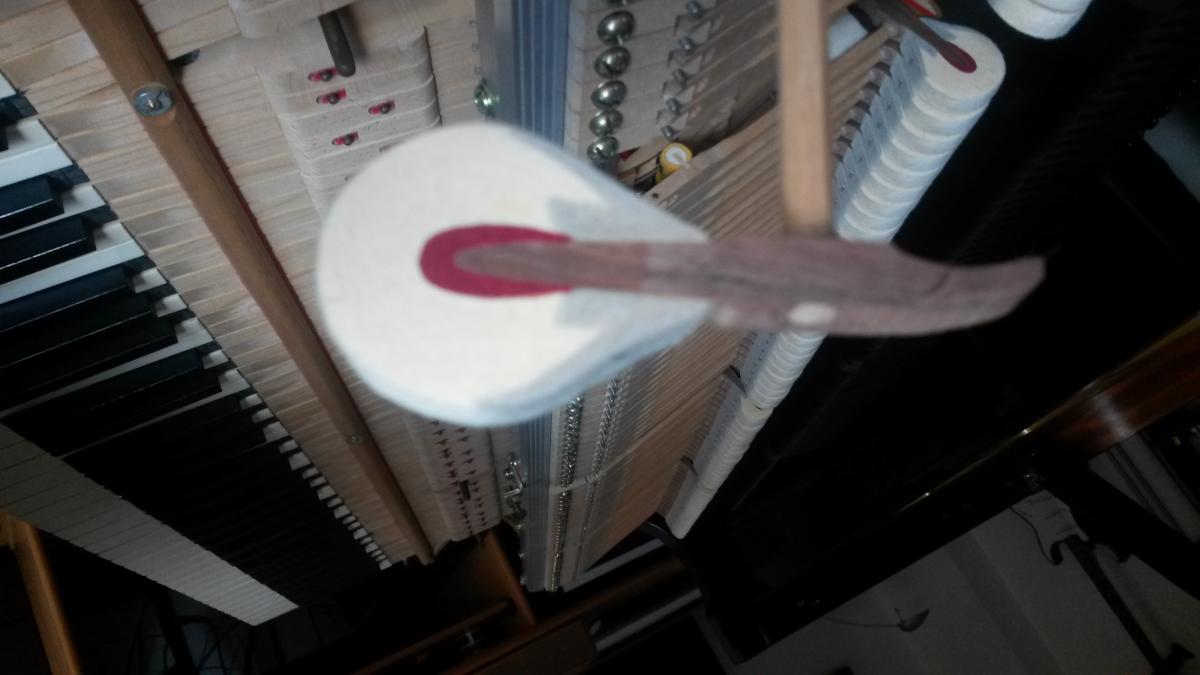
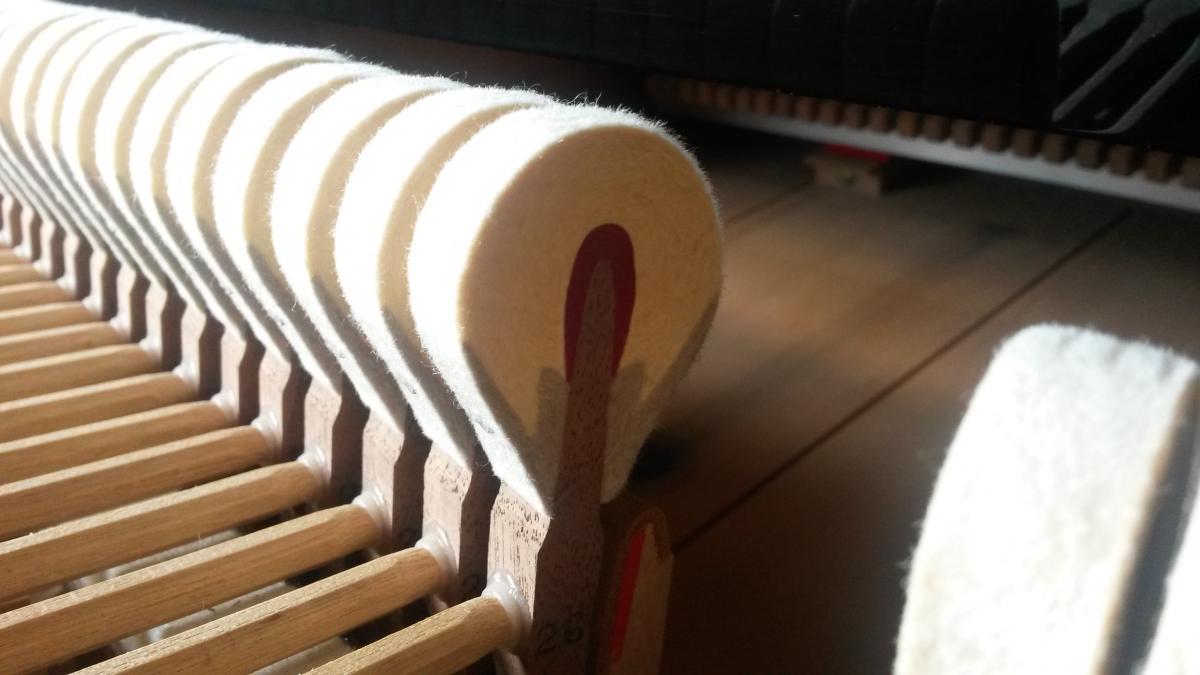
The hammer rail has been planed, and I have attached some photos where, in the even higher part compared to the one I am referring to for these notes, the planing intervention is quite evident.

The planing was done quite recently because the hammer heads appear rather homogeneous; they are not grooved at all; on the contrary, thanks to the planing, they almost look like new when viewed from above, with only a few mid-low notes showing a hint of a groove.

The shape of the hammers does not seem very pointed in this area to me; unfortunately, the photos I am attaching (taken a few days ago to ask Abel for a quote to evaluate the future replacement of the hammers) do not relate to those notes, since Abel asked me for the lows and the highs. Among other things, the cost of the complete hammer rail is around €500, to which the cost of the technician's labor to replace it will clearly be added (I don't think I am capable of doing it myself, and it will also obviously need voicing and escapements will need to be regulated, etc.). I am not planning an immediate replacement, but it was to understand what expense I will encounter in the coming years.

James, I tried moving the felt; something changes, the ideal position seems to be halfway through the string section, but the felt that was inserted is 1mm thick, not 2, and anyway threading it between the strings was not easy; I believe the 2mm one would be even more difficult to insert.

Thank you again for your input.

I look forward to further contributions

AttachmentAttachmentAttachmentAttachment

Moderator

Reply 12 by pianoexpert

Posts
3,876
City
rocca di papa

From the photos, it is quite evident how little felt remains on the treble side. With this shape, without "pulp," and with the striking point very close to the wooden core, the hammer is practically impossible to voice. Furthermore, the stroke fails to transmit energy to the "shoulders" of the hammer. The striking point is, so to speak, rigid and strikes (at a striking point that is no longer the original one) "leaving the string immediately." This also prevents the generation of good harmonics. In short, a combination of factors. Replace the hammer rail/set. Enjoy it peacefully and when the time comes, DO NOT shave them, replace them. Naturally, during subsequent tunings, the voicing should be monitored and one can intervene by compacting the apex and checking the planarity of the hammers against the strings, all to achieve a clean sound for a long time.

Member

Reply 13 by theonlyfly

Posts
7
City
Verona

Hi Paolo,

in effect, even to an untrained eye like mine, the problem of the insufficient felt that you highlighted on the high notes is evident, and the replacement of the hammer rail will probably need to be planned in the short term.

However, regarding the note problem for which I opened the topic, I haven't taken photos of those hammers yet (but I will shortly), and those hammers are in much better condition compared to the worn-out high ones seen in the photo.

The other notes will probably sound better after the replacement—in fact, they certainly will—but the annoying notes at the moment are those where you can see the supplementary felt pad inserted, which I have just replaced with a new one of greater thickness (2mm) and also using double insertion. Unfortunately, the problem is improved but not resolved; tuning will probably be necessary (which I don't feel comfortable trying to do by myself at the moment, so I will wait for the technician).

I'll take this opportunity to ask a question regarding the hammer rail.

I have seen around that there are Abel hammer rails. Are they good and worth considering for the replacement, or would these compromise the sound, making it better to replace them with the original Yamaha? In terms of cost, they seem affordable.

Thank you again and I look forward to your input

Moderator

Reply 14 by pianoexpert

Posts
3,876
City
rocca di papa

Abel, in my opinion, works very well. Prices fluctuate a lot. A good technician will know how to choose one suitable for the instrument which, I am sure, will sound better than with the original one. Abel uses several qualities of felt, all good, some excellent. Furthermore, the technician will order the correct compression for the bass and treble. Do not refer to standard prices. Then there is the price of the shanks, which must be new! In short, it is a job of high precision and competence, which falls to an expert Technician. It cannot be quantified starting from the cost of the material. Price = hammer rail + shanks + gluing + keyboard balance control + regulation + tuning + voicing. Always preserve the old hammer rail mounted on the shanks!

Member

Reply 15 by sofia5434

Posts
4
City
napoli
sofia5434 wrote:

4 hours ago, sofia5434 said:

when I play the F note softly, I hear a noise as if the key is touching something else. what should I do? ps I bought the piano two days ago.

Moderator

Reply 17 by pianoexpert

Posts
3,876
City
rocca di papa

if you purchased the piano two days ago, you must call the store technician and present the problem. In any case, these are problems that need to be heard on the instrument. Try sending me more audio files only

Log in to participate