In a recent interview Jacob Collier talks about negative harmony or mirror harmony, but the examples aren't very clear to me, could you provide some clarification?
Regarding the first part Super-Ultra-Hyper-Mega-Meta Lydian, I would say that the Plagal and the perfect seem okay to me (at 40''); regarding the proposed scales at 52''... let's talk about it. At 1'10'' ... well.
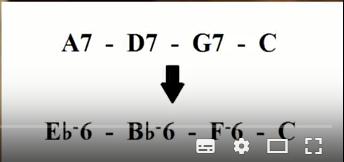
Regarding the second part, negative harmony, I understood very little ... starting from the examples reported by Jazz Mania
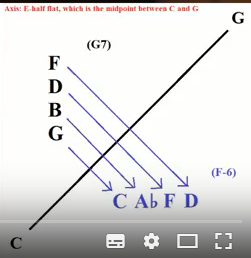
In the end, maybe I have understood something. There are some interesting examples in Persichetti's book. It is about constructing harmonies through mirror intervals; for example, a F minor is superimposed on a C major: C=C, C-E = C-Ab (desc.), C-G = C-F (desc.). The discussion becomes more complicated in the case (as it seems to me Collier does) where the inverted intervals start from two different notes. In the example he constructs, he builds a DØ mirror to a G7, obtaining the inverted intervals starting from the G; thus he obtains 2M (D), 4G (F), 5G (G), and 7M (B) descending from the G: F, D, C, and Ab. How the result should be interpreted from a harmonic point of view remains a mystery.
In this regard, Levy's book probably provides some clarifications, which I still need to read properly; it seems to me that he finds a harmonic relationship between the chord and its inversion, but from an acoustic point of view, there is no longer a numerical relationship. In other words, in tonal harmony chords are constructed based on harmonics (...), consonances, and dissonances; if we try to recreate these ratios on inverse harmonies, the principles of tonal harmony end up distorted, leaving only the numerical ratio between intervals and inversions.
In inversions, a major third will result in an augmented triad, a minor third in a diminished triad, a tone will lead to a major triad, a semitone to a tone, etc.
Therefore, in concatenations, in my opinion, at the level of triads one finds polyvalent chords; with other intervals (which would be formed starting from inversions and tetrachords) other chords not in root position would be formed. Whether this fits into a "tonal" context (albeit a very extended one) is a bit difficult or rather, everything makes sense to me if the engine were the juxtaposition of colors... if there were a II V behind it... well
Example:
Starting from
re fa lab do | sol si fa lab (II7 Vb9 in do minore)
We would have
mi sol# si re | fa# la mib sol (V7 ?, let's say a possible tonicization of something that is to come)
It can certainly open up interesting scenarios, but it would no longer be about tonal relations but intervallic ones. So much so that Persichetti treats a post-tonal harmonic context, where clearly the relations between chords had shifted to other fronts