I believe that today 440 is a rather low pitch even for home use; I know technicians who have been tuning to 442 for 50 years. But these are choices.
For me, concert pitch and factory pitch are a single concept; I do not like the idea of a reworked Steinway, and here in Italy, today, one can find a "straightforward" Steinway at Passadori.
C
Celibidache
Member
Reply 24 by Celibidache
Posts
201
From 442 to 445. No further (under penalty of excessive thinning of the sound) and not below (voiceless and impersonal sound).
On pianos of a certain size, there is also the physiological need for slightly higher tension to maintain stable tuning, as increasing the length of the instrument also increases the diameter of the strings.
Perhaps you are referring to the steel, but the real difference lies in the bass frequencies between the various models; on the highs, they are more or less all the same except for half a number... if you are referring to the steel, yes, it increases slightly, perhaps the grand piano ends with 13 and a half while the others end with 13, but we are talking about a difference of thousandths of a mm.. on the bass, the wrapped copper is also taken into account, obviously, and the finished string is thinner as you go up in length, in fact it is less disharmonious.
The grand piano can certainly be loaded a bit more on the highs, perhaps there is even a few mm of difference in length. At least it also plays more easily
C
Celibidache
Member
Reply 29 by Celibidache
Posts
201
Of course, I was referring to the steel and, in particular, to the cantabile... where most of the music is played...
Once the "midfield" on the piano has been determined, the extremes follow accordingly.
This is why many pianos sound bad today: to prepare them, they start by listening to the extremes and then do the center.
Yes, the steel gauge increases by one number, but I have also heard of someone, I don't know if it's true, who stripped down a new grand piano to unload it, perhaps even modifying the gauges, during a masterclass and it seems that the assembly was even convinced that there had been an improvement in terms of sound performance... But, as I always say, it's a matter of taste!
C
Celibidache
Member
Reply 31 by Celibidache
Posts
201
Bertrand Russell maintained that man is the most credulous mammal in nature... he believes everything out of a need to do so.
Among many manias, there is also this one of thinning strings... without having the slightest knowledge of the subject.
Bertrand Russell argued that man is the most credulous mammal in nature... he believes everything out of a need to do so.
Davehammerklavier, I was not aware of this aphorism.
For those who might be interested, I looked for the original:
"Man is a credulous animal and must believe in something. In the absence of good grounds for his beliefs, he will settle for bad ones" [Bertrand Russell]
Giovanni, Michelangeli is extraordinary... it is superfluous to tell you that he was one of my piano passions, especially regarding the rationalist historical periods, Scarlatti for example, and the symbolists; his Ravel and his Debussy are unreachable. His interpretations are the apotheosis of empirical balance and taste,
But his pianism came at a cost: severely restricting the repertoire compared to all others… something that unfortunately no concert pianist seeking typical Apollonian perfection can/has the possibility to do today. As a piano, I like it very much; initially, this was my tuning, then over time I preferred to allow myself also what lies beyond forte. I prefer the balance that occasionally allows for the "exception"; I think one shouldn't deprive oneself of anything, just as in life, in short
In my opinion, even the escapements are neither too close nor too far, so as to be able to better control the central dynamic range; they are perfectly in balance and in line with his music. On the bass notes, they seem slightly further away in order to make the touch rounder. He often has to use somewhat more evident falls, a sign that the key needs a greater push to produce the forte; even the pianissimos are often performed this way…. And it is much more difficult.. exceptional technique.
What is known about that anecdote when Michelangeli realized immediately after testing the instrument that one of the rolls he had asked to be installed had been glued in backwards? Do they have a specific sense? Because observing them, they seem perfectly symmetrical to me; I notice nothing different between front and back.
Davehammerklavier, I wasn't aware of this aphorism.
For anyone interested, I looked for the original:
"Man is a credulous animal and must believe in something. In the absence of good grounds for his beliefs, he will settle for bad ones" [Bertrand Russell]
Giovanni, Michelangeli is extraordinary... it is superfluous to tell you that he was one of my piano passions, especially regarding the rationalist historical periods, Scarlatti for example, and the symbolists; his Ravel and his Debussy are unreachable. His interpretations are the apotheosis of empirical balance and taste,
But his pianism came at a cost, heavily restricting the repertoire compared to all others… something that unfortunately today no concert pianist seeking typical Apollonian perfection does/has the possibility to do. As a piano, I like it very much; initially, this was the tuning of mine, then over time I preferred to allow myself even what lies beyond forte. I prefer the balance that occasionally allows for the "exception"; I think one shouldn't deprive oneself of anything, just as in life, in short
In my opinion, even the repetitions are neither too close nor too far apart so as to better control the central dynamic range; they are perfectly in balance and in line with his music. On the bass notes, they seem slightly further away to make the touch rounder. He often has to use somewhat more evident falls, a sign that the key needs a greater push to produce the forte; even the pianissimos are often performed this way…. And it is much more difficult.. exceptional technique.
What is known about that anecdote when Michelangeli realized immediately after testing the instrument that one of the rollers he had asked to be installed had been glued in backwards? Do they have a specific sense? Because observing them, they seem perfectly symmetrical to me; I notice nothing different between front and back.
MephistoPheles wrote:
Giovanni, Michelangeli is extraordinary... it is superfluous to tell you that he was one of my piano passions, especially regarding the rationalist historical periods, Scarlatti for example, and the symbolists; his Ravel and his Debussy are unreachable. His interpretations are the apotheosis of empirical balance and taste,
But his pianism came at a cost, heavily restricting the repertoire compared to all others… something that unfortunately today no concert pianist seeking typical Apollonian perfection does/has the possibility to do. As a piano, I like it very much; initially, this was the tuning of mine, then over time I preferred to allow myself even what lies beyond forte. I prefer the balance that occasionally allows for the "exception"; I think one shouldn't deprive oneself of anything, just as in life, in short
In my opinion, even the repetitions are neither too close nor too far apart so as to better control the central dynamic range; they are perfectly in balance and in line with his music. On the bass notes, they seem slightly further away to make the touch rounder. He often has to use somewhat more evident falls, a sign that the key needs a greater push to produce the forte; even the pianissimos are often performed this way…. And it is much more difficult.. exceptional technique.
What is known about that anecdote when Michelangeli realized immediately after testing the instrument that one of the rollers he had asked to be installed had been glued in backwards? Do they have a specific sense? Because observing them, they seem perfectly symmetrical to me; I notice nothing different between front and back.
Many anecdotes are told, who knows.... Surely regarding a backward roller, you too might notice it because it would produce a greater obstacle to the exit of the pusher, then you would also feel an almost jerky advancement in addition to the rustling, as you have the roller working against the grain.... there is anyway a horizontal notch that identifies the correct direction of sliding.
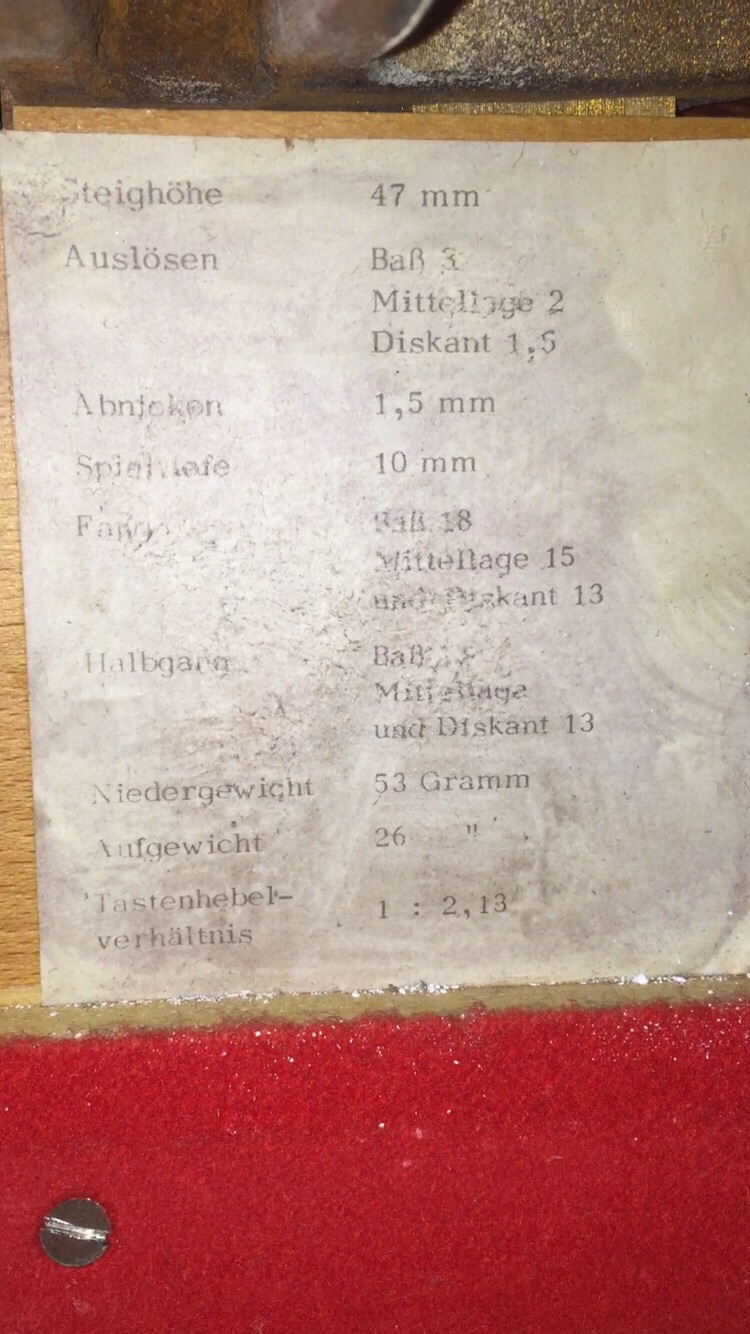
As far as adjustments are concerned, I know he did not like those that are too tight, which are fashionable today... indeed, in the 70s, those who went around German factories as visiting technicians remember that the repetitions were 2 mm for the first, and double for the second... More abundant up to 3 mm on the bass (the drop remains the same, obviously)...
Attached you can see a sheet glued to a German piano from the 80s reporting the factory settings: even on Steinways delivered by the factory, there are no repetitions touching the strings and half-millimeter steps after the middle touch, quite the opposite... Then everyone can do as they prefer.
There is an interview by Fabbrini that tells this story, but there is also the little story of the broken egg inside the hammer
C
Celibidache
Member
Reply 38 by Celibidache
Posts
201
Frank wrote:
Davehammerklavier, I wasn't aware of this aphorism.
For anyone interested, I looked for the original:
"Man is a credulous animal and must believe in something. In the absence of good grounds for his beliefs, he will settle for bad ones" [Bertrand Russell]
Wikipedia..? In an academic setting or during a seminar, the lecturer has the freedom (and implicitly the duty) not to quote verbatim, but to reinterpret sources that come to mind without preparation, a tendency for which the Italian language, more than other languages, has a natural predisposition... Not to mention that Bertrand Russell never formulated the concept in Italian.
In any case, the subject of the discussion was the Steinway hammers... Greetings
C
Celibidache
Member
Reply 39 by Celibidache
Posts
201
MephistoPheles wrote:
Giovanni, Michelangeli is extraordinary... it is superfluous to tell you that he was one of my piano passions, especially regarding the rationalist historical periods, Scarlatti for example, and the symbolists; his Ravel and his Debussy are unsurpassed. His interpretations are the apotheosis of empirical balance and taste,
But his pianism came at a cost: strongly restricting the repertoire compared to all others... something that unfortunately no concert pianist seeking typical Apollonian perfection can/has the possibility to do today.
Blessed be, Michelangeli was not only a great concert pianist, but also a teacher of unfathomable preparation.
This issue regarding the "narrowness of repertoire" is like his supposed "mania" for the piano: urban legends.
We must consider that in the period in which he lived (and especially in Italy...) people marveled and/or were amazed much more easily than today. It was enough that Michelangeli requested a string from Steinway or noticed a felt hammer placed upside down (with the real deer skin of that time, you could hear the rustle of the hair) that he was immediately believed to be a maniac or out of this world.
In the same way, people behaved regarding his repertoire: he chose (artistically) the music he wanted to bring to concert, naturally excluding much of the rest. Which, just as naturally, he knew by heart.
To quote (always from memory... forgive the non-literal translation) the interview addressed to Grigory Sokolov reported in the booklet of his last "Salzburg Recital":
".. I only bring to concert what I desire to play. For me, it is impossible to do otherwise. Of course, this puts theater impresarios in difficulty, but that is how things are. I do not understand those pianists who play everything by all authors. For me, it makes no sense."
C
Celibidache
Member
Reply 40 by Celibidache
Posts
201
p.s.
(slip of the tongue, excuse me... first I meant to say "hammers" instead of "easels"... Renner possibly... )