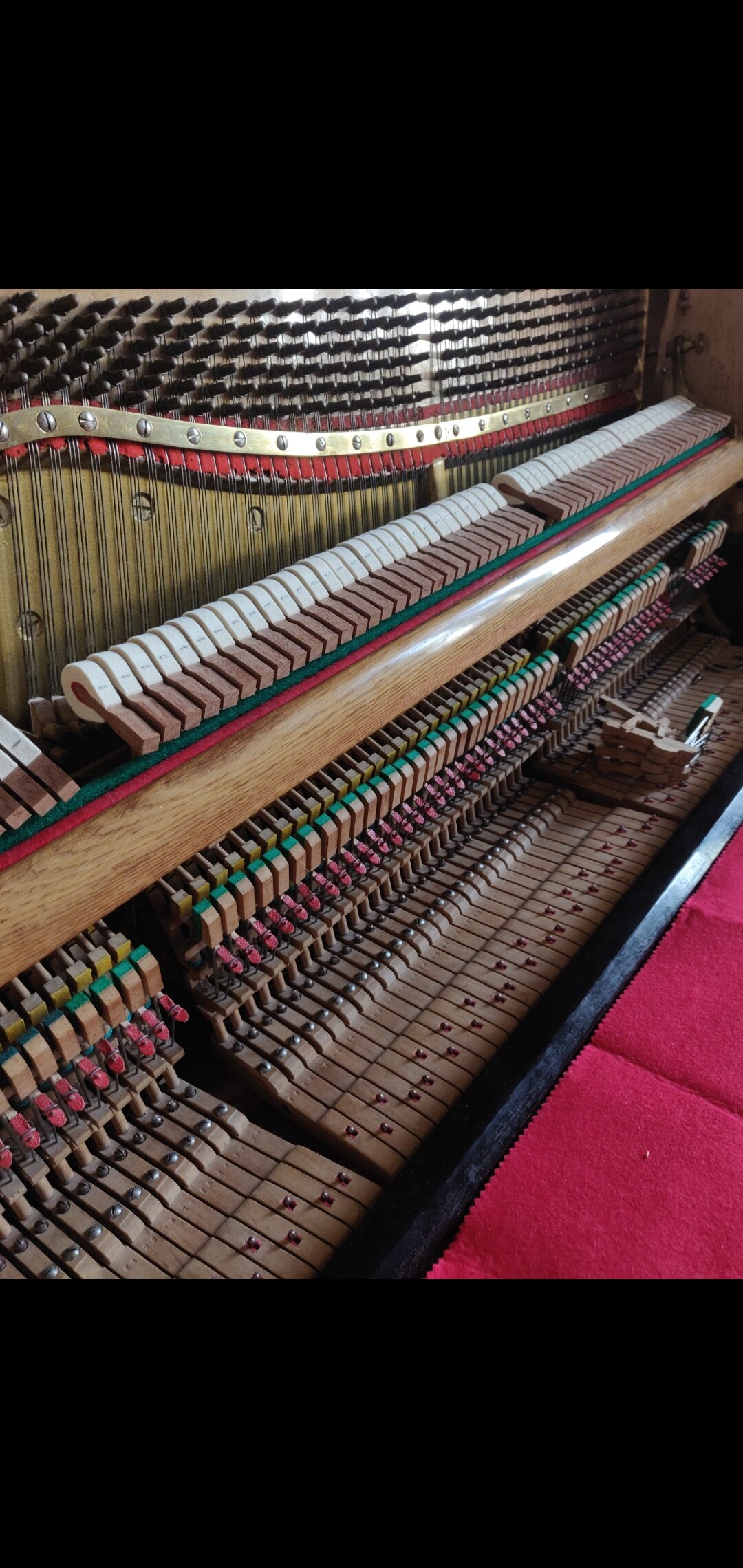
Good morning! I am Nicola, and I am restoring an upright piano by FIP, Fabbrica Italiana Pianoforti. On the action group, I have changed almost everything: the kasimir, springs, hammers, skins, felts, etc. However, I find myself with a bothersome defect.
The key repetition is very low, or rather, the hammer tends to bounce too many times on the repetition spring (mollettone) before returning to rest. I have used a 6mm repetition spring, but with poor results. Do I need to increase the thickness? Or are there other parts to check?
Yes... but does the white key have enough let-off? Then the hammers must not rest on the rail (if it is a grand piano). If instead it is an upright, it must rest on the rail and there must be a small amount of play to allow the escapement lever to return under the cap…… Look at my tutorials.
The piano is an upright. I did the work on the action specifically to prevent it from bouncing back. I set the depth of the white keys to 10.5 mm
The feeling is that after the hammer hits the string, both the hammer and the repetition spring still have too much energy to bounce, as if not enough is being lost. This only happens when I press the key forcefully but without holding it down, or during trills. I notice that if I want to increase the speed of the trill, the key is late, precisely because the hammer did not stop on the repetition spring but managed to bounce, causing the key to go empty.
Check the hammer rail. The inclination of the same and the efficiency of the nasetto leather in gripping the green hammer rail felt in the forte. Pull the straps. Check the fork pins. They could be too loose... or too tight (too much friction). Key delay can depend on insufficient return weight. Check the correct position of the escapement lever under the repetition lever. It could also depend on the key being over-leaded and the dynamic assembly being too slow to return. There must be a proportion between the masses. If their value shifts too low, the key returns before the hammer-repetition lever falls with the right weight and a void is created.
First of all, check the hammer fork pins, then the jack fork pins, and then the escapement lever pins. When friction is excessive, increase the downward weight and decrease the return weight. This happens when friction is excessive and/or when too much lead is added thinking of overcoming them!!!
Check everything
the hammer and jack pins must not exceed 3-4 gr., the escapement lever pins 1 gr. The parts must not "wobble" laterally. For this, straight reamers must be used and the pins increased by 0.025 (e.g., from 1.30 to 1.325)
First of all, thank you for your answers and your time.
Regarding the pivot pins, I have already replaced the loose ones, except for those on the wippens, so I have ordered a larger size.
I also checked all the frictions. In fact, the sensation seems to be the opposite, as if they had too much freedom of movement (but not play), in the sense that the hammer, when bouncing on the hammer rest felt, manages to drag the wippen along as well. For the keys, I checked that they begin movement at 50 grams and they all do; I haven't touched anything regarding this.
I have just replaced the hard felt of the hammer rests as it was too worn, and indeed I need to ensure a proper fit.
Do you have any suggestions on how to achieve a perfect fit?
The point is that the keys and hammers are free, they return immediately to their starting position; however, the hammer has too much residual inertia and continues to bounce. Obviously, if I leave the key pressed, the hammer rest stops it. If, instead, I play a fortissimo without leaving the key pressed, it manages to bounce, dragging the wippen along with it.