

Help!!! I have to take an exam for a master's degree, which involves the analysis of a Lied with a Schenkerian graph. Can anyone help me? I am desperate!!!
Member
Opening post by Natalia
- Posts
- 3
- City
- Bergamo
Started by
Member
Member
Help!!! I have to take an exam for a master's degree, which involves the analysis of a Lied with a Schenkerian graph. Can anyone help me? I am desperate!!!
Member
Member
Which song? Are you desperate because your teacher doesn't support you? I mean, what kind of master.... is it?
Member
It is a specialized master's in opera production, they gave me one month to do this analysis, but I have never studied Schenkerian analysis!!! And the notes I have are not clear at all! It is 8 measures, from a harmonic point of view nothing complicated, but I don't know where to start with the graph!!! Plus I live in the Middle East, and it is not easy to find books...
Member
I also know the text by Bent-Drabkin, "Musical Analysis," Italian edition edited by Claudio Annibaldi, EDT ed. 1991, which dedicates pp. 100-105 and 137-144 to Schenkerian analysis.

Moderator
Master in opera production with a Schenkerian analysis?! In Italy?!
this should be the best text in Italy for Schenkerian analysis "Schenkerian Analysis. For an organic interpretation of musical structure" by Pasticci, Drabkin and Pozzi.
http://www.libreriamusicale.com/product_info.php?products_id=11719
But it is quite curious that they have you do a Schenkerian analysis... that very book explains well that Schenker himself changed methods over the years and that Schenkerian analysis techniques are flexible, they should be applied differently for different pieces... how to say, it's not something that is done lightly and without awareness

Moderator
The ideal thing would be, as suggested, to study the recommended texts. In addition, you should try to analyze on your own, based on the theoretical notions acquired, at least a couple of pieces among those proposed in Schenker, Five Graphic Music Analyses (which I might have in PDF) and compare it with Schenker's own analysis. This is necessary for you to understand how to "classify" the compositional material ... you do it yourself and then verify how it should be done.
Afterward, you will see that the 8 measures they gave you will be a walk in the park.
Take a look at this site as well
http://www.schenkerdocumentsonline.org/profiles/composition/entity-000055.html
Moderator
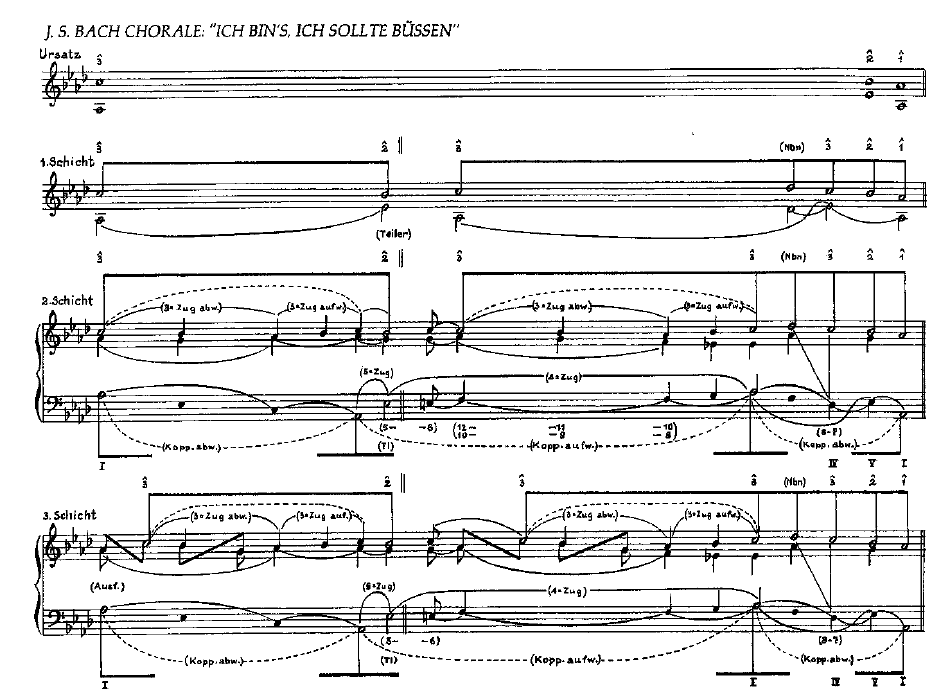
Just to get an idea: example attached
Moderator
Even if the point of view is different, you can find other examples in Counterpoint and Composition by Salzer Felix; Schachter Carl, EDT
http://www.ibs.it/code/9788870631524/salzer-felix/contrappunto-composizione.html
Member
Natalia wrote:And the notes I have are not clear at all!
That is why books exist, but despite that, I also had some doubts. I tried to resolve one of them here
http://www.pianoconcerto.it/forum/index.php?/topic/3273-analisi-schenkerianacuriosit%C3%A0/
Member
Thank you all!!! I downloaded Drabkin's book, and I will try to study it as quickly as possible... they expect the drafting of the graph and report in one month... anyway the university is in England... And the request seems strange to me too, also because musical knowledge was not required at the time of enrollment...