Piano technology

New purchase and difference between brands

18 replies 1,652 views

Started by

Gib

Member

Member

Opening post by Gib

Posts
104
City
Bat

Hello, I am about to purchase an acoustic piano...

I love European sounds compared to Japanese/Chinese ones, although the sound of Kawai doesn't displease me

At this point, at the same price, is it better to get a new Kawai (for example K300) or a used European one? (I was thinking Petrof or Schimmel)

As for actions, however, what differences are there?

Member

Reply 3 by Gib

Posts
104
City
Bat

I am aware of this, but I would like an opinion regarding the purchase of a high-end used one or a new one from Kawai or similar...

What would be the best choice?

For example, can you tell me anything about Broadwood pianos built in the '80s?


Moderator

Reply 4 by pianoexpert

Posts
3,876
City
rocca di papa

It is impossible to say which one is better to buy. One must see the condition and efficiency of the individual pianos. The actions may have differences in craftsmanship, but the important thing is that they work! I mean that if one of the best actions is left in a warehouse, perhaps with high relative humidity, for a period of time waiting for sales display, it could function terribly, creating a feeling of "hardness" and lack of responsiveness to the touch! So everything must be seen

Member

Reply 5 by Gib

Posts
104
City
Bat

I understand... And what about "restored" pianos from almost 100 years ago?

Can they be reliable over time?

I am asking this because I see many private individuals SELLING OFF prestigious brand pianos (Pleyel, Krauss, Gotrian, etc...) but in suboptimal condition...

Would it be worth restoring them? (I am talking about the soundboard, hammers, strings)

Or in the end, do you end up with a decent instrument that wears out quickly anyway?

Moderator

Reply 6 by pianoexpert

Posts
3,876
City
rocca di papa

It is possible, but they must be carefully examined and the construction choices of the era must be respected. Naturally, some reservations must be addressed. I am fully restoring a beautiful Steinway mod. B, from the early 1900s, in an Embassy in Rome: it is turning out very well. Long job. Soundboard is excellent. Its tension has been checked. New strings and mechanics completely overhauled with new hammers and all other parts (felts, skins, and keyboard bushings) restored. Hammers made specifically and styli for that New York model.

Member

Reply 7 by Gib

Posts
104
City
Bat

Agreed, thanks for the important information!

But an operation like that on an upright, roughly speaking, how expensive is it?

My ideal would be to have a piano that's a bit "old" but well-serviced/restored... They have a warmer and less "stinging" sound compared to modern ones, especially if we are talking about Japanese brands

Moderator

Reply 8 by pianoexpert

Posts
3,876
City
rocca di papa

Certainly, but one must first see the instrument and evaluate 1) if it is worth it 2) what needs to be done 3) costs and precise materials

Moderator

Reply 9 by pianoexpert

Posts
3,876
City
rocca di papa

Certainly, but one must first see the instrument and evaluate 1) if it is worth it 2) what needs to be done 3) costs and precise materials

Member

Reply 11 by Gib

Posts
104
City
Bat

Of course, I will certainly evaluate carefully before purchasing something that is new or used/restored

pianoexpert wrote:

7 hours ago, pianoexpert said:

Where are you?

Barletta, Puglia

Member

Reply 12 by Gib

Posts
104
City
Bat

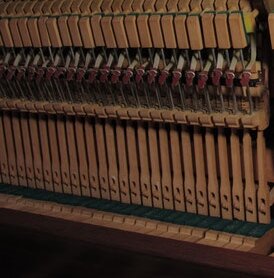
I have a curiosity regarding the mechanics of upright pianos

Usually in recent pianos, I have always seen the pilaster as the system to raise the lid...

What is the difference between pianos that instead use this other type of mechanism?

Better or worse compared to modern systems?

IMG_20240218_225552.jpg

Member

Reply 13 by Gib

Posts
104
City
Bat

I don't know if the image can be seen, but there is a pin connecting the key to the bridge, instead of the pilot

Member

Reply 15 by Gib

Posts
104
City
Bat

Ah, there it is! In fact, I found a Bechstein (to be restored) from the late 1800s/early 1900s in my area, like the one in the following video

https://youtu.be/aPph3x4LXLw?feature=shared

Dalle foto sembra in buone condizioni in proporzione all'età dello strumento ma non l'ho ancora provato o visionato con un tecnico.

From the photos, it seems to be in good condition considering the age of the instrument, but I haven't tried it or inspected it with a technician yet.

It is probably a model IV or 9

If well restored, can it be a valid and durable instrument?

Does sluggish action worsen the keyboard response?

Moderator

Reply 16 by pianoexpert

Posts
3,876
City
rocca di papa

it's not certain. One must see the stability of the ankles! condition of the soundboard and bridges. strings. regarding the mechanics, one can do everything

Member

Reply 17 by Gib

Posts
104
City
Bat

Sure

I will check with some technicians and see if "it's worth the candle"

But a piano, if completely restored, how long can it last if well maintained and played every day for a couple of hours?

Moderator

Reply 18 by pianoexpert

Posts
3,876
City
rocca di papa

If well restored and well maintained, it can sound very well for many years. One must choose the right hammer rail and follow its regulation, caring for it during tuning. The condition of the plate, the tuning pins, and the correct tension of the soundboard are essential.


Log in to participate