good morning, I purchased a new Kawai K200 piano a few days ago, built in early 2020, and I have encountered some problems.
First of all, the complimentary tuning performed before shipping was useless since the piano arrived slightly out of tune, and in these days as it has settled into its new position, it has lost even more tuning (the middle-high register has risen).
But the biggest problem I find is in the resetting of some keys, which if pressed and released very (very) slowly, no longer function on a second press; meanwhile, there are two keys that, if I press the right pedal, do not rise completely, resulting in the same problem described above.
Now I don't know if it is a problem that occurred during the move or if I didn't check with the same attention in the shop.
My question is: can this issue be fixed? Do you recommend asking the shop where I purchased the piano, or do I risk having it poorly touched up since they failed to calibrate it well initially?
How much would it cost me to call another technician to fix (if possible) the key problem?
Regarding the tuning, is it reasonable in your opinion to request a second free one?
Could you give me some advice regarding this? Thanks in advance.
Then I have a small doubt regarding the "new" condition, as the hammers have very slight string marks, even on the high and low registers. Do hammers get marked even if they are played little? Considering about 8 months of exposure with the normal possibility of testing it by potential customers. For example, counting about half an hour every now and then, can the light marking of the hammers be normal? Or is it something "suspicious"?
The slight marking is not a problem. For the rest, it needs to be regulated, tuned, and voiced. You mention shipping, so I deduce that it arrives directly from the factory, without having passed through a shop or the expert hands of a technician (for commercial reasons). Not a big deal: since it is a new piano, it can change from day to night with the intervention of an expert who will have to spend a little time on it (even 1-2 days, hoping only that there are no friction problems that can arise even in brand-new pianos).
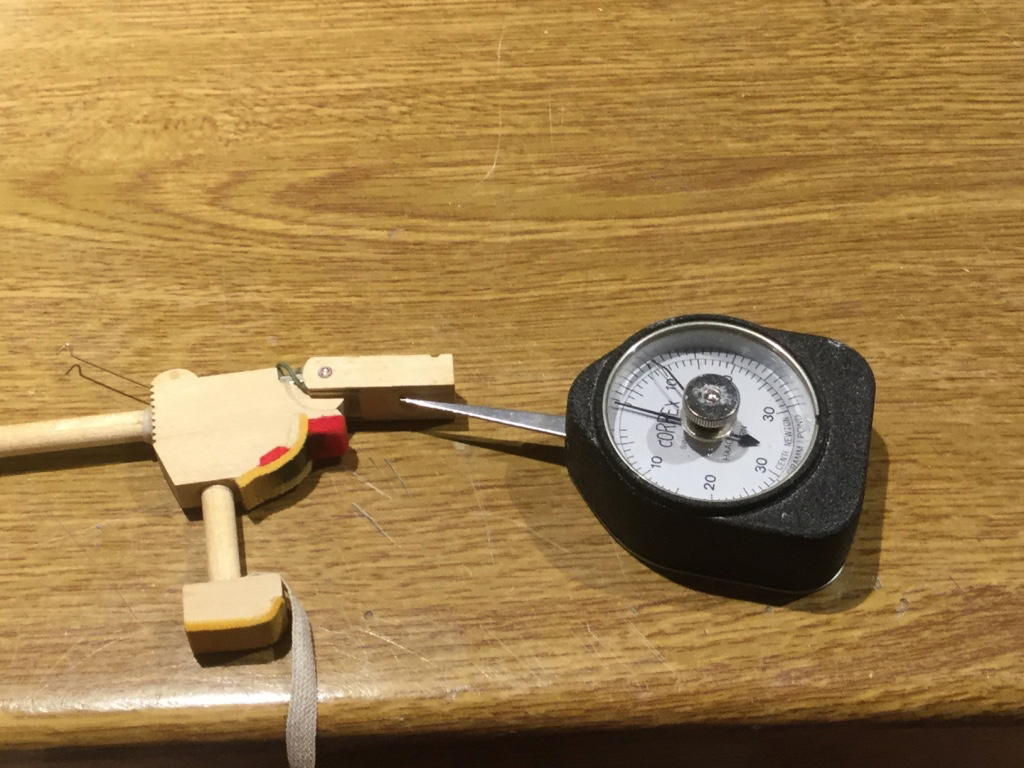
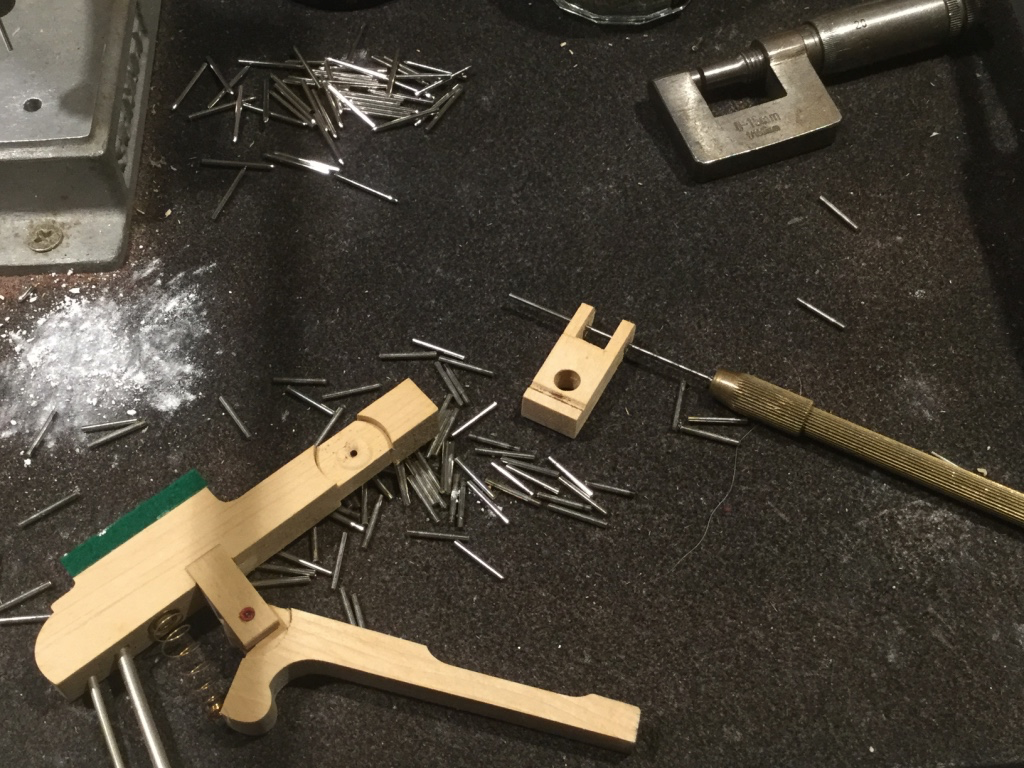
I assume this piano has friction problems in the action, even though it is new. To fix it, I wouldn't call whoever sold it... because if they had noticed the problem, they would have intervened. Intervening, as Francesco says, is a delicate matter, but definitive, and everything can change radically. The important thing is to work with professionalism (enlarging the pins, boring with straight reamers, etc.). All makeshift lubrication methods should be discouraged and sometimes make things worse with irreversible damage.
Everything could depend solely on poor regulation (which must be done anyway)... but I doubt it.
As a seller, the only thing the shop can do is replace the instrument... I wouldn't invite them to intervene on the instrument!
In fact, it is better to have it shown to a competent technician who has no relationship with the seller, who, I am sure, will dismiss you with some tall tales or, if acting in good faith, fails to trace the origin of the problem or even finds no defect at all! I've been through it. The best guarantee is not the commercial one, but the one given on one's word by a trusted and competent technician. The seller's warranty is useless if they are not capable of achieving the goal. I've been there, so I am truly speaking from experience and "scams" received. Let us remember that we are not talking about household appliances where you can replace the defective part under warranty; we are talking about "living" musical instruments, where the problem is often not in the quality of individual components but in the way they "dialogue" harmoniously. In this field, a "guarantee" is something that requires abilities that go beyond the "defect" (in the commercial sense), but much competence and, above all, artistic and artisanal sensitivity.
I take this opportunity to satisfy a curiosity of mine with Paolo (peripillo, don't be scared because it doesn't concern your case). If, in the event of an evident defect or an intervention clearly performed poorly, the technician or whoever they are insists on claiming that everything is fine, is there the possibility of intervening through legal means?
In my opinion, let time take its course! Defending a right regarding something so subjective is extremely difficult. It is very hard to prove an inefficiency, especially when it stems from such "subtle" reasons which, however, if added together, lead to a functional problem. The proper functioning and sound adjustment of our instrument is becoming increasingly obscure, also because it requires patience, competence, and intuition regarding the various needs of the pianist. Therefore, it is hardly practical to engage in legal disputes on such little-known ground. Everything could, beyond objective functional "blocks" (stuck key, broken mechanical part, etc.), be subjective.
In the case of Piripillo, we are dealing with Millennium III mechanics, which, beyond its high-sounding name, can, in my modest opinion and for many reasons I won't list, present some operational problems. It is, however, all to be seen and verified
The shopkeeper told me that the problem might simply be that the action is new and the friction with the felt placed at the base of the hammer does not allow for the perfect resetting of the escapement rail. But this seems like a trivial excuse to say: "they weren't properly calibrated". But I am speaking as a total novice and I could be wrong.
The fact that leaves a bitter taste in my mouth is that I purchased the piano from a well-known shop with a decent reputation.
The reason why I asked about having it looked at by a technician sent by the shop is that the warranty might be voided if an outside person lays hands on the instrument. Precisely because of this, I am undecided on how to proceed.
Also because I wouldn't know who to turn to for this issue, other than my teacher's tuner, but I don't know if they is also a technician.
P.S. while pressing the pedal, I heard a noise like friction with polystyrene; opening the bottom part (which still had the screws and the block), I found a bag containing beads inside (the ones that retain moisture, to be clear), do you recommend removing it from the piano?
In Piripillo's case, we are dealing with Millennium III action, which, beyond its high-sounding name, can, in my modest opinion and for many reasons I won't list, present some operational problems. It is all to be seen and verified regardless.
Does he mean that, in general, they are not a good action even if perfectly functional, or that they often come from the factory with issues?
Could you tell me if they have an average durability similar to pianos in the same price range, or if they are more fragile?
Unfortunately, I must state that what the seller says is fairy tales.
The advent of plastic and carbon, in my opinion, has not been a happy one. Let me explain my convictions:
The pins of the action repetitions (that is, the joints, the articulations, which absolutely and in a precise and stable way determine the efficiency of the entire action and, consequently, the touch) are inserted into a calibrated hole lined with a special, and also calibrated, cashmere cloth. The friction that the pin develops during the movement of the mechanical part, stressed by the pianist's fingers, must be JUST RIGHT! Neither too low (sluggishness) nor too high (hardness). The perforated and lined mechanical part, complete with pin, is made of wood.
Now, if we replace the wood with a material that does not absorb or yield to humidity (plastic, carbon, etc.), this exchange occurs only at the expense of the cloth, which swells around the pin in the presence of excessive humidity (a little warehouse moisture or inefficiency in a place that is perhaps not too dry is enough) and does not shrink when it returns to a dry place.
Paolo was the ONLY one to understand my piano's problems and also the only one to understand ME. Now the piano sounds much better, I wouldn't change it unless I had the chance for a big-brand grand piano (it probably sounds even better than factory conditions). Trust him....
pianoexpert's observations are always enlightening.
A few months ago in a showroom in Rome, I tried several pianos. I immediately noticed that the Kawai action is very "smooth" compared to some others I tried (for example Yamaha. Not Steinway though... at least on the models on display). The "tactile" sensation seemed pleasant to me, but I didn't imagine that the pitfalls described could arise.
Since I have to purchase a grand piano and live in a place with considerable humidity, I will take to heart what I have read.
The "tactile" sensation can be strategically facilitated to entice the buyer. A bit of lubrication, depth reduced to the bare minimum, a few fairy tales, acoustics that contribute to creating confusion, and there you have a fine piano that seems to play itself at times. Then, once home, all the defects come out...
One can try to compress the key bushings with the appropriate pliers, but the key play must be minimal, almost imperceptible. It seems strange to me, however, that you did not encounter this during the trial at the shop. In any case, it is not something that changes during transport.
If, on the other hand, it is found that lateral stresses on the key produce sudden blocks during descent, then it depends on the keybed felts, especially the front ones. But if the piano is new, it is unlikely. The condition of the key pins is also important for the proper sliding of the keys