

The world has truly changed. And it is happening in New York: the last classical music sheet music store is closing after 80 years

Moderator
Opening post by Frank
- Posts
- 3,838
- City
- -
Classical Music
Started by
Moderator
Moderator
The world has truly changed. And it is happening in New York: the last classical music sheet music store is closing after 80 years

Member
"Absurd", without it being in black and white we truly risk losing everything.

Moderator
http://www.yelp.com/search?find_desc=Sheet+Music+Store&find_loc=New+York%2C+NY
from this site it seems that there are still quite a few sheet music stores in New York.
I have never seen the Big Apple, but something tells me that the news refers "only" to that specific store and that that store is not at all the last sheet music store in New York. At most, it could have been the last store with only classical sheet music, and I don't see how a Beethoven Ninth could be less of a Ninth if in the next room there is also the score for Cats...
Member
It seems to me it was already in the air, unfortunately.
Thallo, a few years ago I was in New York and decided to visit the Juilliard library, convinced I would find who knows how many treasures: little music but many hoodies, mugs, and various pins to satisfy any taste (maybe Cats)
Frankly, I am not worried about Beethoven's great-grandmother, but about a classical music bookstore where I could find everything else... which in fact is everything that is highly sought after and difficult to find.... to put it American style, "less popular".
Additionally, even in Italy, shops of that type are closing; I can only proudly mention the Beethoven Haus in Turin.

Member
thallo wrote:http://www.yelp.com/search?find_desc=Sheet+Music+Store%26find_loc=New+York%2C+NY
from this site it seems that there are still quite a few sheet music stores in New York.
I have never seen the Big Apple, but something tells me that the news refers "only" to that specific shop and that that shop is not at all the last sheet music store in New York. At most, it could have been the last shop with only classical sheet music, and I don't see how a Beethoven Ninth can be less of a Ninth if in the next room there is also the score for Cats...
Claudio, allow me to join another issue to your writing that you, I would say somewhat despondently, often raise lately, namely this:
Now Thallo arrives who, as often happens to him in recent months, is DISHEARTENED by the turn of some discussions...
For me, they are all variations on the theme of the usual crusade against "contemporary" music, which is no longer contemporary at all.
I am joining them because they are, correct me if I'm wrong, relevant to your way of thinking at this moment regarding our relationship with contemporaneity and, since this discussion had already developed between the two of us in another topic, it allows me to clarify a few things.
You know well that on my part there are no crusades against anyone, much less against music of one genre or another. However, I think it is wrong to always make a muddle where different genres are equated, where everything becomes substantially the same; I think this for contemporary music, as well as for that of yesterday and that of the early nineteenth century, baroque, renaissance, and medieval. In reality, we both know well, as everyone knows who from time to time lashes out against that other music: it certainly won't be our tastes, our more or less correct or debatable arguments, that will decide which of this contemporary music of ours will be decreed immortal, but rather future generations.
Therefore, let us each keep our own tastes, with the awareness, however, that the music we love most will not necessarily be the one that lives on imperishably.
The discussion then about the disappearance from the scene of certain places that until a little while ago seemed out of the question, is an expression of our modernity and thus our contemporaneity. Therefore, nothing will be useful, as some people do even in this forum, tearing their clothes, cursing this and that because, whether we like it or not, we can only take note of it and come to terms with it.
Now Claudio, however, if I am not among those who think that the world of yesterday was "the best possible world," I am equally not among those who think that today's world and the one that, at the current state, is projected to be, is "the best possible world."
Now, it is true: Beethoven's Ninth is Beethoven's Ninth whether you put it next to .... or whether you put it next to ...., but it is equally true that it is a fact that shops that were exclusively carriers of a certain type of music can no longer sustain themselves today. And this is a clear symptom of a cultural, social change... towards which we can grieve, remain indifferent, or even rejoice, but in any case, such it is.
It was so for movie theaters: especially in the provinces, second-run but also many first-run ones. It was so for many activities, it is also so for private bookstores, etc. etc. etc.
From my point of view, I take note but I do not rejoice and I am not and do not remain indifferent to all this. As an "old romantic," as I am, I think that we are, substantially with consensus and indifference, squandering bit by bit much of our cultural capital...(pffff, to the wind) The important thing then is afterwards, not to regret it because afterwards it might be too late."}
Moderator
My "The world has truly changed" is an awareness that the process of materialization is indeed taking its course; if money has become virtual... let alone the rest.
In fact, a change in medium never automatically decrees any loss. When printing arrived (which sent things like miniatures into retirement), culture finally began to circulate. I think we are now fully in the era of Amazon (just one example), PayPal, Web 3.0... it may or may not be liked, but in fact, I spend more money on books now than before... simply because it only takes connecting to the network for 10 minutes to have everything delivered comfortably to my home.
The fact that people no longer want to invest in culture, however, I don't think lies in the media themselves but "elsewhere". I find this an area for reflection... not that it is an absolute truth, of course.

Member
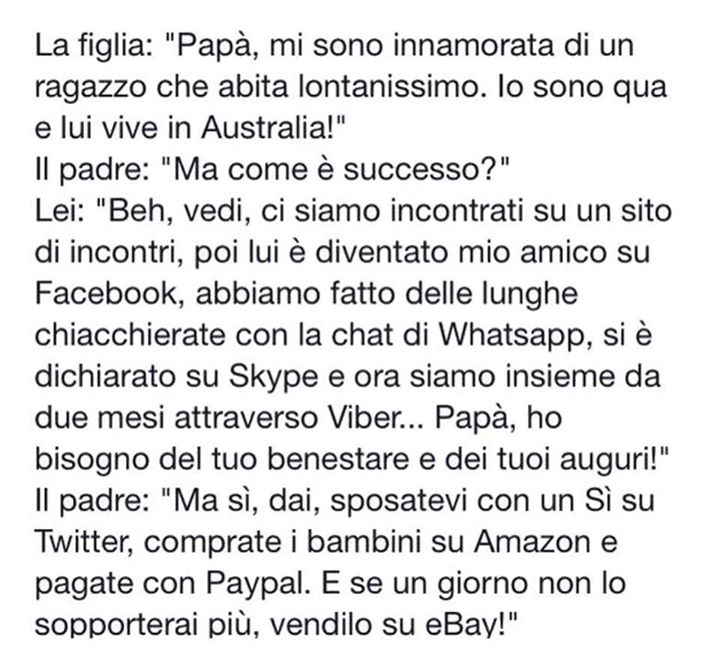
This virtual thing made me think of this ironic joke.
It might seem a bit OT but if you think about it...
Moderator
when the ninth was written, "classical" music sheet music stores did not exist.
Everyone can be attached to whichever places they want, as strange as it seems to me to be attached to a shop that one has never seen and that is overseas.
If we begin, however, to make every place, every event, every closing of this and opening of that symbolic, we end up always and only talking about our fears and never about reality. And that is the problem of symbolization. If we have a fixed thought, then we make almost everything a symbol of that thought.
And that is what I see in some threads and comments on the forum lately. The fixed thought is more or less "the culture we believe in is dying", and any event is experienced as a sign of this apocalypse.

Member
Forgive the banality, but if you are wondering where Beethoven's Ninth went, having disappeared from the New York shop, here it is:
http://imslp.org/wiki/Symphony_No.9,_Op.125_%28Beethoven,_Ludwig_van%29
The problem, if anything, is that IMSLP and similar sites inhibit, in many cases, scientific research on sources: how can research be funded if everyone then searches for and finds the music on the internet - even if in editions that are often critically unreliable?
However, I read this other thing:
danielescarpetti wrote:In reality, we both know it well, as do all those who from time to time lash out against that other music: it certainly won't be our tastes, our more or less correct or debatable arguments, that decide which of this contemporary music of ours will be decreed immortal, but rather future generations. Therefore, let us each keep our own tastes, with the awareness, however, that the music we love most will not necessarily be the one that lives on imperishably.
It is not precisely the topic of the discussion - and anyway, these days I don't have the time to develop the argument. Regardless, sooner or later I will have to write something about the fact that this approach - historicism applied to music - is wrong. It is a kind of artistic Darwinism as widespread as it is devoid of real foundations. Music "decreed immortal" is not in itself the best music, or aesthetically more significant; conversely, "forgotten" music is not in itself devoid of value. As soon as I have time I will develop this argument, but in the meantime I would suggest rethinking the misery of historicism.
Member
Yes, I know, Red, that the Ninth ended there, just as I know that today films are on the web and that anyone, often illegally, can download them; just as I know that books can be ordered on Amazon - or whoever it may be - without going to our dear old bookseller; just as I know that we can listen to and possess music without going to record stores; just as I know that ...
Now, setting aside the wondering of who and what is behind all this, how they work, with which contracts, how much staff is used, and how much, conversely, it has cost economically and humanly to have torn down what once was—of which many perhaps do not care at all—I wonder: is the world that lies ahead of us truly better than the one we left behind? Are we sure that all this is the main road and that instead, in the long run, if not sooner, it will turn against us? And mind you, let me be clear, I am not asking this out of pure conservative spirit, but precisely in terms of human and social quality.
Probably you and Claudio - and also many others - think so with certainty: it is better. I, on the other hand, have some doubts. But, as often happens, I hope that you are naturally always right.
A small note on the ending which rightly deserves its own discussion: I am certain that if you are referring to pre-Baroque music or more from the 1600s, you also have your reasons, but if you are referring to music from the 1700s up to tonal twentieth-century music, I think that the composers and the music that has remained in the shadows have a reason for being exactly as they are.
Every now and then someone tries to re-propose something forgotten but, essentially, it is stuff that can quite easily remain forgotten, or at least, that's what I think.
Quite different is the discussion regarding all the twentieth-century avant-gardes, which I think must still be well understood and analyzed in its extraordinary complexity and scope, and which will surely be a task for generations to come.
How I would hope that future generations have the desire and the capacity to understand the greatness of ancient music.
But, even on all this, I have some doubts.
Member
I must say no: I have no reason to believe that the future of our Western European world is particularly happy, neither on a social, nor cultural, nor spiritual level. I hope I am wrong, obviously.
danielescarpetti wrote:A small note on the ending which rightly deserves its own discussion: I am certain that if you are referring to pre-Baroque music or more from the 1600s, you also have your reasons, but if you are referring to music from the 1700s up to tonal music of the twentieth century, I think that the composers and the music that has remained in the shadows have their reason for being precisely because they are such.
As far as this point is concerned, broadly speaking I can agree (although perhaps I happen to listen to a piece without knowing who wrote it, find it beautiful, then they tell me the composer's name, and I say to myself: "Well look at that, I have never listened to anything by this man, I thought he was a minor one, but in reality he was a fine musician!").
But one must also consider the opposite perspective: what we judge today to be eternal and imperishable because of our scale of values will probably not be eternal and imperishable forever and for everyone. In another topic I mentioned the name Josquin, who must be considered a composer of value equal to Bach and Beethoven, in absolute terms. And yet how many know him? And why shouldn't a fate of semi-oblivion analogous to that of Josquin also be reserved for Beethoven, perhaps in two or three centuries? One only needs to remember the case of the popular Albanian musician who, led to listen to the Ninth Symphony, found it "beautiful, but too simple," consistent with his standard of judgment based on the complexity of rhythmic and metric articulation. Ethnomusicology proves extremely useful for putting things into perspective.
In short, the Ninth Symphony is of absolute value, on this we agree: but not because it is eternal and imperishable.
Moderator
I am not convinced that we live in the best of all possible worlds.
I think that complaining about the world we live in doesn't serve much :-) let alone improving it, on the contrary!
Regarding the fact that music fallen into oblivion is somehow "less important" or "less beautiful" than that which continues to be played, I completely disagree instead. Rossini's Le Voyage à Reims was performed in Pesaro after ONE HUNDRED AND TWENTY YEARS of absence from the stage, and it is a masterpiece. Everything we called Baroque until not many years ago was misunderstood and despised, regardless of its beauty and artistic value. When you, Daniele, publish threads on medieval music, you should ask yourself "but why is it so difficult to find a CD in which these things are performed?". We possess a vast amount of ancient repertoire. Obviously my "vast amount" is relative, but certainly among masses, hymns, praises and more, we should hear medieval liturgical music every day. Its artistic value is INDISPUTABLE; we are talking about the BASIS of Western musical culture, the one for which NO ONE in this forum spends a word (except for a few exceptions).
And here we are still talking about Beethoven's Ninth...
And this is what I don't understand. For me, the discussion is absolutely comparable to that of the League and the conservative parties. Everyone fights for "values," but the choice of values to fight for already says a lot. The closing of a sheet music shop in New York will have no repercussion on the state of music in the world. The opening of a site like IMSLP has had gigantic repercussions on the state of music in the world.
Why haven't I heard anyone rejoicing?
Because you are complainers :-)
Must I link to you again the image of all the times when intellectuals have predicted the death of music?
Member
Look, I agree with you on many of the things you write, and therefore what I am responding is not and does not intend to be a rebuttal to your considerations, but merely a clarification because I realize that writing is always limiting.
I am perfectly aware that our value systems are not necessarily the same as those of future generations and, however, precisely for this reason, I find it highly unlikely that the greatest composers will become the least - and this is naturally to push the concept to extremes - and vice versa. I find it possible that future generations will no longer listen to the music of those composers - yes, that - but not to replace it with others from those eras, but precisely because that music will no longer interest anyone, and this saddens me and I would consider it a great cultural loss for the world of tomorrow. (A complaint, Claudio)
Claudio, I had the privilege of watching the revival of Il viaggio a Reims on TV in 1985 or 86, directed by the regrettable Luca Ronconi and conducted by the regrettable Claudio Abbado. I remember that evening as if it were today. To tell you that I was moved and enthusiastic is an understatement. I said to my father - literal words - "this is the masterpiece of Rossinian opera buffa and surpasses Barber of Seville and Cinderella". The opera, among other things, was recently restaged by La Scala and just this morning RAI 5 broadcast it, and I enjoyed it once again.
Some time ago, Muti brought back from the sands of oblivion at La Scala an opera by Salieri: Europa galante - but I don't remember the title well - which, quite rightly, has fallen back into the depths of oblivion.
This is to tell you that Rossini is still Rossini, Salieri is still Salieri.
No, do not take my words as snobbish. Rossini was a great one and, like all greats, he did minor things and major things, but he was Rossini.
History has taught us that some of the composers who were considered masters in their time are nothing today: this does not mean that everything they did was rubbish; it means that the history of music, in its evolution, has swept them away. It also teaches us that others who were held in lower regard today are stars. That a myriad of composers have disappeared forever from our knowledge; perhaps they even did something good but... in general...
The Josquin case, on the other hand, fits into what has been the knowledge of past music and its assimilation by contemporaries. It is not a matter of fate as you say, Red, but of a cultural limit that, even today, has not been overcome.
Until a century ago, listening was limited only to the contemporary - of those times, naturally - and to Romantic and Classical music, and separately to Baroque music.
Then things changed, also driven by many new composers who began to look at ancient music.
But it is a fact that the vast majority of listeners - and perhaps even professionals - continue to stop at music that essentially goes from 1700 to 1920, more or less.
And, I repeat, this is due to a major cultural limitation. It pains me to say it, but it is so. A cultural limitation that affects all of us.
And my publications aim precisely at that: to arouse interest in that music. Only that! But I have seen no results, even within this forum of "professionals," and I am very sorry about it. But once again, I take note! (Another complaint)