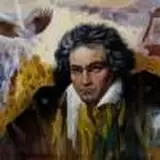
And... so let's talk about these nine symphonies once again.
Yes, and above all, let's try to ask ourselves once more why, despite everything: the passing of time, much more recent symphonic corpora – Mahler and Shostakovich above all – of immense value, these symphonies continue to provoke such intense feelings in the imagination and in listening.
Beethoven arrived at the symphony very late; while he was finalizing his first String Quartets at age 29, in 1800.
Both for the Quartets and for the Symphonies, he felt a strong fear of confronting the two great composers who stood behind him: Mozart and Haydn.
It was to them that the last masterpieces in terms of symphony were owed: Mozart's last ones dating from 1788 and Haydn's, dating from 1795.
Beethoven arrived in Vienna in 1792 and, until 1798, he was known more as the greatest pianist of the moment than as a full-fledged composer. On the other hand, it is true that, apart from the two cantatas for the two emperors and some Arias, all his compositions up to that point contemplated only the presence of the piano or, at best, its centrality.
With the trios for solo strings, the slow detachment from the principal instrument began, and then the quartets and, finally, his First Symphony crowned him as such.
Thinking about it now, I find that the most appropriate definition for the First Symphony is "Shimmering Sea," precisely because it is the departure of a composer who finally decides to set sail without having a clear destination in mind and without knowing where that adventure might lead him. He has finally decided to leave; he has taken the courage to confront the "greats" even in this genre and, albeit still very timidly, begins to do so in a different way.
Yes, because although still anchored to Haydnian stylings, we can say that even in the First, there is something different: that the music is no longer that of Haydn and Mozart.
The rhythm certainly has a function not analogous to his predecessors: not a way to solemnly affirm the tonality, but to amplify the entrance of the main theme and give it greater importance. To the point where one could say that the theme becomes a character that requires a proper introduction to enter the stage. And how does Beethoven do this? He conceives the introduction with entirely unusual harmonic motifs, wandering into other keys, in order to then affirm the C# of the theme.
The First Symphony is not a masterpiece, yet it finds its genius moment in its third movement, when Beethoven replaces the classic Minuet with a Scherzo. No longer melodic grace, elegance, or graceful rhythm, but a driving and overwhelming rhythm.
Thus, Beethoven sets out on this "Shimmering Sea," calm but then beginning to swell a little, and he does not yet know, not only, where he will arrive – the destination – but also, along the way, where he will land – the ports.
For the Second, I also make amends and change the definition – even if I hadn't written it before –: "Welcoming Home." Why? Because I consider this one more than the First – and more than any other Beethovenian symphony – to be the emblem of the encounter between the composer from Bonn and the Viennese tradition. Hector Berlioz said of this Symphony: "One can discern in it only the youthful ardor of a noble heart in which the most beautiful illusions of life are kept intact." Sacrosanct words. We are in 1802, and with this Symphony, Beethoven retreated not only from the First but also toward works like the Pathétique, returning to Eighteenth-century stylings: the Second is comparable to the Serenade – a musical form typical of the late 1700s – and finds its widest representation in its Larghetto.
Shortly thereafter, there will be the Testament of Heiligenstadt, and for Beethoven and his music, everything will truly change.
The Third is the first of the ports where the Beethovenian symphonic ship docked.
Thinking about it, Luca, I now think you are right to define it as a "blazing forge," a clash of the composer with the ideal of freedom. I do not know if Beethoven was fully aware of the revolutionary scope of this work, but today, we can certainly affirm that those two Eb major chords do not only open a Symphony but, much more: "a new way of feeling music that imposes itself on the listener with profound pathos and an enthralling charge." (Alfredo Casella)
Beethoven's Nine Symphonies have a somewhat unitary character and represent Beethoven's most conscious stance toward the Viennese public.
Therefore, if the First is the first incursion of revolutionary spirits into eighteenth-century patterns, the Second, the acceptance of a way of life anachronistically tied to an Arcadian past, the Third, the imposition of a will for subjective affirmation, the Fourth is the...
to find in the noble class, a lost paradise of frank and rustic patriarchal simplicity and for this reason, changing my first statement once again, I would say that it can be likened to the garden of light.
The Fourth does not pose problems of rupture with the outside world and responds to the desire of the one who commissioned it from Beethoven: Count Oppersdorf who, as it happens, was enthusiastic about the Second. To an admirer of Opus 36, one certainly could not deliver a Symphony like the Fifth – a symphony that Beethoven was working on at that moment – and the composer was fully aware of this. So much so that he interrupted its composition and composed Opus 60.
The struggle triggered by Beethoven with musical form and society thus subsided in this Symphony, and the composer managed to find a happy, albeit brief, formal and interior equilibrium.
"The new and the original generate themselves, without one even thinking about it," so said Beethoven and, indeed, the Fifth is evidence of how an elementary spark, in the hands of a genius, can almost unconsciously magnify itself, to the point of becoming the generating element of one of the most complex and – at least in its first movement – most famous Symphonies in the history of Western music. Hard rock, dear Luca, you define it and it suits me perfectly. I think of "poor Goethe" when listening to this first movement by the hands of the very young pianist Felix Mendelssohn; in 1830 he interrupted him shouting: "it is truly great but it seems as if the whole house is collapsing." And this phrase has already said everything about the absolutely revolutionary scope of this Symphony, which represents the second port where the ship that set sail in 1800 anchors.
Regarding the Sixth or Pastoral, I have already said at other times and I will not change my mind here: a path in the woods but only because forced by play. In reality, if I had to define it, I would say: an expression of spirituality, of inner peace. And this is another port where the Beethovenian Symphony anchors.
The Seventh is, indeed, as you assert, "A marvel of nature, and the inexhaustible force that agitates it... a rough sea." But if it is a rough sea, it cannot be a sparkling sea. Therefore, it could be a very fresh wind, where however the definition must be understood as a metaphor for strength, a overwhelming rhythm that in its great freshness, charges us and fills us with energy. Another port, then, where the ship anchors.
The Eighth, unjustly considered, also due to its dimensions, a minor symphony, today, as Beethoven wished, is one of the favorites. Seductive material, devoid of imbalances and naivety, behind an apparent simplicity and linearity, it hides a great complexity and a great diversity compared to all the other Beethovenian Symphonies: it is astonishing to note the presence of an entirely new world in forms almost identical to those of the eighteenth century; we can well define it as the true first neo-classical work within the history of music. Therefore, in this new port, I embrace your idea of a lively city, for "the grit, the vigorous spirit, the irony... the haste of the finale" but not only: for that capacity for renewal, within the old, of which it is a bearer.
The Ninth, my dear friend, I consider another port of the Beethovenian symphony and, by stating this, I know I am excluding the destination. The destination, that which Beethoven might have reached, perhaps would have been the Tenth. From there, we surely could have seen the truly stupendous panorama but, in the Ninth, this climb is interrupted in the Third movement – that is the highest peak – with the fourth one returns to earth and from there, we can turn our faces toward the celestial vault – as the composer exhorts us – but not admire panoramas.
But let us not despair! Beethoven then gifted us, before dying, another truly insurmountable peak, the Great Fugue Opus 133 and from there, as Massimo Mila stated, he in an "extraordinary intellectual adventure... having reached such heights" can afford to "be able to contemplate, like a god, past and future."
And what more wonderful, larger, and more absolute panorama can there be than this?