

Non-retrogradable rhythms ... ?
Dura a capire per uno come me
Started by
Member
Member
Non-retrogradable rhythms ... ?
Dura a capire per uno come me
Member
Actually, the concept is very simple: a non-retrogradable rhythm is a rhythm that, when read from left to right, is identical to its inverse, i.e., read from right to left. Two consecutive half notes in a 2/4 rhythm represent a non-retrogradable rhythm, precisely because they are (obviously) identical from one side as from the other. Generally, the typical reference regarding these rhythms is Messiaen and thus his Technique de mon langage musical (with all the necessary accents that I have not included). In essence, one speaks of inversion, one speaks of Bach (The Art of Fugue, Musical Offering), and much earlier, a very famous example that I like to cite especially for its title: Ma fin est mon commencement by Guillaume de Machaut.
http://erato.uvt.nl/files/imglnks/usimg/1/1f/IMSLP200679-WIMA.b721-ma-fin.pdf
Referring to words or entire phrases, one speaks of: palindromes. Words like radar, anna, or even some phrases (I am telling you just because they amuse me, even if a bit off-topic):
1) i topi non avevano nipoti
2) aro un autodromo o mordo tua nuora
3) a man, a plan, a canal : panama

Member
For example.
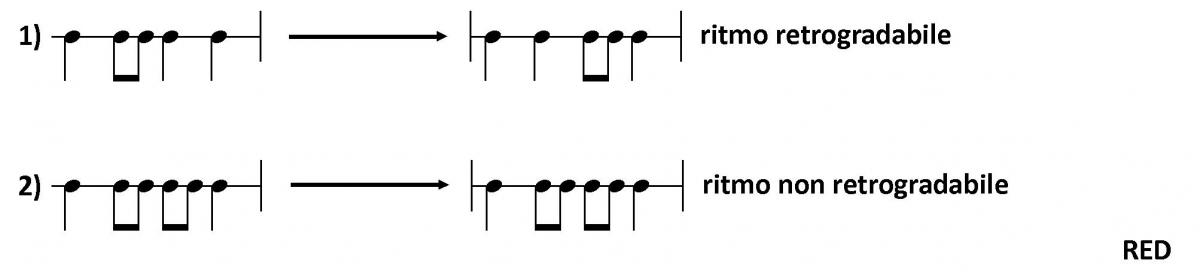
If you read the first measure from end to beginning, you get a different rhythm from the original, and therefore retrograde is possible.
If you read the second measure from end to beginning, you get a rhythm identical to the original, and therefore retrograde is not possible: it is a non-retrogradable rhythm.


Member
Reasoning by logic, it seems like an oxymoron to me.
Member
Ehm... I tried to insert an image in the previous message, but I don't think it worked!
I hope it works better now ...
If you read the first measure from end to beginning, you get a different rhythm from the original, and therefore retrograde is possible.
If you read the second measure from end to beginning, you get a rhythm identical to the original, and therefore retrograde is not possible: it is a non-retrogradable rhythm.
Member
Yes, everything is fine, thanks, I had a momentary lapse of intelligence.
Member
I was wondering if the same concept that applies to rhythm could be translated into other "dimensions"; I don't know, for melody perhaps it is "still" easy... I don't know about harmony...
Member
I will write something banal or simplistic, but non-retrogradable rhythms are ultimately already retrograded rhythms, except that this criterion can apply to both melody and harmony (to answer Bit); in the end, it is a matter of two m(i/a)cro cells (rectilinear/retrograde motion) placed side by side