Restoration

Old Stallberger For Educational Use

3 replies 1,959 views

Started by

GnazzJazz

Member

Member

Opening post by GnazzJazz

Posts
63
City
Raiano

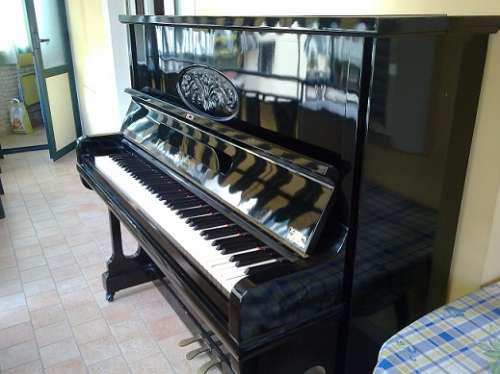
I am writing in this section because I would like to restore a minimum level of functionality, for purely educational purposes, to an old school piano. I am attaching images of the instrument and will then attach a couple of audio files, rough, but still useful for assessing its condition.

In more detail:

I am presenting the "problem":

In the local elementary school, there is an old piano that is effectively abandoned to itself and disused, appearing in a pitiful state: ruined and dirty mechanics, cracked soundboard (glued-off boards?), tuning dropped by an average of half a tone with all the unison strings out of tune, hammers in the treble area hitting off-center, and so on…

I have therefore proposed to "take care of it": once the idea of a restoration is set aside—which in my opinion would cost more than a used and usable piano, but I would like your opinion on this—I could "get my hands on it" with two linked purposes:

to attempt to tune it, or rather proceed as much as possible and without illusions toward a tuning, gaining experience myself without risking damage to a good piano. From this, I would then create a sort of educational workshop, aimed at middle school students or even other users outside the school, to bring them closer to the very interesting world of the piano, its evolution, the evolution of "Western" music with the choice of equal temperament, as well as the physics of sound, starting from the vibrating string in relation to harmonics and the natural scale, and then with beats in relation specifically to equal temperament. In reality, it is a work in progress that needs to be invented, but I believe it will certainly be fruitful.

In these terms, with a clearer and more organized discussion, I expressed myself to the principal, who quickly granted me permission to proceed, also thanking me on behalf of other people in the institute. I also think it was important to stir things up regarding this and other abandoned instruments in the town (one more important one present in the municipal premises which I would also like to discuss, but absolutely not touch J). Now, however, I must do my part…

The help I would therefore like to kindly ask of you is a general opinion on the instrument and on my statements regarding it, and then naturally advice on how to proceed, if you approve of the idea, in this experience of tuning and also small restoration (just to make the instrument minimally functional). For this reason, I am submitting images and audio samples to you. In particular, I would like to understand what the correct size of the tuning key is, or rather, which tuning pins/bushings to use.

hello and thank you

Ignazio Prignano

Moderator

Reply 2 by pianoexpert

Posts
3,876
City
rocca di papa

dear Gnazzjazz,

Ok. Nice photos and a nice initiative. The key could be n:2 or 3. But.....I wouldn't want to dampen the enthusiasm.

The instrument was.. I say was... it had to be a good instrument. But in its current condition, only an expert can make the right decisions. First of all, one must see the state of the strings and see how the knuckles react under the key. Then general cleaning. Then a mechanical overhaul which involves many spare parts and the ability to install them. It is a very complex job and must be handled by a specialized person. The strings instead of the straps are pitiful!!!! As are the two dampers kept "behind the strings".

One cannot always avoid intervening. DIY can be valid for small things. I understand the distance from large Centers and the little interest that you, fantastically, have managed to awaken, but it is not enough. To the point where the instrument is at risk of breaking several strings, and then? In short, even if in my videos I explain techniques and many things that I have acquired over the years through study, research, and in-depth analysis, I believe that one should always consult an expert Technician before "touching" an instrument like this in a total way. I would request a targeted and gradual intervention by a specialist.

Let me know

Member

Reply 3 by GnazzJazz

Posts
63
City
Raiano

thanks for the answer!

The point is that nobody will spend money on that piano, so I was thinking of downgrading it to a teaching laboratory. I saw (attaching image) an apparently identical piano for sale on the internet for 500 euros and on the outside at least everything is nice and shiny, so...

Of course, if all the strings break and the soundboard cracks as soon as it's touched, then it's better to give up.

The strings seem to have only some superficial signs of rust

The idea was to start trying to tune the unisons and then, once the stability and thus the ability to do so without causing damage has been verified, move on to tuning, at most even without going up a semitone if it should be deleterious.

The goal would be to be able to use it as a basis for general musical study for the school children, not to destine it for normal use.

The other problem is that I had clearly warned about the possibility of giving up during the exploratory phase, but instead the operation has already been publicized! :-))

What could be the estimated cost for a complete restoration instead?

hi

Ignazio Prignano

Attachment

Moderator

Reply 4 by pianoexpert

Posts
3,876
City
rocca di papa

one must always see and listen to the instrument before deciding and quantifying the restoration cost. It will be the responsibility of a good Technician to evaluate the possibility and issue a quote

Log in to participate