

I hope this is the right section.
Can someone explain to me why in Palestrina's scores the tenor voice is written in an ancient mezzo-soprano clef? I mean, why not in tenor clef?
Started by
Annuccia
Member
Member
I hope this is the right section.
Can someone explain to me why in Palestrina's scores the tenor voice is written in an ancient mezzo-soprano clef? I mean, why not in tenor clef?
Member
By tenor clef, do you mean the treble clef with an 8 (notes to be played an octave lower)? If so, this is already a "modern" clef, so I imagine there was a different one in Palestrina's time.
But I am no expert
Member
I do not remember any examples in Palestrina of tenor written in the modern mezzo-soprano clef: can you post an example?
Usually, the tenor is written with the C clef on the III (modern alto) or on the IV (modern tenor).
In general, the use of voices and their respective clefs should not be understood in the modern way (Bassus=bass, Tenor=tenor, etc.) but by considering the general context and the relationship between the vocal registers in the piece in question. The tenor, if overall high, uses the C clef on the III line, otherwise on the IV. Even more specific is the Bassus, which uses the F clef on the IV (modern bass) but also on the III (modern baritone) and sometimes even the C clef on the IV (modern tenor). The modern mezzo-soprano clef, the C clef on the II line, is used by the Altus (which, in addition to the modern alto clef, sometimes uses the soprano clef).

Moderator
consequently it is always worth remembering that much of Renaissance vocal polyphony, and certainly Palestrina, was not written for female voices, so the "gender" difference between the various registers did not exist. The altus was a high tenor, or a castrato, or a boy (male) with a contralto voice
Member
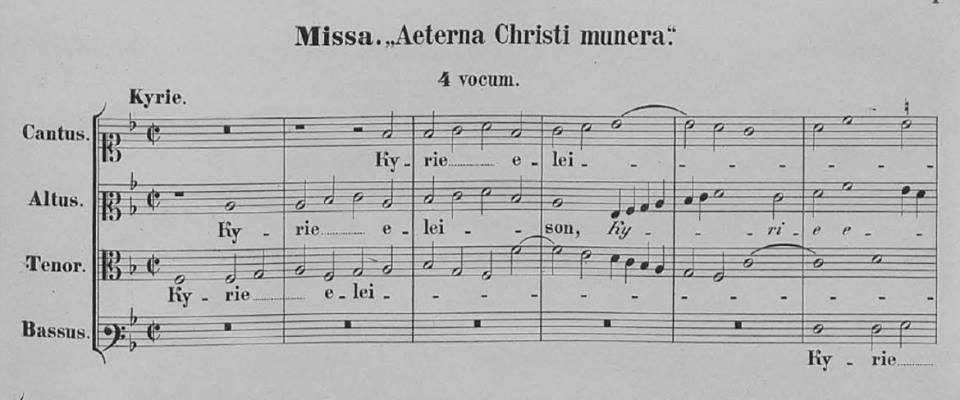
Thank you very much for the posts, I don't know if I managed to explain myself well but what sparked my curiosity was this image. What do you think?
Member
Annuccia wrote:Thank you very much for the posts, I don't know if I managed to explain myself but what sparked my curiosity was this image. What do you say?
The Tenor one is a modern alto clef, not mezzo-soprano.
The Mass “Aeterna Christi munera” is written in a transposed Ionian mode with a rather high range for both the Tenor and the Bassus, which justifies the transcription into alto and baritone clefs. Obviously, the possibility remains to transpose the pitch at will (the modes are only an intervallic convention).
In contrast, the Sicut cervus, also written in transposed Ionian mode but with "SATB" clefs for a generally lower range: many mixed choirs/vocal groups today perform it higher precisely to balance the registers.
Member
I'm joining the conversation, I am fascinated by what you write Zedef, but how does one acquire this knowledge? I mean, is there any specific text that treats the subject well?
Member
Aspirante wrote:I'm joining the conversation; I am fascinated by what you are writing, Zedef, but how does one acquire this knowledge? I mean, is there any specific text that treats the subject well?
There are texts
(Zanolini
Swindale
Cervenca
and others..)
but above all courses, both within the Conservatory framework and outside of it.
Member
Thanks Zedef, also for the bibliography.