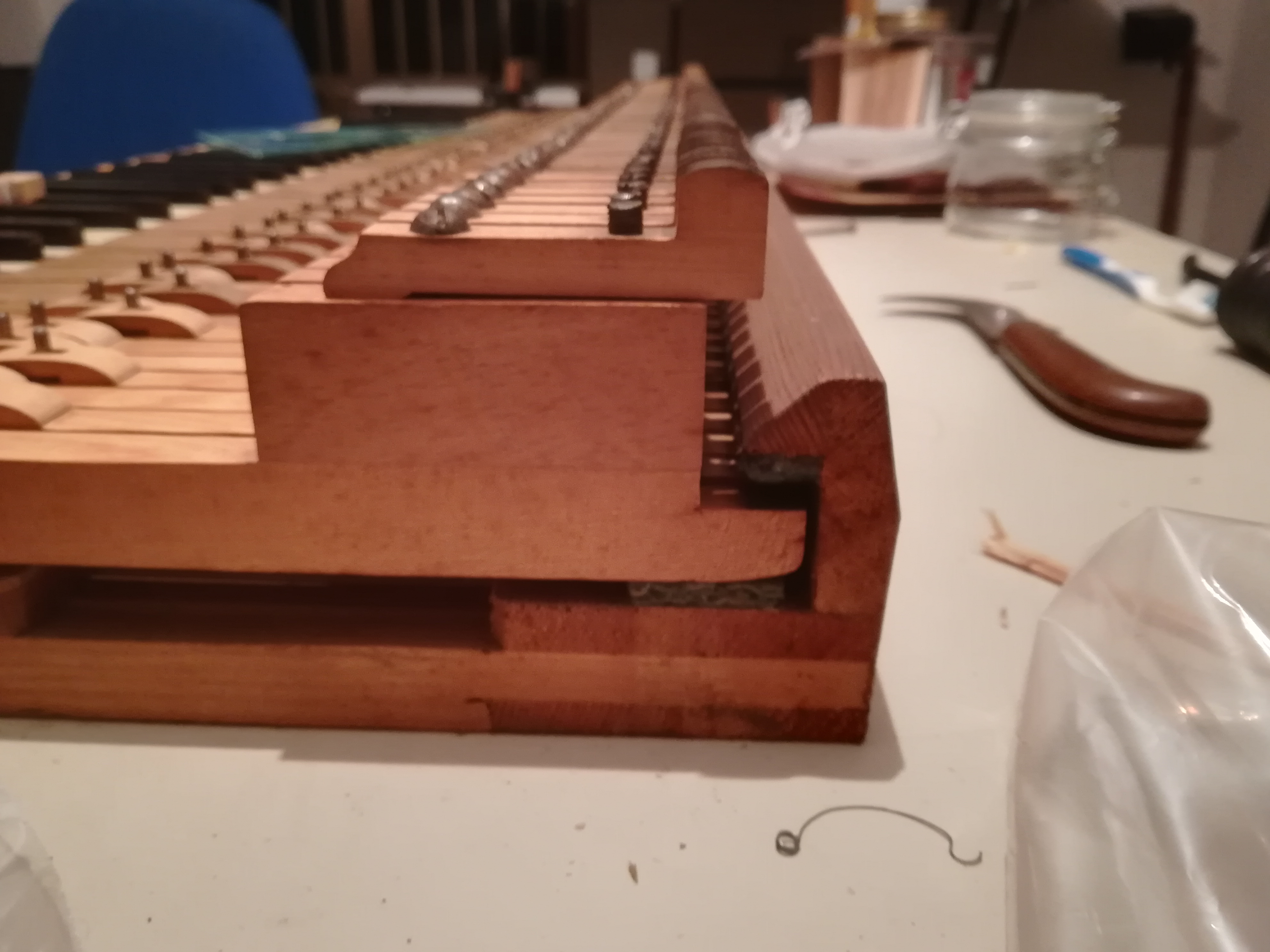
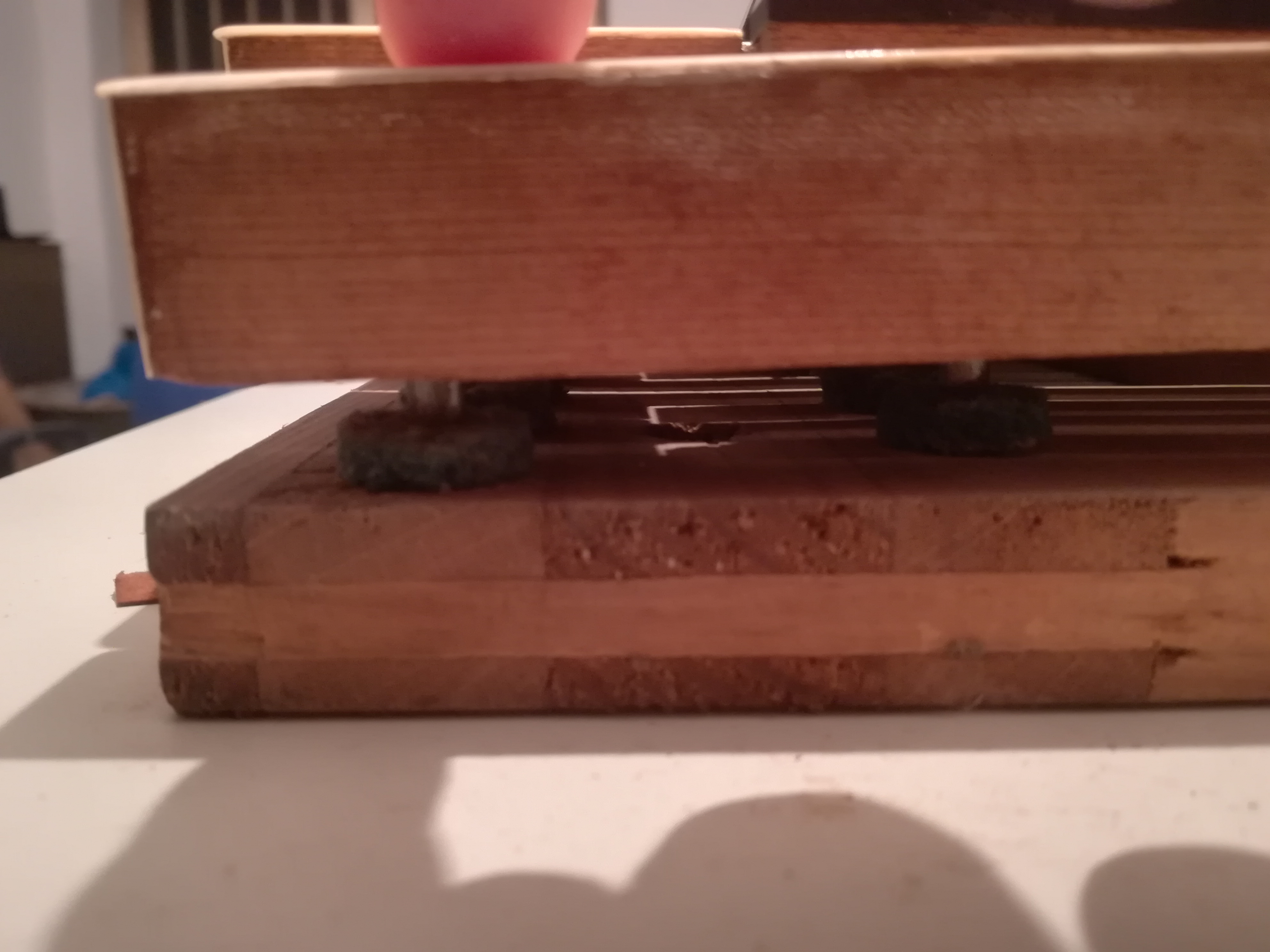
I am writing because I noticed something peculiar in the piano I have: as you can see in the attached photos, the keyboard frame has a horizontal bar that stops the key travel so much that it makes the keybed felts useless. This is something I have only seen on this piano. Could anyone provide some explanation?
P.S.: the piano was restored in the 80s; it is possible that this component was added during the restoration phase, perhaps.
No, nothing was added in the 80s. It used to be done in ancient times to ensure a stable aftertouch over time. But this proved to be stressful for the key lever, which would have two opposite stop points that rarely combine perfectly. Furthermore, it is not always necessary for all keys to have perfect aftertouch. Sometimes, perhaps, they need 0.05 mm to compensate for inaccuracies in the roller position or other factors. I recommend removing the bar, ensuring good aftertouch provided by the green round springs and the related leveling spacers.
No, nothing was added in the 80s. It used to be done in ancient times to ensure a stable aftertouch over time. But this proved stressful for the key lever, which would have two opposite stop points that rarely combine perfectly. Furthermore, it is not always necessary for all keys to have perfect aftertouch. Sometimes, perhaps, they need 0.05 mm to compensate for inaccuracies in the tracker bar position or other factors. I recommend removing the bar, ensuring good aftertouch provided by the green round springs and the related leveling shims.
Thank you very much for the explanation!
I have another question: what material is the cloth attached to the frame at the back of the piano usually made of?
It's a cotton. The weave is particular. A heavy-weave satin cotton can be used. It was used in ancient times to prevent the nesting of insects and the accumulation of dust and lint. Anyway, it provides a finish. It can be gray or anthracite. The small frame is detached and mounted with a stapler or a staple gun. No glues.