

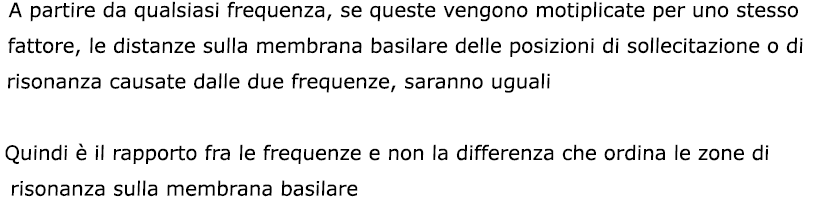
Regarding the physiology of the ear and pitch perception, could someone explain the attached definition to me?
Started by
Rach3
Member
Member
Regarding the physiology of the ear and pitch perception, could someone explain the attached definition to me?

Moderator
if I remember correctly, the perception of pitches is logarithmic. That is, on the membrane, the points that are excited are not arranged as if they divided the space in a pure geometric sense. That is, it's not that between the point excited by C2 and the point excited by C3 there is a distance that you can divide into 12 where each point will be a semitone. In reality, between E2 and F#2 there is a shorter distance than between F#2 and G#2. And it is interesting because that is also what happens with acoustic frequencies, or rather, with their distribution on the monochord. The frequency of C3 is double the frequency of C2.
This means that, I don't know, let's say we give C0 a frequency of 20, C1 will be at frequency 40, but C2 will be at frequency 80. On the membrane, they will all be at equal distances (geometric distances, fractions of a millimeter, I believe), even though C1 is 20 Hz away from C0 and C2 is 40 Hz away from C1.
I don't know if I explained myself well

Administrator
The text says: if you have two frequencies, for example 50 and 100 Hz, and you multiply them by a scalar, let's say 2, to make an octave, going to the basilar membrane and measuring the distance between the two resonant zones (let's assume it is 0.5 mm), the frequencies multiplied by the scalar will always have the same distance on the membrane. This is due to the fact that the basilar membrane behaves non-linearly in frequency (logarithmically, as Thallo already explained to you) and therefore one must calculate a logarithmic difference, but a fundamental property of logarithms states that: log(f2) - log(f1) = log(f2/f1)
"Therefore, it is the ratio between frequencies and not the difference that orders the resonance zones on the basilar membrane," as reported by your book.

Moderator
In short, the octave relationship is physiological... you'll see that Frova is right
Member
I wonder what Frova thinks of Berg
Member
Thanks guys
micamahler wrote:I wonder what Frova thinks of Berg
If you are referring to
"Celestial harmony and dodecaphony. Music and science through the centuries"
http://www.ibs.it/co...odecafonia.html
Don't you find that among the 3, Berg is the one least "driven" towards dodecaphony?
Moderator
I haven't read that book, but a friend spoke very poorly of it to me...
Member
Yes of course, mine was just a provocation given Frova's dislike for these genres. I have that book, I bought it quite a few years ago and I read it. The thing I remember about Frova is that he invented the Fundamental Theorem of Music but I can't remember it... Anyway (in my opinion) when he "limits" himself to topics that concern him more closely (i.e., physics) I find what he says interesting (I am referring, however, to the book Physics in Music)
Moderator
the fundamental theorem of music?! I mean, the further I go, the more convinced I am that music drives people crazy...
Member
micamahler wrote:given Frova's dislike for these genres
If he actually demonstrates scientifically that certain music is distant from the physiology of the ear, perhaps it is not just dislike, maybe it is a fact.... unless science becomes science fiction...
Member
Frova talks about our tempered system, since this is not a matter of fact and since the world continues to make music without taking into account what he says....
Member
micamahler wrote:since the world continues to make music without taking into account what he says....
Do you mean without the tempered system (equal temperament)? So you are referring to the microtonal world?
Member
micamahler wrote:Frova talks about our tempered system, since this is not a matter of fact and since the world continues to make music without taking into account what he says....
But doesn't Berg use "our" tempered system? Could it be that perhaps they were referring to the key/tonality?
Administrator
Rach3 wrote:However, if it actually proves scientifically that certain music is distant from the physiology of the ear, perhaps it's not just a lack of love, maybe it's a fact.... provided that science does not become science fiction...
If we are talking about the physiology of the ear in the audible range, then perhaps there is nothing that is physiologically distant. In the sense that certain music can be pleasant or unpleasant, but the basilar membrane vibrates at any frequency. Except for particular cases in the critical band where the perception of two sounds is the average of the two (in the case of beats) and here it is effectively physiological, because if we go to analyze it, in a real-world setting two very specific frequencies sound, but the ear perceives one that is the average of the two... Then there are also other cases, but it's better not to stay here making a list.
Administrator
micamahler wrote:Frova talks about our tempered system, since this is not a matter of fact and since the world continues to make music without taking into account what he says....
One example above all: Stockhausen's equal pentatonic system (with a constant fifth root of 2) made ad hoc to write a piece. Of course, one may like it or not. I think Frova is referring to the fact that practically until the beginning of the '1900s, music moved towards the search for something that sounded sweet to the ear. Probably, both for reasons inherent to the period being referred to (need for rebellion) and to give a turning point to the equal tempered tonal system, some artists felt the need to change systems and in some cases to not care about so-called "classical" rules in order to find new sonorities.
Personally, I prefer the classical, but I do not disdain contemporary music at all, which has many of its merits. De gustibus non disputandum est.
Member
Of course, as far as Berg is concerned, the discussion is about tonality; as far as what comes after is concerned (using Stockhausen or others, Partch, Wendy Carlos, or Indian music as examples), we are talking about temperament.
But then, let's even assume for the sake of argument that Ligeti's music is distant from the physiology of the ear....if I like it, what does that mean?
1) I have a different ear than others, I probably come from Saturn
2) one does not simply rely on the physiology of the ear to judge a musical piece
to posterity