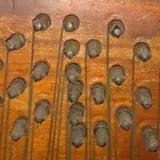
Hello, I wanted to know that in order to change a bass string on my C3, how much string needs to be left from the hitch pin towards the keyboard; that is, since the same string was turned about 3 times to be removed, is it enough to measure the length of those 3 turns which amounts to about 9 cm? I await advice (I already possess all the tools to pull up the string windings, etc..) Compliments on the site valter
It seems to me that you already have the answer. Check with a piece of string if the turns correspond to 9cm... although it seems like a bit much to me (usually no more than 4 fingers = 7.5-8.0 cm). Set it at least half a tone higher and wait one night before tuning. Turn it clockwise at the end of a turn. Bye
I forgot: remember to tighten the string windings well and, at the end, check the grip of the tuning pin. If necessary, give the tuning pin a tap. There is a controversy regarding whether one should only turn or only tap the tuning pins. In my opinion (and also according to the American school), both are necessary. It is true that by unscrewing (by hand) and rewinding, the micro-texture of the hole seat is not modified at all. However, a complementary tap creates a positive friction that benefits the grip of the tuning pin. Furthermore, the tap allows the tuning pin to go, even if minimally, to find the part of the hole that is still tight because it has been unused. Good luck with your work
Hi Paolo, I'm taking the opportunity to wish you a Happy New Year and to ask you for some advice.
I installed the bass strings on my C3 (in the end, I changed about ten of them), about 3 and a half turns on the tuning pins, tight turns in an impeccable way; basically everything is okay, except that I don't like how the strings sound—they seem dull and metallic. I also tried turning it counter-clockwise on the capstan at the end, since the capstan rotates counter-clockwise and not clockwise; I should mention that the old strings sounded better than these. The only thing that comes to mind is that you said to turn them clockwise, but that seems like it would loosen the capstan since it was designed to rotate counter-clockwise.... ugh, anyway, enough words, I await your kind advice (as for the rest, dampers and hammers seem fine to me) thanks, see you soon, Valter
The string must be wound in the direction of the copper winding. Everyone winds strings clockwise... except Steinway, which winds them in reverse. Therefore, they should be wound clockwise. In any case, the strings, even without the "winding," should sound good if they are wound correctly. The wire-winder should test them as soon as they finish winding. Let's hope that by winding them in the opposite direction, you haven't caused the copper to shift. When in doubt, it is better not to wind them. So, try one of those that are not very resonant to eliminate the torsion. Let me know. Also measure the bridge load at that point and make sure there has been no movement of the bridge. Best regards, Paolo
Hi Paolo, I returned these past few days and haven't been able to update you on the situation with my C3. In effect, I turned the strings clockwise and now they sound really good, except I notice that some strings tend to go up instead of down; I did as you said and kept them a half tone above for a day, anyway I don't think it's a problem. The thing I wanted to ask you before having a proper tuning done by a tuner is, how long should I wait before the bass strings stabilize and don't lose their tuning immediately after a few days? thanks again for your availability, see you soon Valter
Yes, sometimes the bass strings tend to rise. Wait about two weeks and check that the strings do not go out of tune. You also need to carefully check the contact with the bridge and ensure that the eyelet is all the way into the frame pin. They should stabilize. If this does not happen, you must be sure of the correct dimensions of the copper and the steel, as well as the length of the copper winding relative to the total length. But surely you will have been precise in the duplication. The new strings might have a slightly different timbre....Let me know. If you then require my intervention, Rieti is not that far away. Bye Paolo
It's risky. Up to a tone and a half is fine. Steinway can even go to two. But think, by changing all the bass strings, bringing them a fourth higher, what tension load you could apply to the frame! I'm a bit against it. I respect my colleague's choice, but I wouldn't do it too lightly. Furthermore, one could risk breaking a string.
Good morning, reading this post a doubt has arisen for me: are there effects on the timbre and on the tuning stability in the long term if, when replacing the steel strings, it is decided to let them settle by tuning them several times only to 440 Hz?
The fact of bringing them immediately up and only once contributes to stretching the entire string, including the backstrings. It does not seem to me that there are any influences on the timbre.
The fact of bringing them up immediately and only once contributes to stretching the entire string, including the backstrings. It does not seem to me that there are any influences on the timbre.
Thank you, in the case of the Schimmel I wonder if a tone could be suitable for the steel strings... generally speaking, how long would you recommend leaving them like this before returning them to normal?
The string must be turned in the direction of the copper winding. Everyone winds strings clockwise... except Steinway, which winds them in reverse. Therefore, they should be turned clockwise. In any case, the strings, even without the "turn," must sound good if they are wound well. The wire-winder should try them as soon as they finish winding. Let's hope that by turning them in the opposite direction, you haven't caused the copper to shift. When in doubt, it is better not to turn them. So, try on one of those that are not very resonant to eliminate the torsion. Let me know. Also measure the soundboard load at that point and make sure there have been no movements of the bridge. Best regards, Paolo
good morning.,,,
as far as the first strings with double copper winding are concerned, I have read conflicting opinions...
in your opinion, to improve their sound without replacement, is the direction in which they should be turned that of the first winding or the second (the outermost one)?
Generally, the final winding is the one that "closes" the string.... so if the goal is to tighten the copper to prevent it from "escaping" and causing humming, the answer seems obvious to me: you have to tighten the winding that keeps the string closed, which is the final one.