

Dear Friends,
today I performed my first tuning using a PC program, perfect, let's see how long it lasts...thanks to everyone!!!
Started by
Giovannip
Member
Dear Friends,
today I performed my first tuning using a PC program, perfect, let's see how long it lasts...thanks to everyone!!!
Member
I'm curious: what application did you use? And is the microphone from the PC or did you use an external one?
Let me know.
Member
Dirk's Project Program
mic neumann u87ai
rme fireface 800 audio interface
Member
The microphone is interesting. Have you noticed uncertainties at the extremes of the keyboard, particularly on the low notes?
The program is similar to mine but has graphics copied from some famous tuner and costs about half as much.

Administrator
A 2000 euro condenser microphone to tune a piano ?? Azz ! Lucky you ! But one day I'll have it too...
Member
The sound card is also "heavy"!
Member
Anyway... I think a Shure Beta 58 is more than enough, the PC preamp should be abolished, it needs a decent sound card!! The Neumann and the sound card belong to the studio, I would never have bought them just for the piano; instead, I think it depends a lot on the piano, it's a Kawai upright, almost new, anyway I am in the experimentation phase... I have to practice trying not to cause any damage, thanks again!!
Administrator
DoubleProMusic wrote:Anyway... I think a Shure Beta 58 is more than enough, the PC pre-amp should be abolished, it needs a decent sound card!! The Neumann and the sound card belong to the studio, I would never have bought them just for the piano.
I'll say!
Of course, if it just catches the right frequencies, a Beta 58a is already luxury!
Member
saverio wrote:Beautiful explanation pianoexpert!!! I am also aware that if one cannot follow a tuning course... it is BETTER to follow your tutorials, they are much better than various texts see e.g. the text by Walter Pfeiffer on the hammer, dampers etc etc.. all theory.. many drawings ..but I finally understood a little something only through the tutorials of the GREAT PAOLO! regards
saverio
.......I am so sorry but I cannot understand the difference between an ankle that rotates and one that twists ...the example of the right index finger clenched in the left did not clarify things for me .....could it be explained better?

Moderator
My example may seem extreme. In reality, the torsion is minimal, but it can be felt. Obviously, the ankle must assume its true final position. This can be achieved by gently "springing" the key.
Member
pianoexpert wrote:Very well, Giovanni!!!!!
So I can consider you an "initiate."
Many have learned to tune by discovering secrets and observing their own tuner, perhaps a good tuner.
It was the same for me.
I remember that when Orsini, a great master, came to my house, it was a celebration. No one, before him, had managed to satisfy me. In his essential, coarse, and good-natured way, he did not skimp on explanations and advice, and I, a boy not yet twenty, was fascinated. When he left, the piano was truly in tune. It vibrated throughout its entire range. Everything was beautiful and singable. Arthur Rubinstein thought so too; when he was in Rome, he only wanted him.
Now as far as you are concerned, you possess a good key (I assume with a star socket!), so....off to experience. You can even tune a piano frequently; it does no harm to the instrument (but be careful not to make "stressful" movements with the key, risking ovalizing the holes). But you must observe certain precautions.
When turning the key, one must sense when the wrist turns and when it "twists." Sometimes we think a movement has occurred... instead, only a single twist has happened, or it partially turned and partially twisted. To understand this, simply take your right index finger and grip it with your left hand. Let's try to turn it. We will see and feel that the finger first twists and then, under the pressure of the torsion, begins to turn. Therefore, go up a little more than is correct and return slightly back with a SWEET, soft spring of the wrist. The tighter the wrist (the better), the more, naturally, it struggles to move and therefore initially twists. Try to learn to feel the distinction between the two movements. Well, then: descending fifths and ascending fourths. Verify the major thirds which, from F-A below middle C, should have beats of progressive speed. F-A about 5 per second, A-C# 7, C#-F 9, F-A 13. Close the verification between the major third F3-A3 and the tenth F3-A4. Same beats. Being able to clearly distinguish from that F3 to A4 is a good start. Keep me informed of your progress. Then we will talk about other checks. Good work, Paolo
Gentlemen!?...this is art!...and the beautiful thing is that Paolo talks about it as if he were preparing ragù!...(ingredients: 2 thirds, a sprinkle of fourths, 3 fifths, beats as much as needed, twists etc. :-) ) thank you Paolo...not only because you are not jealous of this knowledge by sharing it and making video courses, but because you make me look at the piano, which I have played as a self-taught person forever, with a different eye.... Now I am studying music theory and doing exercises just like a little student in their early stages...and the thing fascinates me to death...all thanks to Paolo and Simone....anyway excuse my off-topic comment...just to say that I too have done more tuning experiments on my piano following Paolo's teachings...It is BEAUTIFUL!...bye
Moderator
Dear Giulietto, thank you for the excessive compliments. Obviously, practice is not so strictly adherent to Theory. Regarding the ironic parallel with the ragu......you are saying something profound. Aside from the fact that I am a very amateur enthusiast cook (on Masterchef they would shower me with insults), the example fits. I believe in the "way of doing things" and I personally think a lot that there exists a Modus, or at least a common approach, to all things. I don't want to expand too much, because the discussion would be long and complex, but Cooking, Painting, Music, Theater, Dance, etc., can be traversed by a sweet "fil rouge" that makes them recognizable to one another. How many times do we admire a classical painting with its perspective and planes of depth and a piano melody with an accompaniment background comes to mind. And yet when we mix colors, as my father-in-law used to say, the famous watercolorist Bruno Mercuri, it really feels like executing a recipe: "...here, add a little bit of this, a little bit of that... more... there, now the color is ripe". The famous and infinite "shades of gray," for example, can be understood in a superficial and simplistic way: just take black and add white until you reach the desired gray. Not at all!!!!!!! One must know that gray is not at all a "whitened black," but comes from the wonderful encounter between brown and blue!!! Only in this way can all the shades be obtained....but also all the gradations. That is, every time we discover deeper visions, a World opens up to us, at least that is how it is and has been for me. This is why in Music it is not enough to play softer or louder and keep time (at the risk of the anger of the Maestros who are afraid of "tempo flexibility"), just as in Cooking it is not enough to add salt to flavor. Instead, that vision of the "WHOLE" which, as I have already said numerous times, is MORE than the sum of its parts, we must strive to glimpse and conquer. Simplicity, then, can be the most effective and profound language, which transcends superstructures and looks directly at the "doing".....Well, I've talked too much too!!! What do you think?
Member
In my opinion, an expensive microphone is useless; in the end, it only needs to measure the correct frequency of a single string. Furthermore, the Shure Beta 58A microphone is dynamic and not a condenser (which is more sensitive); moreover, it detects from 50Hz minimum, while the piano starts at 27Hz. So, in my opinion, an inexpensive condenser microphone with a range of 20Hz - 16000Hz would suffice. What do you think?
Administrator
For uses of this kind, even the microphones you find inside a panettone would almost suffice. A condenser microphone is absolutely not necessary; even a contact piezoelectric one (a 5 euro microphone) would work perfectly well.
Member
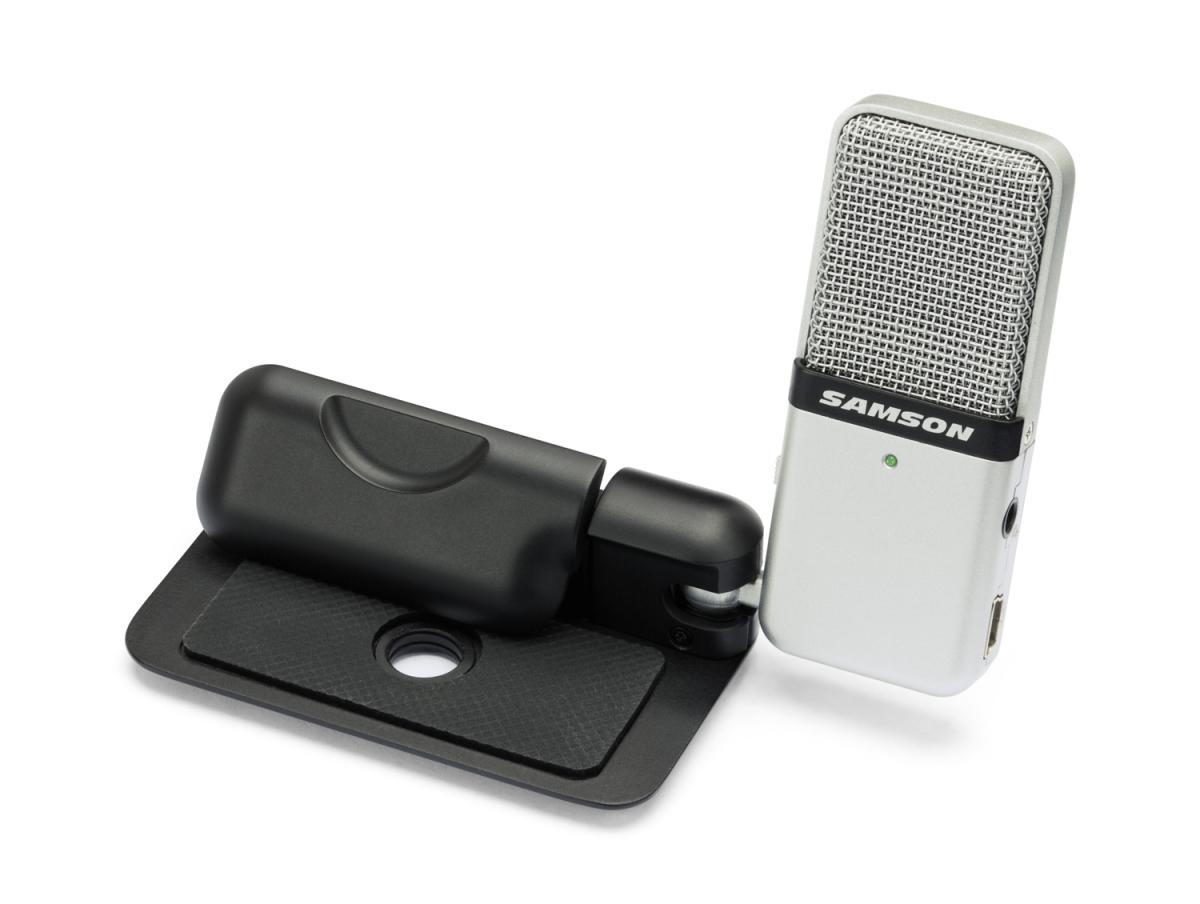
I use this little capacitor one, it fits in the palm of a hand and you connect it directly to a USB port, and importantly, it costs little.
Administrator
Guys, anything is fine. The important thing is that it has a capture capability within the audible frequency spectrum (20 - 20 kHz). It doesn't matter what its frequency response is like; what we need is for it to be able to "hear" the frequencies at play when tuning a piano, and believe me when I tell you they are perfectly "audible" frequencies for any microphone. It makes no sense to buy an expensive microphone solely for the purpose of making it hear frequencies regardless of the capture quality.
Member
Simone, before this microphone I have tried several others, always for just a few euros. Surely, as you were saying, everyone knows how to "listen"; the problem is that these tuning software programs do not know how to "hear" all the frequencies of the piano, especially the last octave; therefore, there is a need for a slightly better quality microphone, naturally I am referring to the versions installed on a PC.
Administrator
On the last octave, the problem is probably due to the fact that the piano doesn't have great sustain for those frequencies... The envelope is very fast, so perhaps that's why you didn't find yourself with 5-euro microphones. However, they certainly weren't contact piezo ones. Those cost 5 euros and work better than all of them. They have a clip and the piezoelectric capsule is in direct contact with the surface of the piano. For tuning with this software, those are the best and they cost next to nothing.
Member
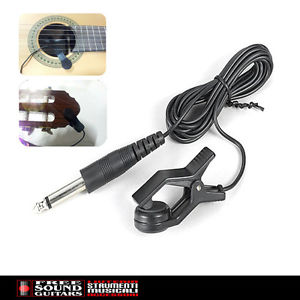
A while ago I bought this microphone, but since I didn't like it, I decided to change it thinking it would be suitable for the guitar; which one would you recommend?
Administrator
The microphone is of this type... I still have a Yamaha piano tuner dating back to the era when these tuning software programs didn't exist yet. The provided microphone was in direct contact.