Do you know anything about "proportional notation"?
Member
Opening post by Tiger
- Posts
- 447
Started by
Tiger
Member
Member
Do you know anything about "proportional notation"?

Member
As far as I know, "proportional notation" can indicate two quite different things.
1) In the most widespread sense, it indicates a rhythmic notation in which values are not defined by a pre-established proportion (for example: 1 quarter note = 2 eighth notes) but by the spacing adopted in the score. See, for example, Berio's Sequenza I for flute: in the legend it writes «The performance time and duration ratios are suggested: from the reference to a constant amount of space corresponding to a constant metronome pulse; from the distribution of notes in relation to that constant amount of space». In this case, there are pseudo-measures of defined duration (70 BPM), within which the musical impulses are distributed in a non-strictly metronomic way, but based on the concrete spacing of the notes. Sequenza III for female voice is even more "free", as the measures are reduced to large "containers of events": for example, the first staff is formed by four "pseudo-measures" each ten seconds long.
Another example: Kurtág uses proportional notation quite willingly, and in a very expressive way. See Játékok. Often the measures have no metric meaning: they are "containers of events" of indefinite duration (the duration is suggested by the "breath" of the phrasing). A half note indicates a longer sound, a quarter note a shorter sound...
2) Less widespread sense. Donatoni's scores (at least starting from the mid-seventies) are in proportional notation, as the spacing of sounds proportionally reflects the duration. For example, a dotted quarter note is 3 centimeters away from the next sound; consequently, the eighth note is 1 cm away from the following sound, the sixteenth note 0.5 cm, etc. Donatoni's scores have a very orderly graphic layout (clinical, if you will), in which all events are perfectly aligned (thanks to the fact that the meter never changes within the piece!).
Strangely, it is one of the few points of contact between Sciarrino and Donatoni: Sciarrino's rhythmic notation is tendentially proportional (I am looking at the Sei quartetti brevi and Quaderno di strada).
I remember reading an essay by Dahlhaus (in In altri termini) in which proportional notation was stigmatized as being uneconomical (more taxing for the performer's eye) compared to traditional rhythmic notation. Perhaps he was right!
Member
Interesting, but if a conductor were provided (imagine a piece that involves an orchestra, even a small one), what system would they use to conduct?
Member
Proportional rhythmic notation, understood in the first sense of my previous post, was experimented with in music for ensembles and orchestra starting from the late fifties, for about a decade, by composers developing "indeterministic" thought (the matrix being Cage's aleatory). Leaving aside the more "extreme" cases, proportional notation was used in orchestral music in the following manner: the "pseudo-measures" I was talking about delimit the beginning and the end of a musical event; the conductor indicates the attack of an event (lasting 10 seconds, let's say), the instrumentalists play; after 10 seconds, the conductor indicates another attack, and the instrumentalists move to the next section, and so on.
Donatoni himself used proportional notation (always in the first sense!) in orchestral music, for example in Per orchestra (1962). Later, when he had already oriented himself towards other techniques, Donatoni occasionally returns to proportional notation in a section of Duo pour Bruno (1975), when the strings (always divided by stand!) move with indeterminate rhythms within short "pseudo-measures": the aleatory coefficient is practically zero! http://www.youtube.com/watch?v=bvxVL8lOQmo around 13:31, if I am not mistaken!
Member
RedScharlach, do you happen to have the score in PDF format or do you know where to find it?
Member
Kappa wrote:RedScharlach, do you happen to have the score in PDF format or do you know where to find it?
The PDF of Duo pour Bruno is rather unacceptable, as the score is about a meter and a half high (always using divided strings per stand!). You can retrieve it by writing to Suvini-Zerboni, since it is now out of print, or in some music library...
Member
Here is an exemplary PDF, so the previous discussion should be clearer!
Member
Thank you RedScharlach
Member
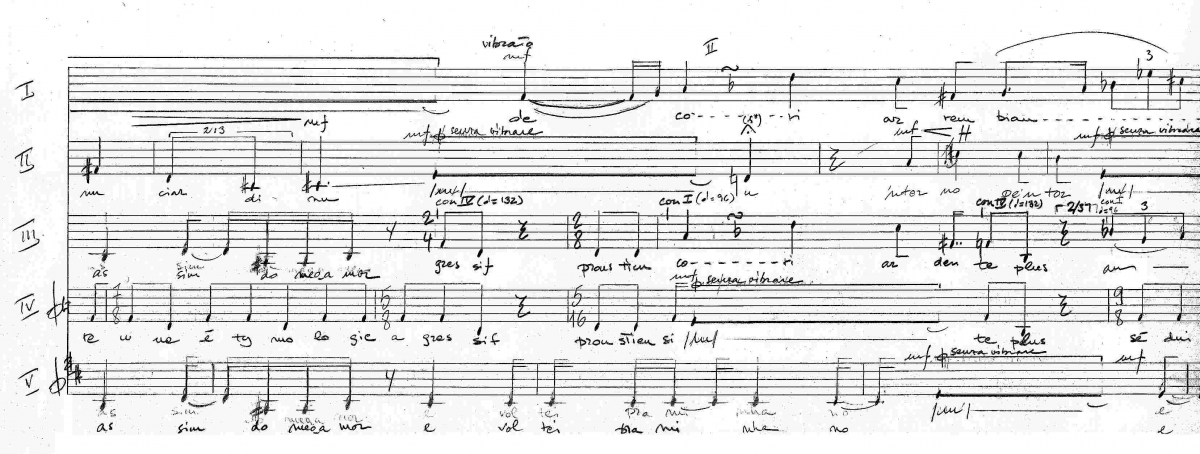
Proportional notation can also solve problems such as polymetric ones; I attach an example by Nicola Bernardini: "D'Altro Canto"