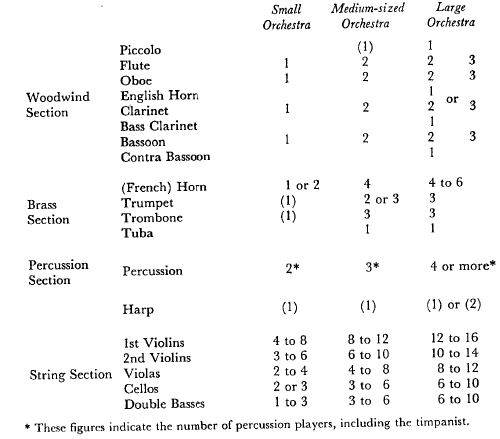
Good evening everyone... I would kindly like to know how one could reduce an orchestral ensemble of an opera to a maximum of 40 elements.
Given that the original score calls for: 1 piccolo, 2 flutes, 2 oboes, 2 clarinets, 2 bassoons, 4 horns, 2 trumpets, 3 trombones, 1 tuba, timpani, 2 percussionists (various percussion), 1 harp and strings...
...what do you advise me to remove? I suppose the woodwinds must remain unchanged, right? If I use 23 performers for woodwinds, percussion, and harp, what is the best way to divide the remaining 17 among the string instruments? I was thinking of 5+4+3+3+2, but tell me what you think... I haven't found much in orchestration manuals regarding reduced ensembles.
I even attempted to count (but in vain) the instrumentalists from the famous production of Falstaff at the tiny Teatro Verdi in Busseto conducted by Muti
Thank you!
E
Eagle
Member
Reply 2 by Eagle
Posts
264
The strings are decided by the conductor during the rehearsal/planning phase based on the weight of the other sections. To be clear, the orchestra is very unbalanced towards the brass... are there "tutti" parts occurring simultaneously with the string parts?
But with 5+4+3+3+2 do you mean 5 (1st violins) + 4 (2nd violins) + 3 (violas) + 3 (cellos) + 2 (double basses)?
Yes Eagle, I meant 5 first violins, 4 second violins, 3 violas, 3 cellos and 2 double basses.
As I said, the original score calls for that instrumentation (it's true, there are 3 trombones and 1 tuba, but it is also true that there is a piccolo along with 2 flutes) and it is not an instrumentation different from those used in many works of the early nineteenth century (with the exception, indeed, of the presence of 1 piccolo and 2 flutes instead of 1 piccolo and 1 flute).
I know that for small theaters a reduction of the instrumentation is planned, but in this case I am the one who has to present a score that is already reduced from the start, so I would have to adapt the one I already have for a maximum of 40 performers.
N
Natan
Member
Reply 4 by Natan
Posts
239
There is no rule, it depends on the textures and how the parts of the original composition are managed.
If the strings play together with all the brass in fortissimo... I don't know how healthy it is to make the mass of the strings thin. Likewise, if strings and brass never mix, it might be simpler due to the greater use of woodwinds+strings.
There is no rule, it depends on the textures and how the parts of the original composition are managed.
If the strings play together with all the brass in fortissimo... I don't know how healthy it is to make the string mass thin. Likewise, if strings and brass never mix, it might be simpler due to the greater use of woodwinds+strings.
Well, they mix during fortissimo moments when practically the whole orchestra is playing, but they are often separate, in the sense that either only the strings play (together with the woodwinds and at most the horns) or perhaps only the brass play (truth be told, rarely)....And it is also rare for strings and brass to perform the same melody in unison or in octaves (to be clear, there are never trumpets and violins or cellos and trombones). The tuba is a bass reinforcement (almost to counterbalance the presence of the piccolo)....By necessity, however, if the maximum ensemble size is 40 performers, no matter how you look at it I only have 17 string players, so 5,4,3,3,2 I believe is the only available choice. I believe it will then be up to the conductor to play around with the dynamics. I believe...
Cromatismo, is a work that I composed quite a few years ago and which I am now...RESURRECTING
C
cromatismo
Member
Reply 7 by cromatismo
Posts
79
mathisdermaler wrote:
. I believe it will then be up to the conductor to play around with the dynamics. I believe...
Sure... maybe they'll even write you a few notes....
I was asking because I thought it was an author's piece (a composed work). Since it is unpublished, the matter is simplified, in the sense that you have the freedom to rewrite those parts that inevitably don't work due to the change in orchestral weights. Therefore, I see a reduction/rewriting of the parts that cannot work with 17 strings instead of 40 (just to name an example).
For the rest, I think no one in these conditions can give you the solution... only you can know if it will work.
Thanks anyway for the tips, especially to Frank for the image. Let's just say that the original score indeed calls for a medium ensemble; I will see which moments to adjust, always with the aim of staying within the limit of 40 instrumentalists.
Regardless of the ideal, very often in the theater one thing is done above all: putting in a keyboard. Whether it is "a" keyboard (piano, harpsichord), or "the" keyboard (i.e., a sampler that can replace instruments with few interventions), the keyboard solves many problems for you.
From January to April, I took part in a production of L'Elisir d'Amore with a reduced orchestra. It is a project called Opera Pocket. I don't know how they organize themselves, whether they directly give the conductor the burden of understanding the instrumentation or if they decide ex cathedra for purely economic-organizational reasons (very likely...). But the keyboard (well hidden, or resting on the structure of a stage piano) is omnipresent.
In reality, I also had it in a "real" production of Turandot, to replace the gong, which could not fit in the pit.
The keyboard would therefore allow you to replace, at the very least, the Harp (which is a significant cost, since it often presupposes the instrument being on-site; that is, many harpists don't even think about carrying it around), perhaps some percussion (if they have solo interventions) and certainly to thin out some woodwinds (since the piano handles the texture/filling).
If the score is complicated, however, this presupposes a skillful transcription work... ... that is, a vocal and piano score is fine, but if you already have the piccolo, it is useless to have its part doubled by the keyboard.
Thank you Thallo for your answer... Indeed the keyboard could be a solution, but in my case it could only replace the harp, because often the harp and woodwinds play together. Perhaps I could use it to replace the trombones (I would gain 3 string players) throughout the entire opera.
Besides, the harp is not a problem since it is provided for in the regulations of the competition I am participating in, so it might as well be used.