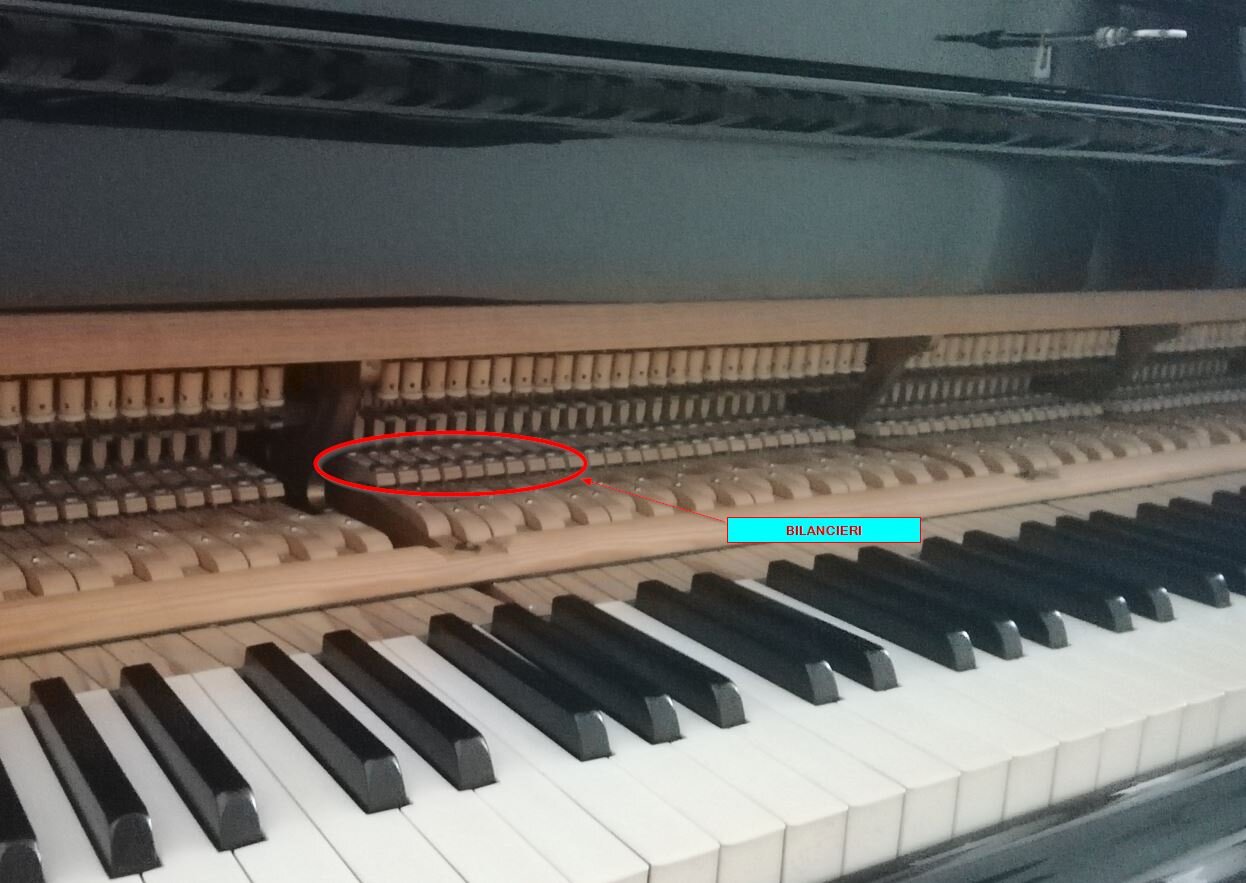
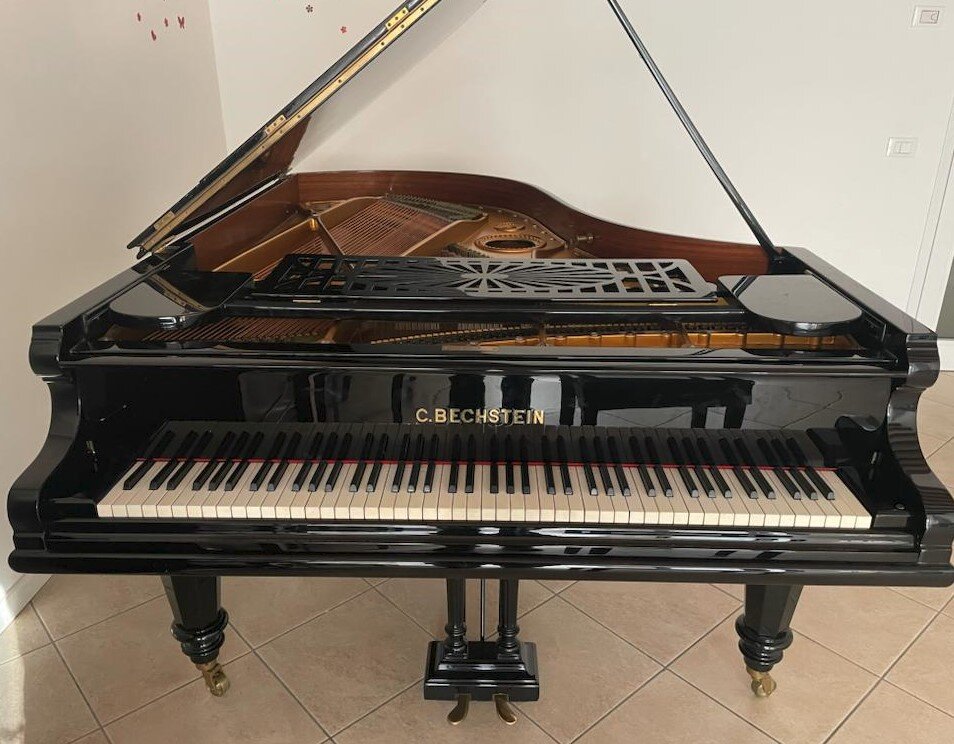
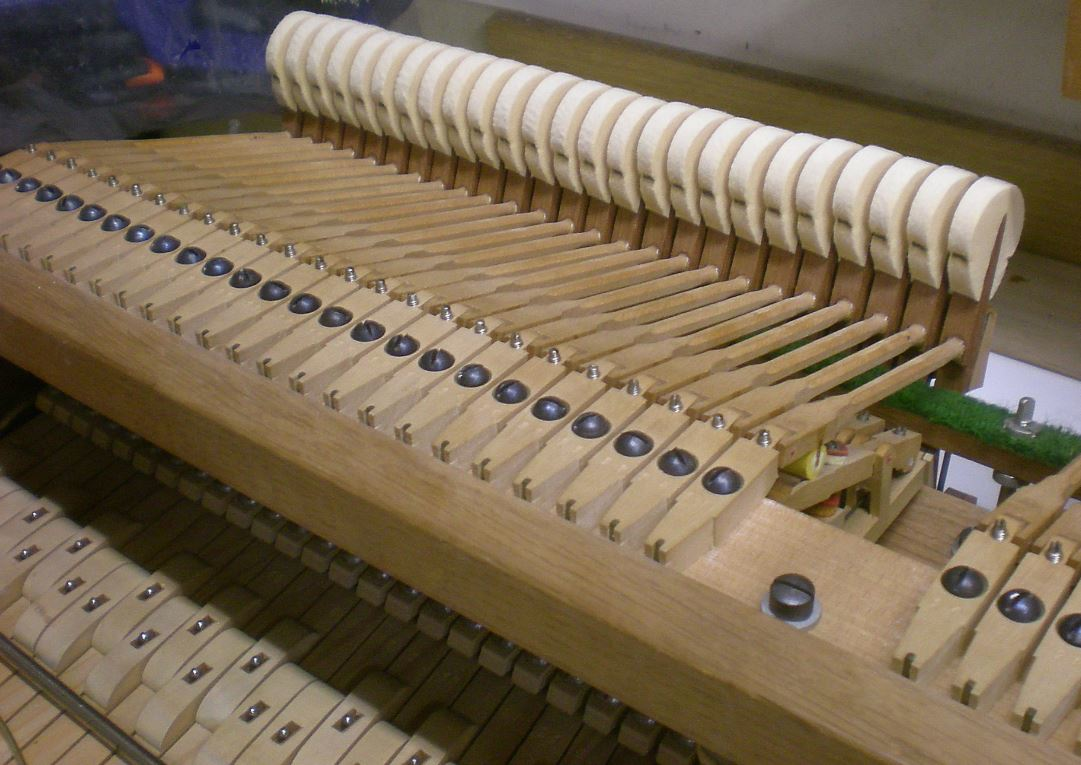
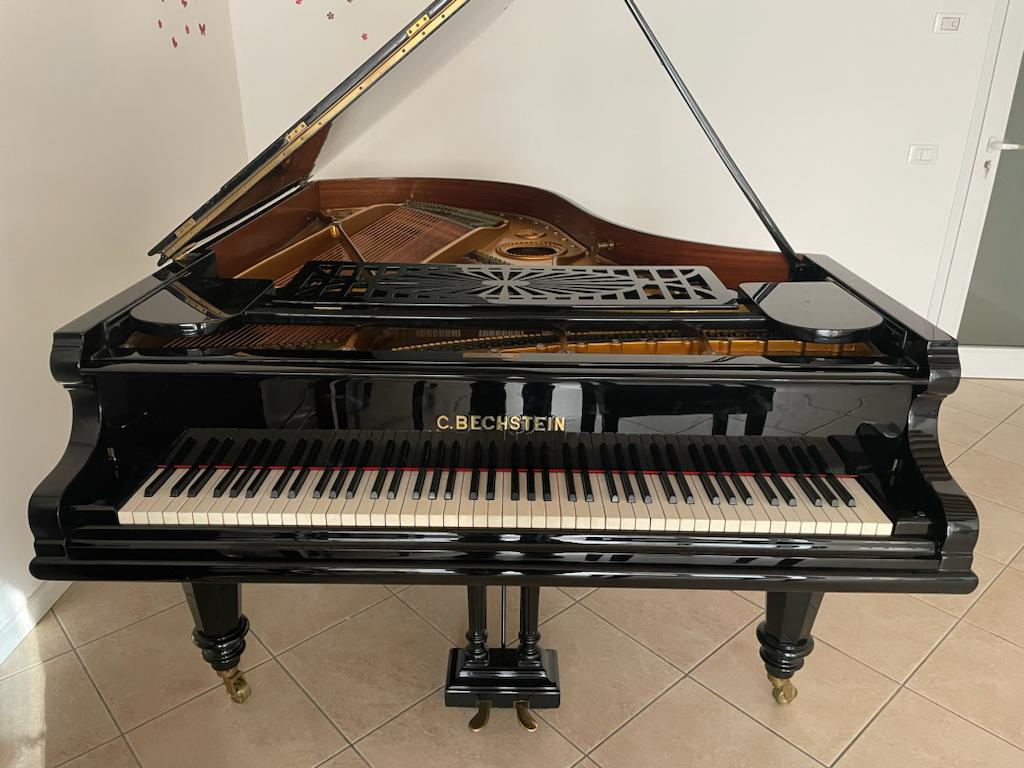
I consider myself a novice in the world of piano construction, but the curiosity to discover how they are made internally has always fascinated me. It's incredible how new details are discovered! My Bechstein B203, which in my opinion possesses a timbre unique and incomparable to modern pianos, I am discovering has a "linked" type action (or mechanics). It is a Langer action from the early 1900s, an outdated version, but I don't believe this makes it less performant for playing 1800s repertoire. I would like to know if anyone has more information on these specific actions. I know that regulation is more difficult due to the need to adjust the screws on the wippens (see attachment). But beyond these maintenance difficulties, what defects might it have had in the past and assuming it had merits... what are we potentially missing out on regarding these old construction concepts that have fallen into disuse? Is it worth updating it with new parts? Or do we risk losing its authenticity? If anyone still uses it, I would be pleased to hear your opinions. Thank you
updating it with new pilots means replacing the capstans. This involves rechecking the geometry of the entire action. I have done it twice in the past successfully. However, every instrument has its own specifications. A piano this old must certainly have the hammer rail that needs replacing. Everything is very specific regarding weights and balancing. (a hammer rail to be custom-made!!!!) It would need to be examined. As a pianist, I personally had one and I must say the sound was very beautiful. The condition of the strings also needs to be evaluated.
Regulation is extremely important. It transforms the piano and makes it ready for any repertoire. Nothing outdated. The double screw is a nuisance. The linked action was a period for Bechstein and others. The piano definitely has 85 notes. The B 203 sounds good. Some have a small defect on the bridge notch in the cantabile section....but it's minimal.
I would look first at other refurbishments that could improve the instrument. If you want, call me at 3393395980
Dear Mr. Paolo, thank you for the advice. The piano has 88 notes. After years of work preparing for a recent diploma, the piano's action has now been maintained, with new hammer clothings and a slight tightening of the hammer felt (typical of Bechstein) to eliminate grooves, and then re-regulated. In the future, I might consider a deep overhaul as you suggest. My only concern would be losing the originality of the action, which, as you say, is unique, very weighted and balanced in a way that has no equal (in my opinion).
May I ask what you mean by that "small defect on the bridge cut in the cantabile"? How can one recognize it? I always find it interesting to learn these details: rather than defects, I would call them specificities, because these pianos have nonetheless made their history with their merits... and also their defects. I am attaching some photos (if the sending works). Regards
"tirata ai feltri della martelliera" means RASATURA!!!!! wrong! I am against scraping. The sound will seem more compact at first....but after a short while it will become harsh and woody! The hammer head should be replaced and made to look like the original. Furthermore, by scraping it, you change the entire geometry of the action and the striking point (FUNDAMENTAL). Also, over time, hammers harden and scraping them means increasing the rigidity even more, making it increasingly difficult to voice.
I don't see any photos.
Anyway, the situation with the bridges remains to be seen. But it is not serious....if it exists: I haven't encountered this particularity in all models of old Bechstein. I am sure the piano is beautiful!
Yes it's true, I had been informed of the shaving risk. The attempt was made anyway given the urgency of replacing the hammers as a priority to have good feedback under the fingers. After years of study, the hammers were now exhausted and the sound was harsh in the cantabile due to mechanical irregularity and grooves. Now it has regained some roundness. The shaving was done by a professional and the hammer rail was already new at the beginning of the study cycle. We shall see.
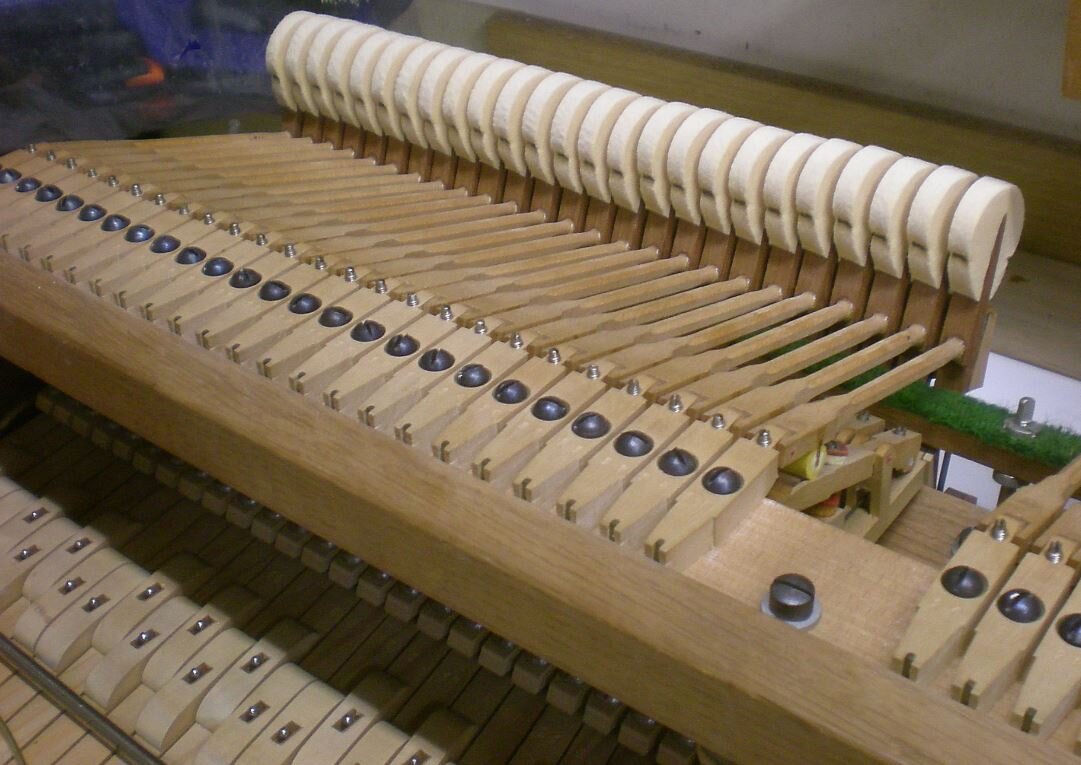
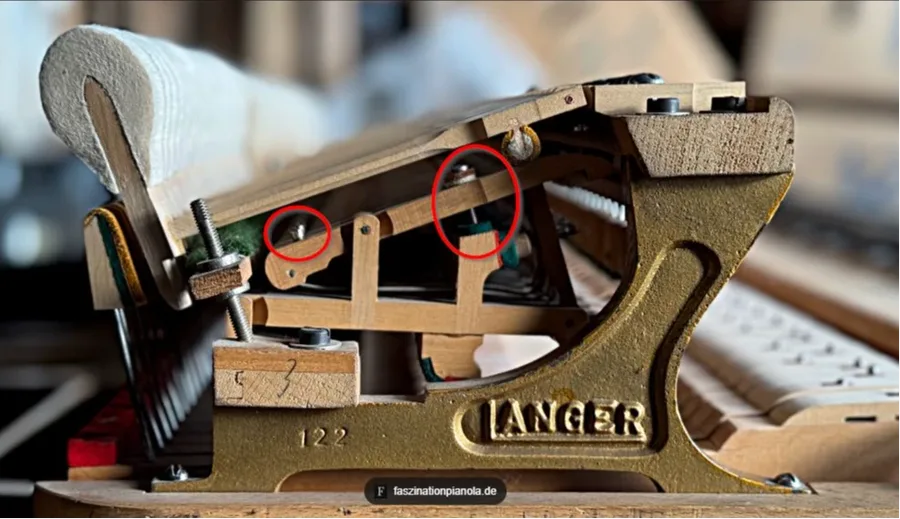
I would like to return to the topic of my Bechstein action to ask for more light on the function of these two screw heads in the photo below. I should preface that this photo is not properly my mechanism, but is taken from the web, though it reflects exactly the same components/arrangement (aside from the fact that mine is a repetition action). In particular, I would like to understand what the function of the left screw is. I suspect it affects the spring, but what is its role in the regulation? Also, I wanted to ask you: the effect that is visually obtained when the hammer, having struck the string and having descended, rises again for a brief snap, slightly loosening the pressure of the finger on the key (aftertouch? 1?)…… which screw governs this brief snap before the hammer returns to its natural resting position upon total release of the key? I would like to understand how to regulate the mechanism to have greater control over the pianissimo…… Thank you in advance for your precious advice.
A
albertoSonata
Member
Reply 8 by albertoSonata
Posts
16
Hi Chri, as a pianist who loves the Romantic repertoire, I tell you that sensitivity to the pianissimo is everything to me. Regarding that aftertouch snap, I doubt it's a single screw: it involves the balance of the lever and the slider springs. The left screw seems to adjust the tension of the wire or the draw spring, affecting the return. I advise you to ask a technician specialized in vintage mechanics to inspect the entire key circuit before touching specific screws, so as not to alter the unique balance that you appreciated.
I am of the opinion that owning a piano where you have total control over the pianissimo means having the instrument that lays bare your emotions when you transform movement into sound vibration.
The action of my Bechstein is tight. Some say it is obsolete, but when I play it, I perceive vibrations in my fingers coming from the contact of the hammer with the string. The vibrations enter you and it is a beautiful sensation.
The problem is that this direct connection admits no errors; it requires total control and a lot of technique... and here the age of the instrument doesn't help, nor does the age of the person playing it 😀
I would like to restore it to its original design conditions, because the Bechstein B203 is a model of exceptional quality for its time that would not look out of place even today
M
martello
Member
Reply 10 by martello
Posts
22
Good morning;
I share the passion for that direct control, which is exactly the beauty of these ancient mechanisms... Regarding the screws, I advise against a DIY intervention: on a Langer, every touch shifts the balance of the entire axis. It is better to rely on someone who knows the original geometry, otherwise you risk losing that pianissimo sensitivity you are looking for.
Regarding the aftermath: often it is not a single screw, but the balance between the spring and the hammer weight... A global check is worth more.