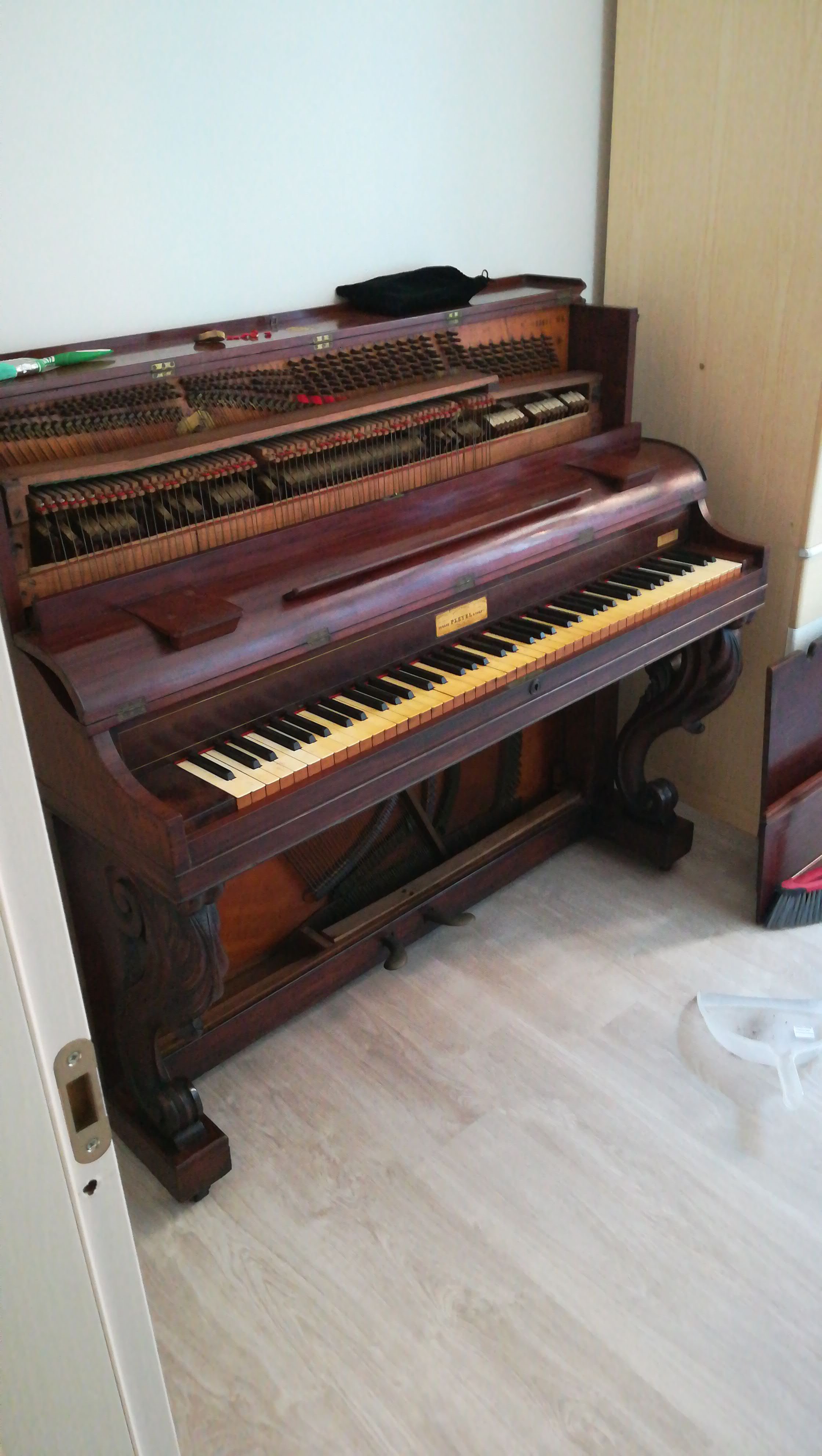
Good morning everyone, I recently received a Pleyel upright piano from 1850 as a gift. Upon opening it, I noticed some initial problems and would like to ask you for some advice for a well-done restoration.
1. The hammer straps (made of leather) are almost all broken and I would like to replace them. I have seen quite a few for sale made of cloth with a leather tip. Would those be okay? However, how do I go about replacing the old ones? They seem to be glued directly into the wood. Is a special glue required?
2. A couple of the high strings are broken. Do you think it is possible to find the same material?
3. One hammer is broken in its shank. Is it better to repair it or replace it?
Furthermore, I am asking if, while I'm at it, there are other parts that are recommended to be replaced, such as tuning pins, felts, etc.
how to restore a piano? This is a question equivalent to "how to disassemble an engine and overhaul it?" A restoration cannot be guided remotely with just a few suggestions. One risks suggesting and encouraging interventions that could do more harm than good. For example, a key lever must be unglued, cut to size, and the hammer reglued with natural hot glue at the correct angle. The repetitions must always be glued with the same glue, preferably inside the jack shank. Strings have progressive diameters, and one must see if they are those for period instruments with a higher carbon percentage. One must check the stability of the tuning pins etc... Given the state of the piano, one also needs to see if it is worth "embarking" on a reconiditioning of the instrument. Among other things, I seem to discern non-crossed strings, and this could mean very poor tuning stability......in short