

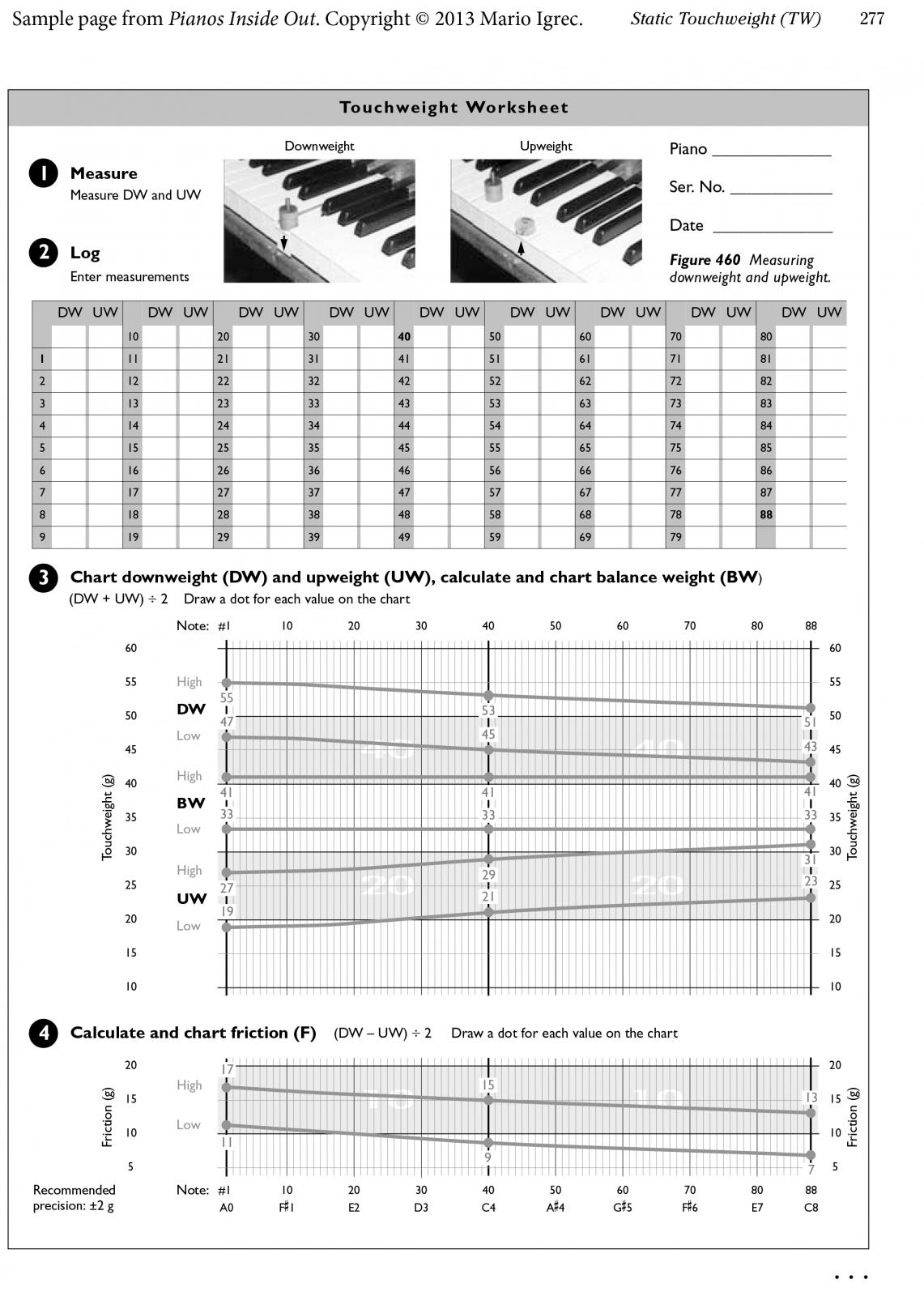
Hello everyone. Still regarding weighing, I found this interesting document. How do the general proportions look to you? Thank you, Have a nice day
m
Started by
Member
Member
Hello everyone. Still regarding weighing, I found this interesting document. How do the general proportions look to you? Thank you, Have a nice day
m

Administrator
I believe it is very useful for technicians. Thanks for sharing.
Member
Yes, it is a correct graph but entirely theoretical; if one were to think of finding real-world confirmation on those curves, they would make some sad discoveries. And even if a technician had the patience to respect those indications to the gram and performed all the checks and actions to reach that situation, the next day they would find themselves with different measurements again, as the mechanical system, even if perfectly functioning, is affected by the climate.
Anyway, in terms of proportions and the calculation of total friction, it is certainly a correct reference, although in my opinion, rather than the numbers, one needs to keep the concept in mind: namely, the greater the distance between the two measurements (downward weight and upward weight), the greater the anomalous friction to be identified. For a quick evaluation, I would say that on average, total friction within 15 grams can be considered normal according to the relationship (downward weight - upward weight) / 2, and downward weights between 47 and 60 grams.
Member
This concerns the balancing of the action without dampers, and without considering the escapement of the mechanism.
Then when playing, one adds the weight of the dampers, any friction in the guides, in the damper lever pins, the friction of the pusher on the roller at the escapement....and one arrives at around the 120 grams necessary to make the first key sound.

Moderator
I agree. The reference is purely indicative. For example, as Giovanni says, the damper affects it. Especially in the vertical [action], the strength of the springs and the friction of the damper pins have a huge influence. On the coda also, especially if the dampers start very early....
Member
Why is inertia considered a negative parameter?
Moderator
Let's not enter a physics classroom... but INERTIA is "the ability of a body to maintain its state of rest or uniform rectilinear motion". Pushing a Fiat 500 or a limousine from a standstill, without a crowd and without an engine, is not the same thing. The 500 will start more easily, but it will stop sooner. The limousine.... you'll be pushing for ages... but once it has started, it will benefit from this laborious push and will preserve its movement more. The former has less inertia than the latter. Any mechanical part that interests us on our instrument has to deal with its weight and with the friction that prevents its movement. We certainly cannot counterbalance a keyboard by adding excessive lead to oppose a hammer action that is very, too heavy. The down weight and the return weight will be in proportion.... but we will have transformed a 500 into a limousine. That is, we will notice that the greater inertia will not favor the "vivacity" of the action, i.e., the ability to oscillate rapidly. Above all, the response of the return weight will be slow under the fingers and we will have great difficulty repeating the key. Just try with a balance scale with overlapping pans and create an equilibrium with 100g and 100g... and then with 1kg and 1kg. By making the pans oscillate, a different "vivacity" of movement will be noticed.
I apologize for the intuitive, perhaps too much, explanation. May the Professors not hold it against me. I hope I have clarified the concept.
Member
Very clear and direct concept..THANK YOU MAESTRO PAOLO FERRARELLI, my respects!
Member
in addition I am attaching the link to the Precision Touch Design website, a weighting method to achieve the ideal touch for the instrument.
Member
good evening sorry I am resuming this discussion even if it is old because it fits my case, (I am new and I take the opportunity to say hello to everyone)
If we have more or less correct downweight and high return weight, what situation are we in? I have more or less these values on my piano
55 - 35 with a ratio of 1.57, I like the piano because it takes little weight to press the keys down and it doesn't tire my hand, but it is a bit slow in the repetitions, according to a professional pianist as well (I am a singer and don't know much about it, but I play a little).
Do you think something can be done? Hearing a technician say that it is already at the maximum of its possibilities
Thank you
P.s. I would like, if possible, to bring it to a ratio of 2
Moderator
We need to see if the mounted hammer action is suitable. It could be too heavy. Furthermore, the keyboard must not be excessively weighted. Based on the values provided, I believe one of these two conditions exists.
Member
Good evening pianoexpert
The piano is theoretically practically new and should be original...
I had also thought about the issue of the hammers...
So by lightening the hammers, could a correct ratio be obtained by lowering the return weight? Is that right?
Member
I didn't understand what kind of piano it is referring to
Member
Yes excuse me, it is a 152cm grand piano... an inexpensive H.J. Bernstein piano made under authority of Pianorama Switzerland, not bad overall....
Member
Ok but with such a short lever you can't expect more ...
Member
Considering that a greater key return speed is nonetheless an advantage, regardless of the mechanical ratio. Let's not focus too much on the theory ...
Member
Considering that a greater key return speed is nonetheless an advantage, regardless of the mechanical ratio. Let's not focus too much on the theory ...
Moderator
I share Giovanni's considerations. You cannot expect much with such a short lever.
Member
Ah I see
So basically we can say that it is in line with any quarto on the market? Or can I take into consideration a possible slight lightening of the hammers?
Member
Explain to me for what reason you should decrease the key return weight? It is an action chosen that way by the factory with a key descent weight of 55 grams, which is correct.
By lightening the hammers you would get less sound, perhaps by subtracting 5 grams from the key. It doesn't seem like a brilliant idea to me. I would also avoid adding lead weights towards the fulcrum to re-establish a theoretical weight ratio, because as already stated, the lever is short and would be affected by the increased weighting, and the greater inertia which would translate into fatigue for the pianist.
If you are not satisfied, you should first identify in which passages you have difficulty, whether in agility, octaves, leaps, legato, staccato etc., and then with a good technician you should evaluate if it is appropriate to review the regulation of the action, evaluating first of all whether the paper strips and the bushings under the key have been correctly allocated in number and type.
Dico questo perché solitamente, e secondo la mia esperienza, nelle produzioni dei pianoforti più economici si tralasciano tutti questi aspetti che comportano un gran dispendio di ore e quindi un aumento del prezzo del bene.
55 grams is an average key dip weight in the current market; sometimes pianos from important brands are found balanced with 60 grams for the key descent, see for example Kawai, which makes this choice precisely to reduce the key inertia, with a sensation of weight that the pianist will not notice within a few pieces and that only emerges after an hour of study (it is the concept of fatigue).
I do not feel comfortable recommending interventions of any other kind.