Good morning,
I recently purchased a Yamaha U1 upright piano from the '80s.
I am very satisfied with the purchase, if only because I was coming from an old 1960s Roesler (109 cm) on which I would have had to spend some money to overhaul the action.
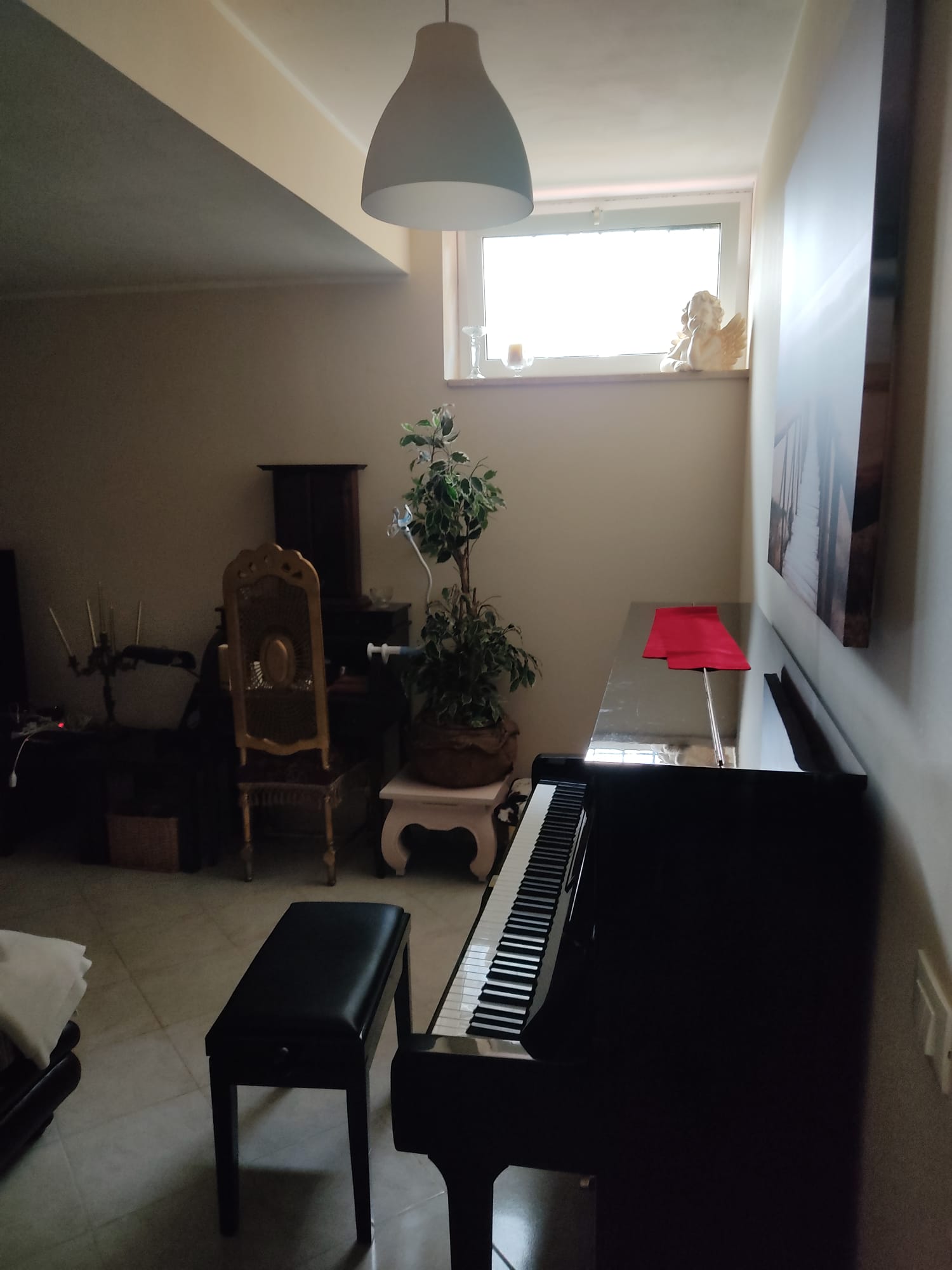
The only thing I hadn't considered is the acoustic performance of a piano of that height in the room where I placed it.
We are talking about a small basement living room of about 30-35sqm (about 7m x 5m). The ceiling height is quite low: 270 cm where I positioned the piano (against a wall) in a small area, but for the rest of the room it is only 230 cm (I am attaching a photo). In the living room, there are: a very large sofa, a coffee table with a 55'' TV, several paintings, a small bookshelf that is currently quite empty of books (positioned against the opposite wall), and a treadmill.
I want to clarify that what interests me is not so much limiting the sound diffusion beyond the room, because fortunately I live in an almost independent villa, but trying to improve the acoustics within the room itself where the piano is played. Let's say the sensation one gets is a sort of reverberation, especially (and obviously) if the piano is played at high volume.
I don't have huge pretensions, also because I would neither want to overhaul the living room decor nor spend too much money.
I noticed that by placing a duvet behind the piano, the sound emission is reduced by a good 30%, but it would remain a temporary solution that does not satisfy me much aesthetically. Therefore, I was wondering if it would be possible to improve the situation slightly through some small intervention.
For example, if I placed those grey sound-absorbing panels on the wall behind the piano's soundboard so that when I move the piano closer, they become almost invisible, would I get a tangible benefit? I also saw that there are paintings/prints made of sound-absorbing material that I could place instead of the paintings. But even here, is it worth it, given that they aren't exactly free?
Any advice is welcome.
Thank you in advance.