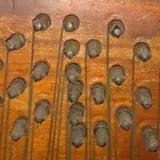
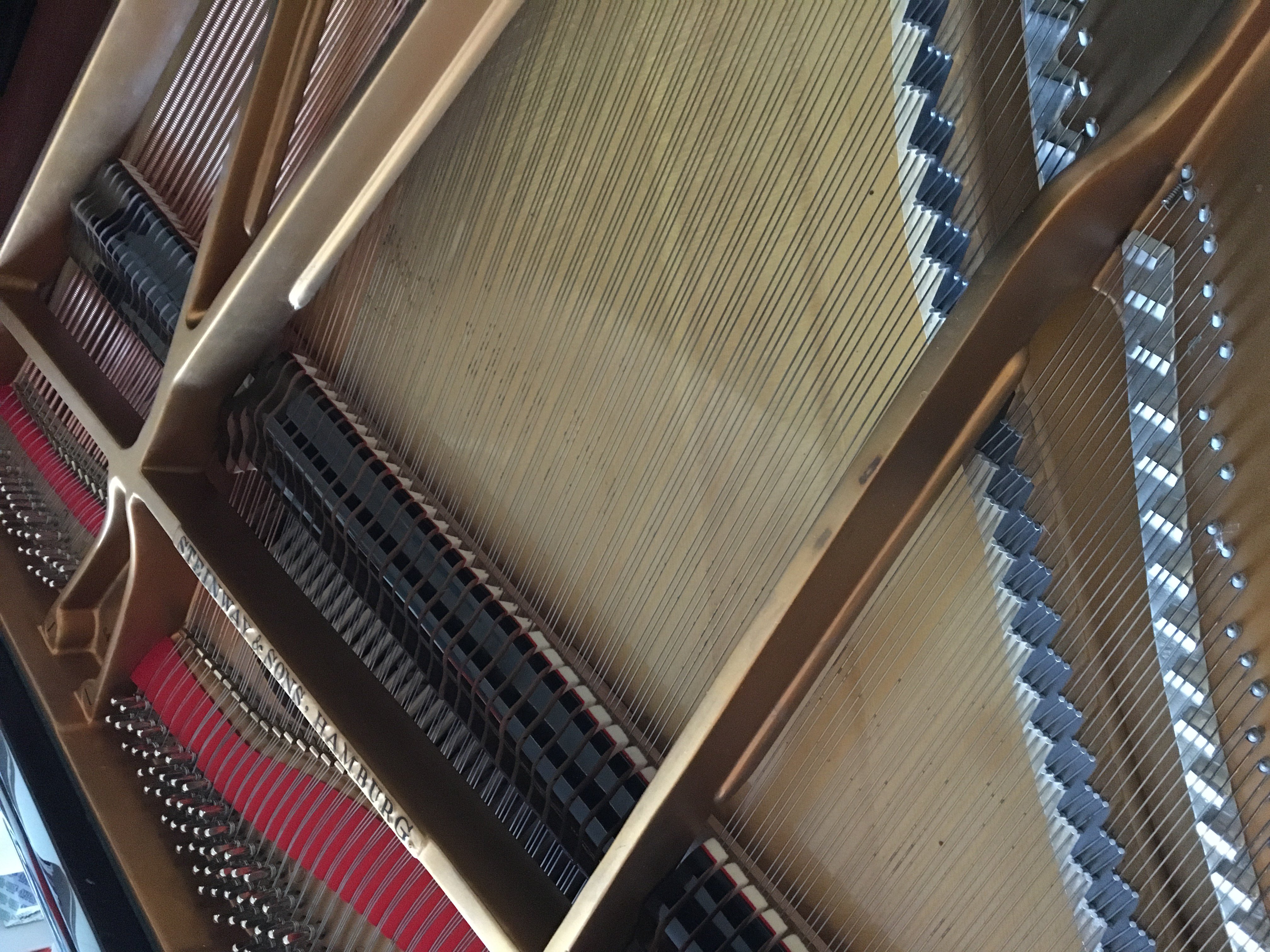
I recently purchased a used Steinway model A piano about thirty years old, in good condition (the previous owner was an amateur who played it once a month). Only a few days ago I noticed that almost all the strings have some kind of small rust spot, moreover (the spots are) all aligned, as if a liquid or something similar had been spilled, even though there don't seem to be any obvious damage of any kind. The sound of the instrument is good, and the rust, although widespread on all the strings, appears in small spots that are not particularly extensive; however, I was wondering if this would nonetheless have some impact on the quality of the instrument. I have read some suggestions elsewhere on how to intervene to remove it, but before that, I would be interested to know what this entails.
removal must be done using exclusively extra-fine steel wool. No other system. Then blow off the residue that falls on the soundboard. The rust indicates that the instrument has been exposed to humidity. Humidity that certainly was not caused by a home environment. You must also check the efficiency of all the mechanical parts. Also check the integrity of the soundboard (cracks and/or swellings)
the advice to clean the strings with steel wool is correct, but unless you find a technician who feels comfortable doing it, I would leave things as they are.
Consider that sometimes pianos are found where the entire plate has been replaced with black spots, specifically rust, more or less in the same places you describe, and it is because of the technician who touched them with bare hands while installing them, oxidizing them with sweat.
On the bass strings, you also risk only making the situation worse: they should be cleaned in the direction of the winding, but if some wire from the steel wool gets stuck between the copper spirals, you could go crazy hearing strange resonances.
So my advice is: leave it alone.
If you want to show some photos, the situation and also the cause can be better understood.
I thank you both. If I can, I will send you some photos. In any case, I am waiting for the technician's intervention, which should happen in a few weeks... the dealer advised me to let the piano "acclimatize" for a while and then perform the various checks/adjustments etc. I am not an expert to the point of being able to specifically identify particular technical defects; the soundboard seems to be in good condition to me, but I do not consider myself capable of evaluating it precisely; there are some slight "lines," but I don't think they are actual cracks. When playing, the action seems quite good to me; the keyboard is not too heavy and is rather responsive, and all in all, compared to other new and well-regulated Steinways that I have had the opportunity to play, I did not seem to notice any particular defects. If you have any advice to give me while waiting for the technician, who is new and whom I do not know (not that I don't trust him, but I would like to be at least aware of what he tells me and does), regarding checks or "tests" that I can perform, I would be grateful. How can I verify if there is actually damage related to humidity?
Regarding the issue of rust, I seem to have understood that it does not cause any particular defects in the instrument (?)
If there are isolated spots on the strings, it doesn't matter.
small superficial cracks on the soundboard can stay there for years and not create problems. They are sometimes aesthetic defects that are repaired during an eventual restoration, but the instrument must be disassembled.
Anyway, if you have some photos, more can be said.
Thank you again to everyone. I will try to attach a photo of the strings for you. When zooming in, the rust is quite visible.
If there are isolated spots on the strings, it doesn't mean anything.
small superficial cracks on the soundboard can stay there for years and not cause problems. They are sometimes aesthetic defects that are repaired during an eventual restoration, but the instrument must be disassembled.
Anyway, if you have some photos, more can be said.
it's nothing, someone was resting their fingers on them.
They are indeed stains and should be superficial. In any case, I agree with Giovanni, that one must proceed with caution or better yet, not at all. Do a test on a small part; if it comes off immediately, continue on the others, otherwise do not insist.