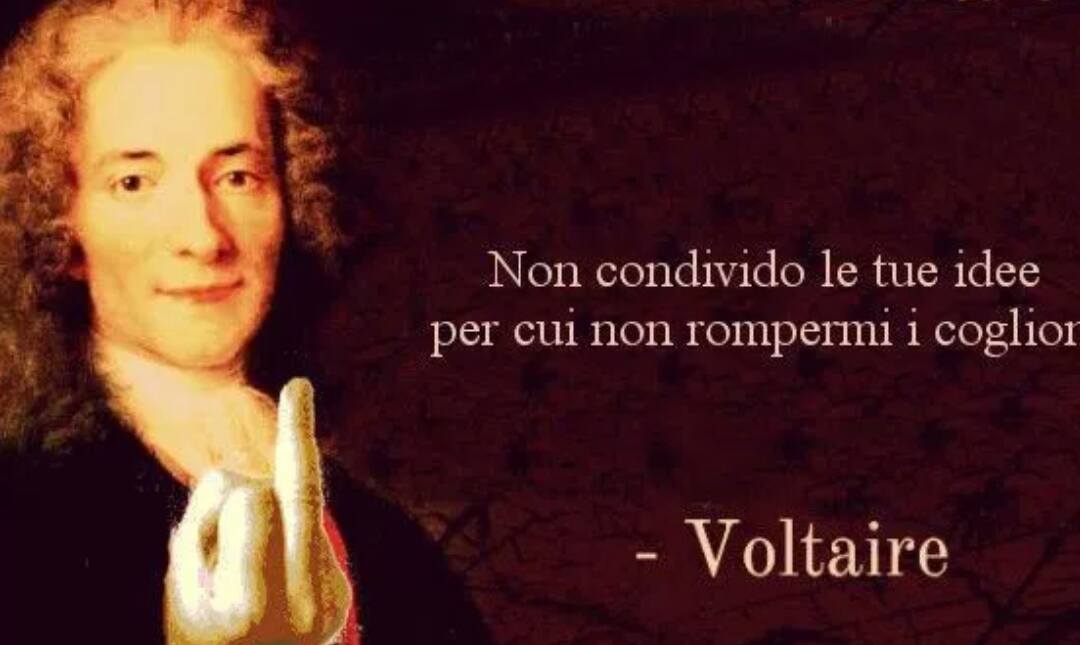
The phrase is as follows: I fight your idea, which is different from mine, but I am ready to fight to the death so that you, and your idea, may express it freely
I knew it was by Voltaire and from what I have understood, instead, it was written and thought of by Evelyn Beatrice Hall, year 1906
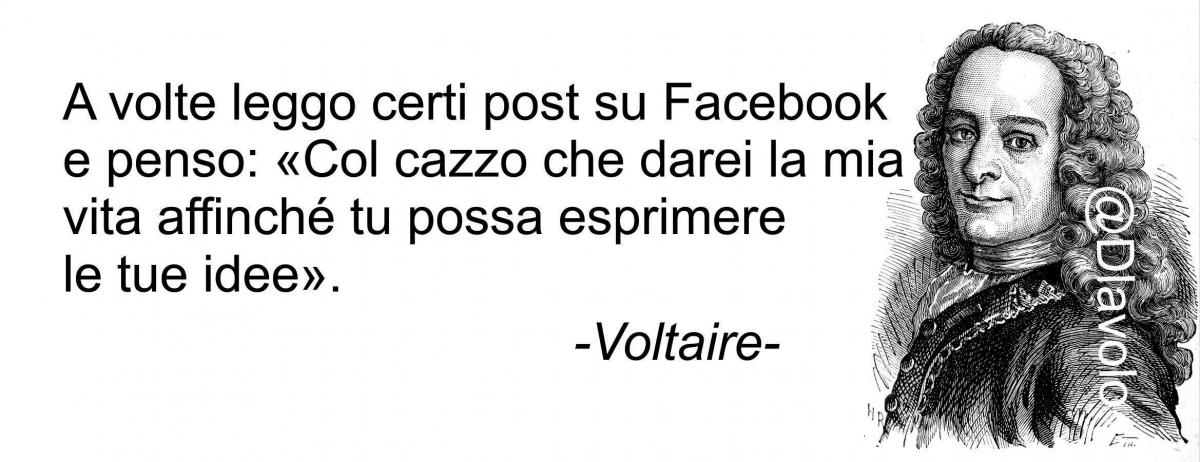
Why satire? Because of this cartoon that I happened to find.
Whether it is Voltaire or Evelyn Beatrice Hall... the cartoon might almost be right
moreover, as it is absorbed today, it is an ethically wrong concept. Freedom of opinion is an individual freedom, that is, it has to do with the rights of the individual, not the rights of the opinion, which has no rights. In this sense, my grandmother has the right to express her opinion but her opinion can still be wrong, criminal, or senseless. It is important that my grandmother has her freedoms, but this does not make her opinions "important". When certain opinions are attacked on fb or on the internet, one often reads "eh, but I have the right to express my opinion", but attacking an opinion does not mean attacking a person. People SAY stupid things, not all opinions are intelligent, interesting, or legitimate, and it is fundamental to distinguish this thing; otherwise, we will arrive at the paradox, which is widespread today, where every opinion must have its space. NO! It's not like that! In the media, in information, or in academic literature, not all opinions have a "right", only interesting opinions, and this is because in pseudo-Voltairean discourse, the subject of rights is not the opinion, but the person.
But is an interesting opinion interesting because it is shared by many people, or is it interesting because there are certain parameters - and it would be interesting to understand which ones - that make it so regardless of the level of sharing?
You, Claudio, speak about the media and information - I will skip the academic literature, which I know nothing about - but I find that there is a lot of garbage in the media and information. Who decides what is important or not?
It is said that the Internet is the most democratic medium ever invented by man because everyone - including your grandmother and my grandmother and... even me - can express opinions and thus say stupid things or more or less intelligent things about everything. Who decides and on what basis, which are the former and which are the latter?
@Daniele...you will recognize that not all opinions have the same value. Therefore, I understand the nature of the question (an obviously very difficult answer), but physiologically Thallo's argument is flawless.
I am perfectly aware that not all opinions have the same value.
But this can apply to any subject of a cultural and scientific nature where there are those who have more authority to make a statement and assert an opinion and those who have less... and those who have none at all.
But when we speak of themes that, whether we like it or not, concern us all regardless of social and cultural status, how can we assert that such an idea, such a concept is nonsense or something intelligent?
I mean, always to follow Claudio: my grandmother might say that the death penalty is right, whereas I think it is criminal, and yet I cannot help but be aware that so many people think like my grandmother and, in general terms, they are all good people and not necessarily lacking in intelligence. So, how do we handle that?
But when we speak of themes, whether willingly or unwillingly, that concern all of us regardless of social and cultural status, how can we assert that such an idea, such a concept, is nonsense or something intelligent?
... interesting point of view, if we were in mathematics I would answer you with statistics; for everything else there is ... history. It seems to me that history is a minimalist book, but it's not understood why no one bothers with it
for everything else there is ... history. To me, it seems that history is a minimalist book, but it's not understood why no one bothers with it
It's true Frank, there is history ... which - you are right unfortunately - no one bothers with, as evidenced by the fact that it is made of ups and downs!
But history, unlike mathematics, must be interpreted, and in interpreting it, opinions are often discordant, starting from the historians themselves. And therefore ... I think that Voltaire - or whoever he represents - was right, every idea should be expressed freely and it is up to all of us to try to understand what is best or worst and often ... the so-so, which ultimately is what, when things go well, governs the world.
And let it be clear, this last consideration is not pessimistic in nature but is a statement of fact: to reach this point, man has taken two million years since he was an hominid and 40,000 since he was sapiens, and always with the ups and downs of history.
Improvements are always small steps and can only mature when understood and digested by the majority of society!
It is all very complicated when talking about opinions. But in theory, oratory and rhetoric, and, in a certain sense, logic, were born as "arts" (techniques, more properly, since Greek and Latin conceived techné and ars in this sense) aimed at convincing others of the correctness of an opinion. Therefore, let's say that an opinion is interesting when you manage to convince as many people as possible, or the "right" people, of the fact that it is interesting, true, or right. In reality, argumentative logic, which should also be the basis of the most advanced legislative systems, proceeds in a slightly different way: true principles are developed and from there true statements are deduced. So, on law, for example, fundamental rights are developed and from there a series of other rights, derived from those fundamental ones, are deduced.
And then there is ethics, which is the branch of philosophy dedicated to human behavior, especially in the nuances of right and wrong.
The problem is that I have given a personal reading of ethics, which not everyone shares :-) and therefore to the question "how do you understand which opinion is interesting?" one responds, paradoxically, in the same way one responds to the question "what are my rights?". That is: History will decide, not I.
The problem is that I have given a personal reading of ethics, which not everyone shares :-) and therefore to the question "how does one understand which opinion is interesting?" one answers, paradoxically, in the same way one answers the question "what are my rights?". That is: History will decide, not I.
Yes Claudio, it's true History will decide but ... Claudio, we are History!
History goes in the direction that a majority wants, and if by chance that majority pushes in the wrong direction, what happens?
What happens is that sooner or later it will be understood. But in the meantime, terrible things could happen and the last century, in this regard, was a school on these keys, and today for completely different reasons something similar could—and in part is already happening—happen if we do not ensure that History goes in another direction. And that is why it is important to understand and discuss the opinions of those who think differently, even if you (I, we, you all) consider them wrong and stupid.